
Every scan on this page was recorded on this Suresult hardware family: buyer captures on a D3Ultra, clips from a clinical trainer who scans with it, and windows from the shared Suresult clinical reference library. Each clip is trimmed to the scan itself. ·Trusted by 8,717 clinicians →
Quick answer
A sports medicine ultrasound machine is a high-frequency scanner that images tendons, ligaments, muscles and joint surfaces at the point of care and guides the injection.
- Suresult linear models span 7.5 MHz to 24 MHz, so a clinician can read a plantar fascia at 20 mm and a hamstring at 80 mm on the same platform.
- The L14Pro, L20Pro, L10SH and L24Pro carry 256-element arrays with 64 channels, which is the element count that resolves tendon fibrils.
- In-plane and out-of-plane puncture guides ship on every imaging model on this page, and the L10H adds Visualized Needle Guidance for injections.
- Stills and cine loops of 100 to 1,000 frames export as DICOM, JPEG, PNG or MP4, so a follow-up scan can be compared with the first one.
The capture atlas
Nine musculoskeletal windows, every frame an unedited capture from Suresult hardware
Unedited clinical captures · select any image to enlarge
3 windows
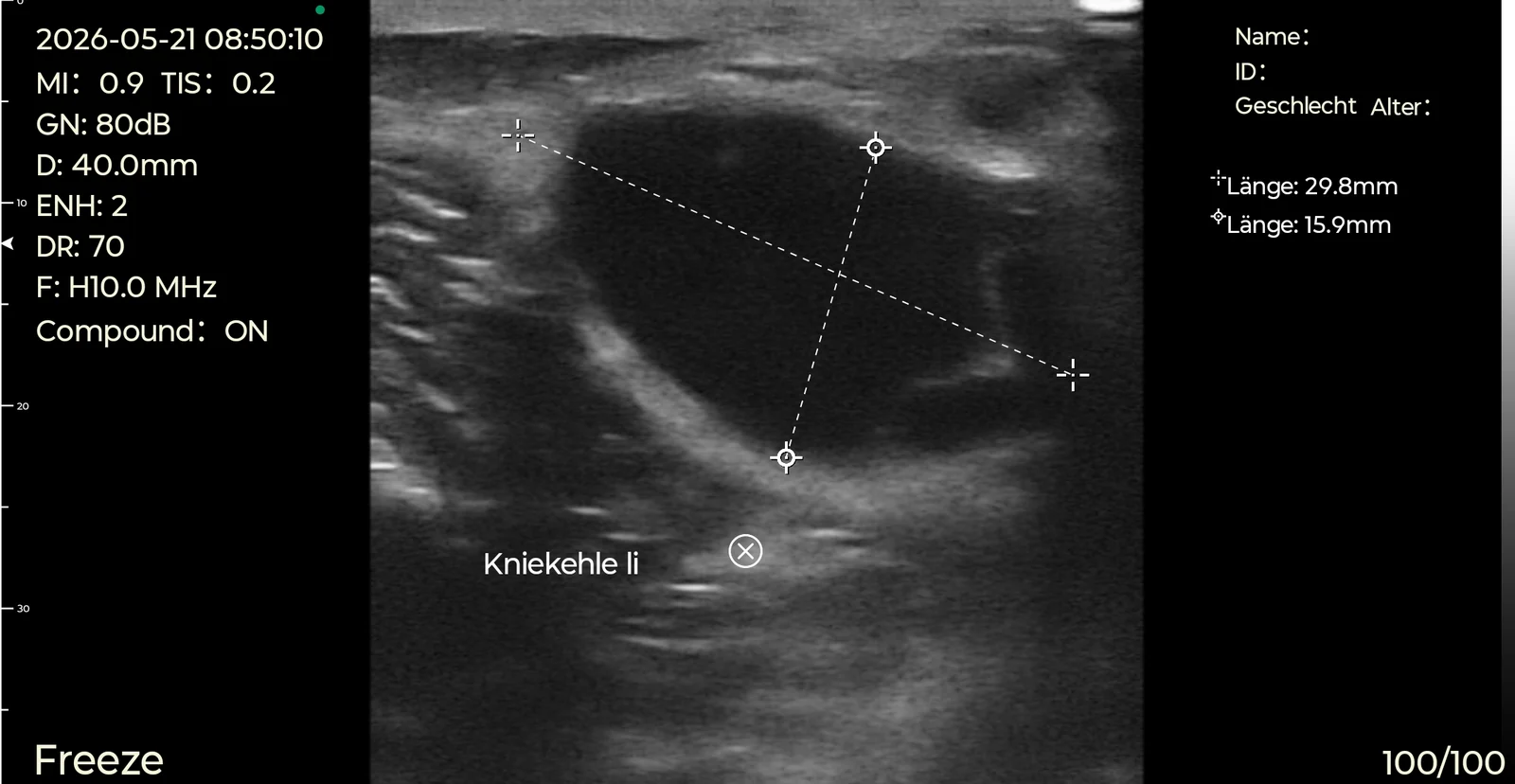
Popliteal cystic structure measured on the D3Ultra
An anechoic collection sits behind the left knee and is measured at 29.8 mm by 15.9 mm on screen. A posterior knee swelling that looks like a calf strain is settled by this window in under a minute.
still frame on a D3Ultra at H10.0 MHz, 40 mm depth, 80 dB gain, compound on, labeled 'Kniekehle li' by the scanning physician; submitted by buyer Stefan Goepfert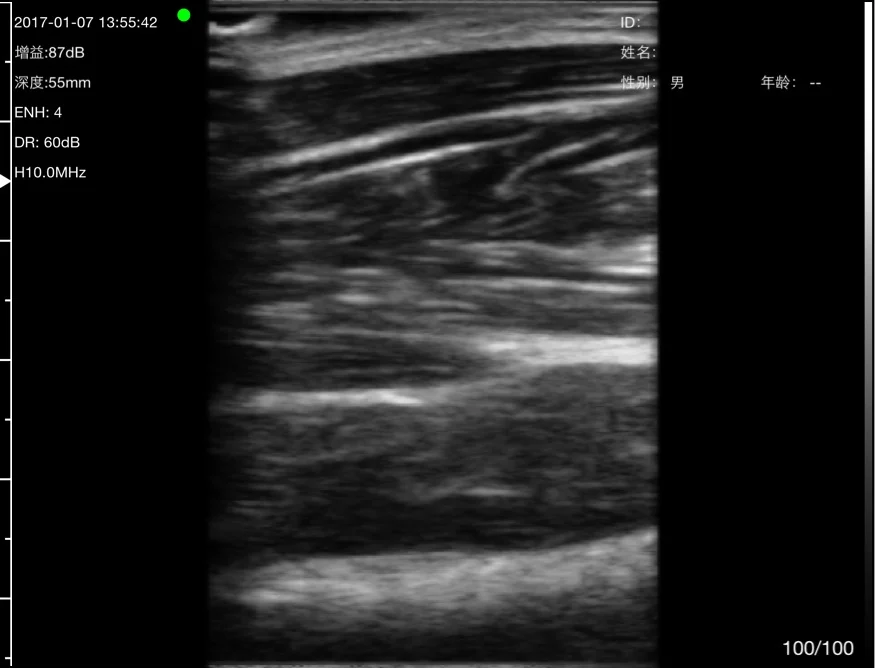
Pennate muscle architecture in long axis
Bright fibroadipose septa run obliquely between darker muscle bundles, the normal pennate pattern. A tear shows as a break in these lines with fluid tracking along the plane.
captured on a Suresult wireless probe in the shared clinical reference library; on-screen header reads 87 dB gain, 55 mm depth, H10.0 MHz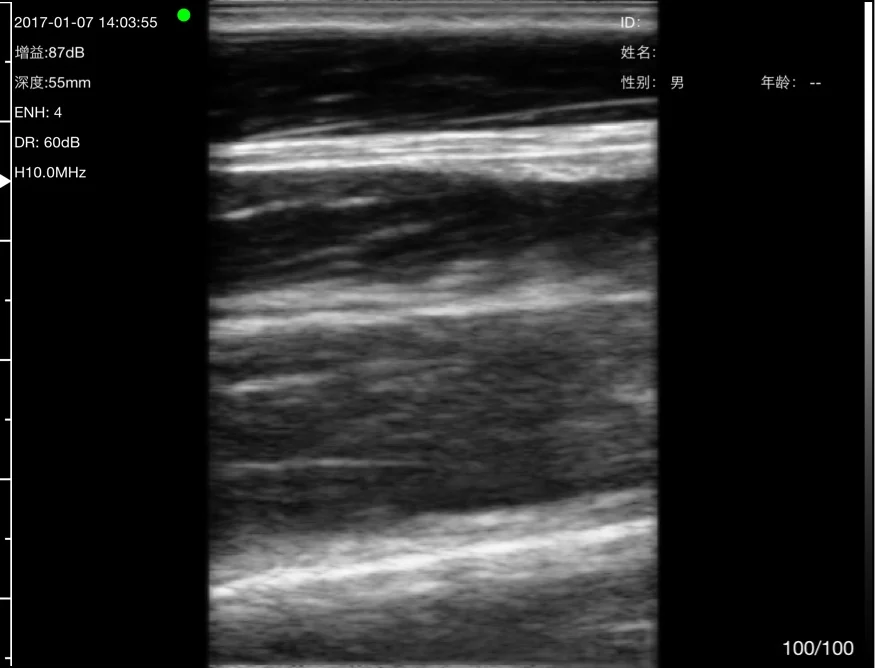
Fibrillar tendon in long axis
A tendon reads as a compact band of parallel bright lines separated by thin dark gaps. Loss of that fibrillar pattern is the finding that separates tendinopathy from a normal tendon.
captured on a Suresult wireless probe in the shared clinical reference library; on-screen header reads 87 dB gain, 55 mm depth, H10.0 MHz3 windows
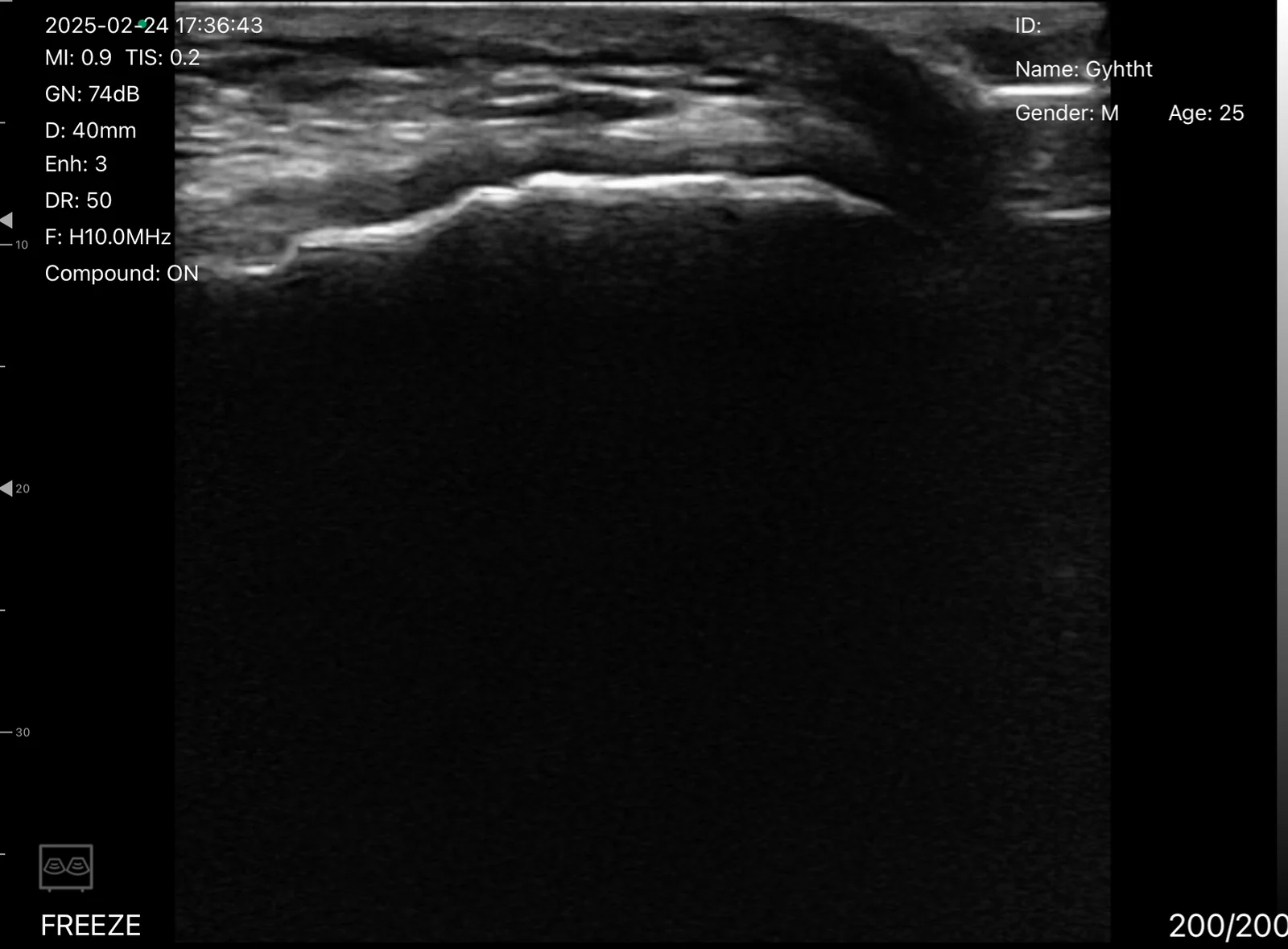
Bone cortex with acoustic shadow on the D3Ultra
A continuous bright line marks the cortical surface, and everything below it is shadow. A cortical step or a break in that line is how ultrasound finds a fracture that a first radiograph missed.
still frame on a D3Ultra at H10.0 MHz, 40 mm depth, 74 dB gain, compound on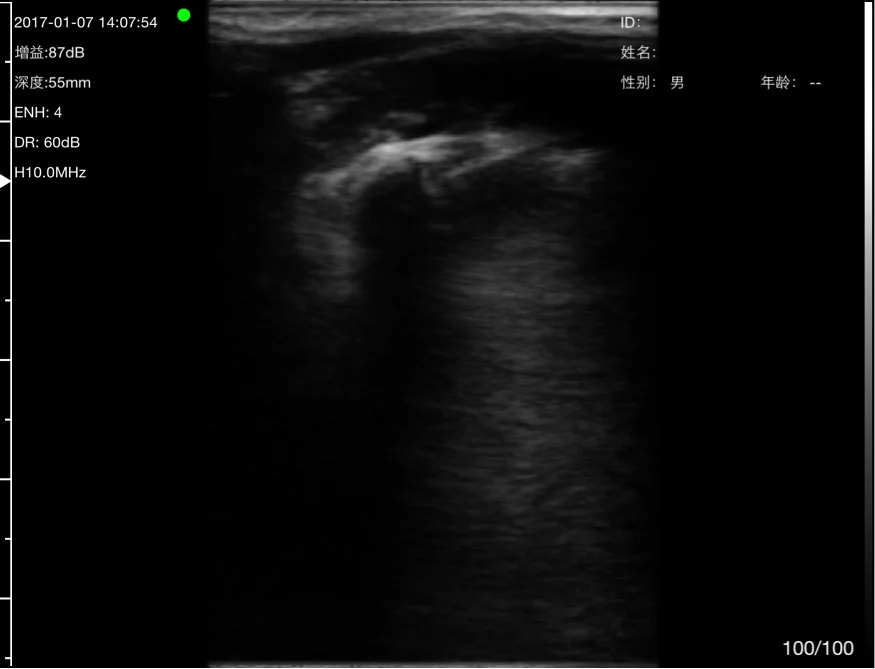
Joint bone surface with an irregular contour
The bright cortical margin turns and dips where two bone surfaces meet at a joint. Sports medicine reads this line for an avulsion or for an effusion that lifts the capsule above it.
captured on a Suresult wireless probe in the shared clinical reference library; on-screen header reads 87 dB gain, 55 mm depth, H10.0 MHz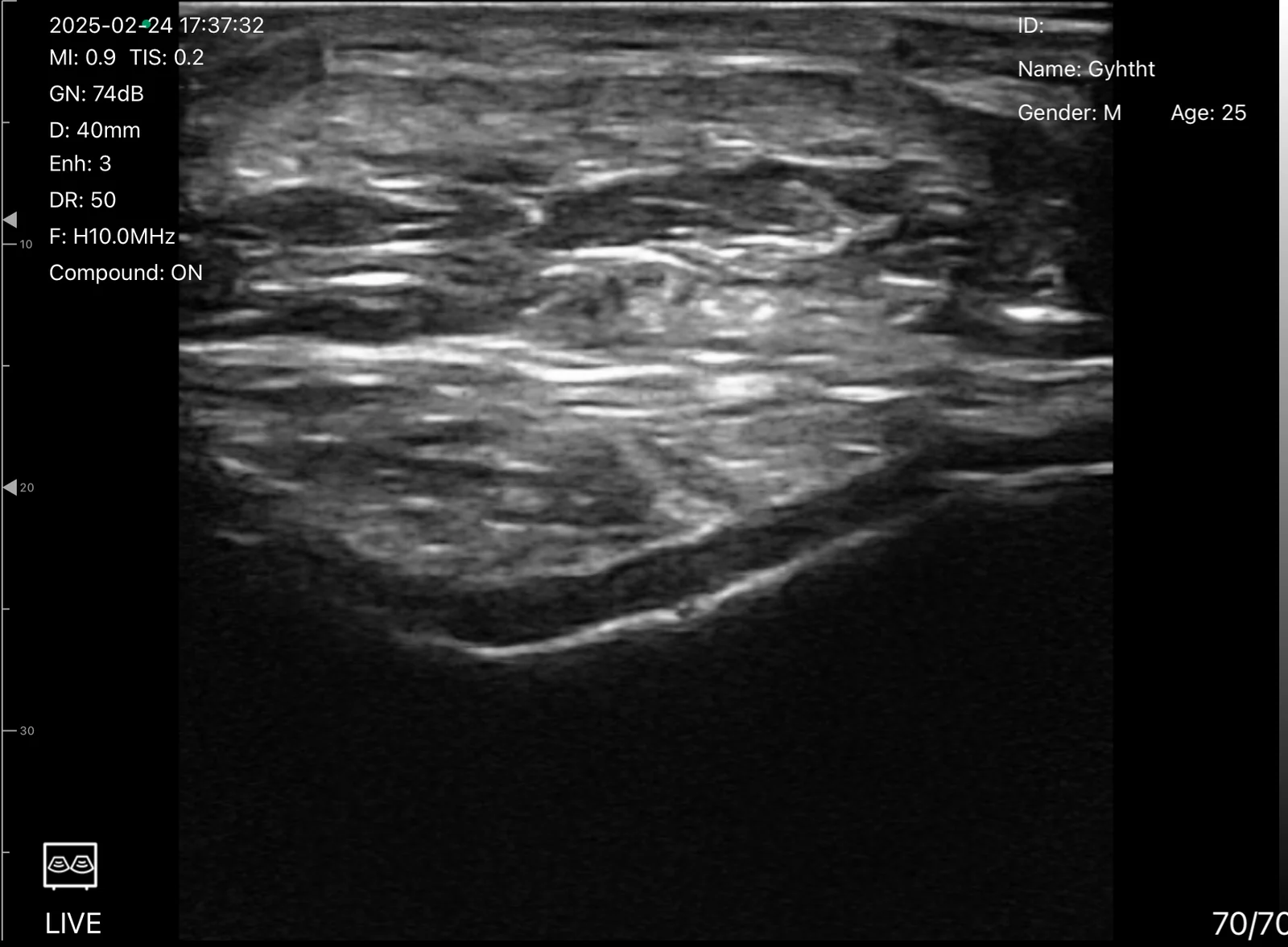
Superficial soft tissue over cortex on the D3Ultra
Layered fibrillar tissue sits above a bright cortical line with clean separation between the planes. Reading the layers in order is how a clinician localizes tenderness to a structure rather than to an area.
still frame on a D3Ultra at H10.0 MHz, 40 mm depth, 74 dB gain, compound on3 windows
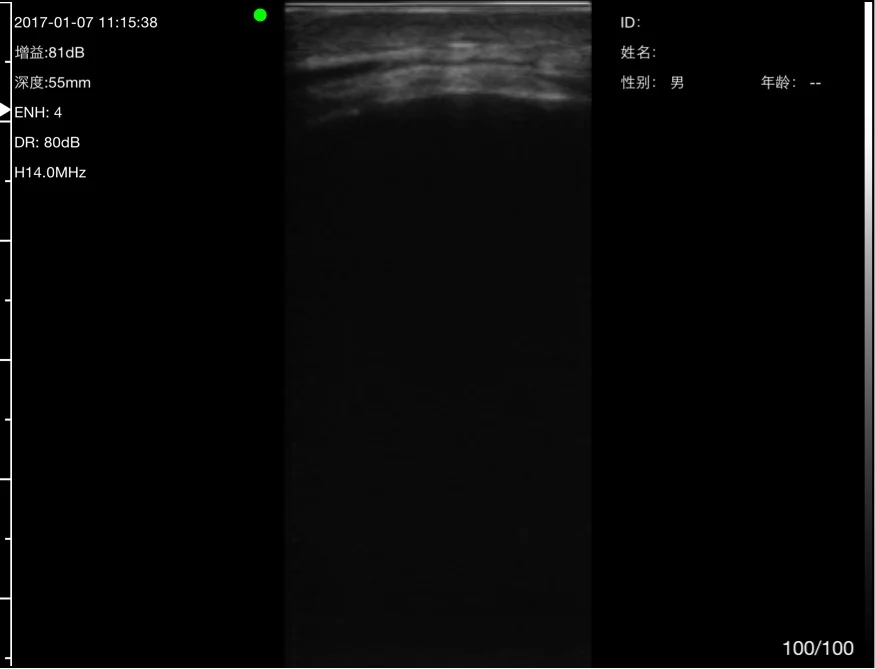
Bone surface with complete acoustic shadowing
A curved bright cortex returns almost the whole beam, so the field beneath it reads as empty black. That shadow is why ultrasound judges the bone surface and never the marrow behind it.
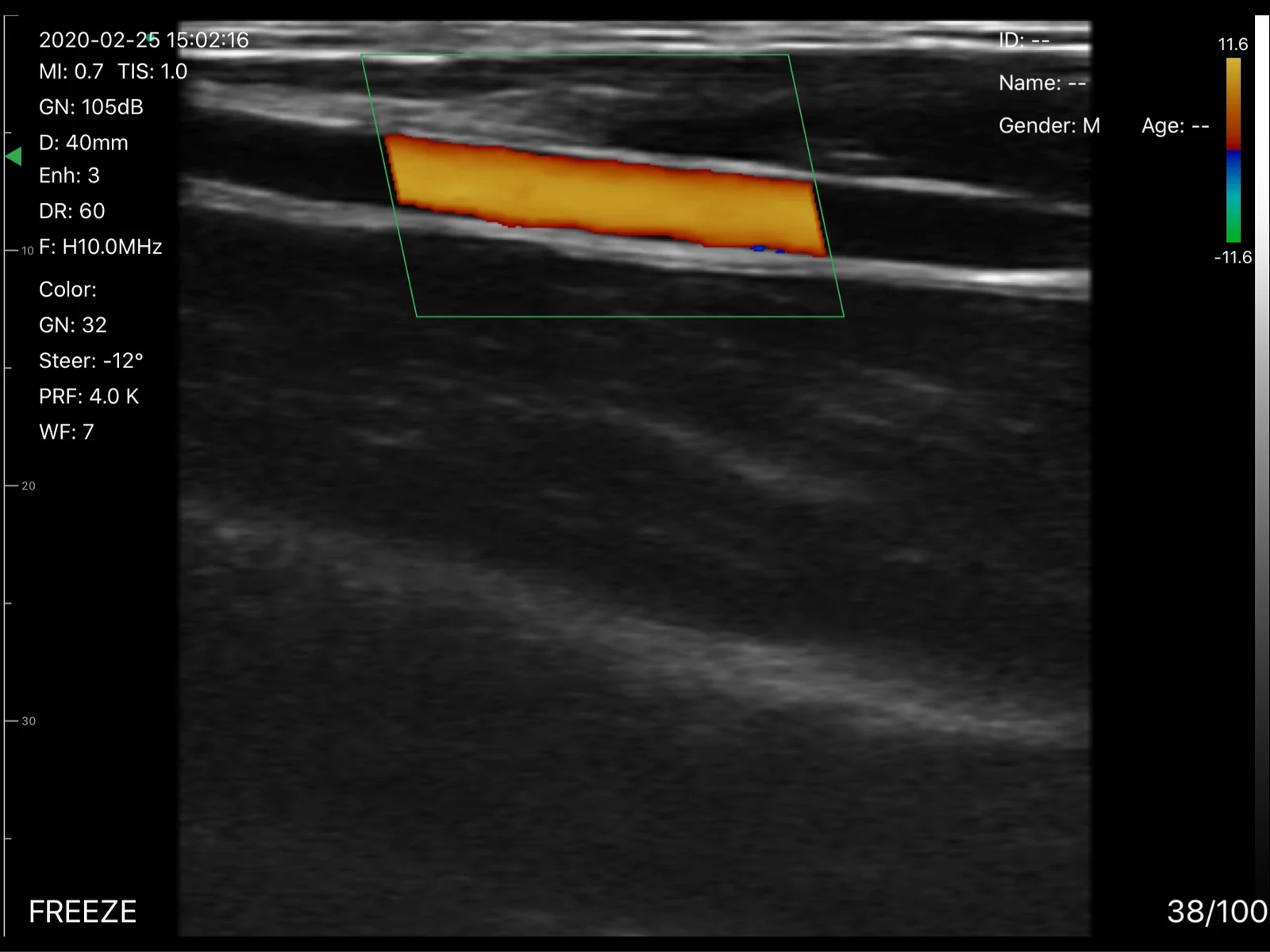
captured on a Suresult wireless probe in the shared clinical reference library; on-screen header reads 81 dB gain, 55 mm depth, dynamic range 80 dB, H14.0 MHzColor Doppler over the wrist on the D3Ultra
The color box fills with flow in a superficial vessel while the surrounding tissue stays gray. The same color settings show the neovascularity that marks a symptomatic tendon.
still frame on a D3Ultra in the shared D3 clinical demo library; on-screen header reads 105 dB gain, 40 mm depth, H10.0 MHz, color gain 32, PRF 4.0 K, steer -12 degrees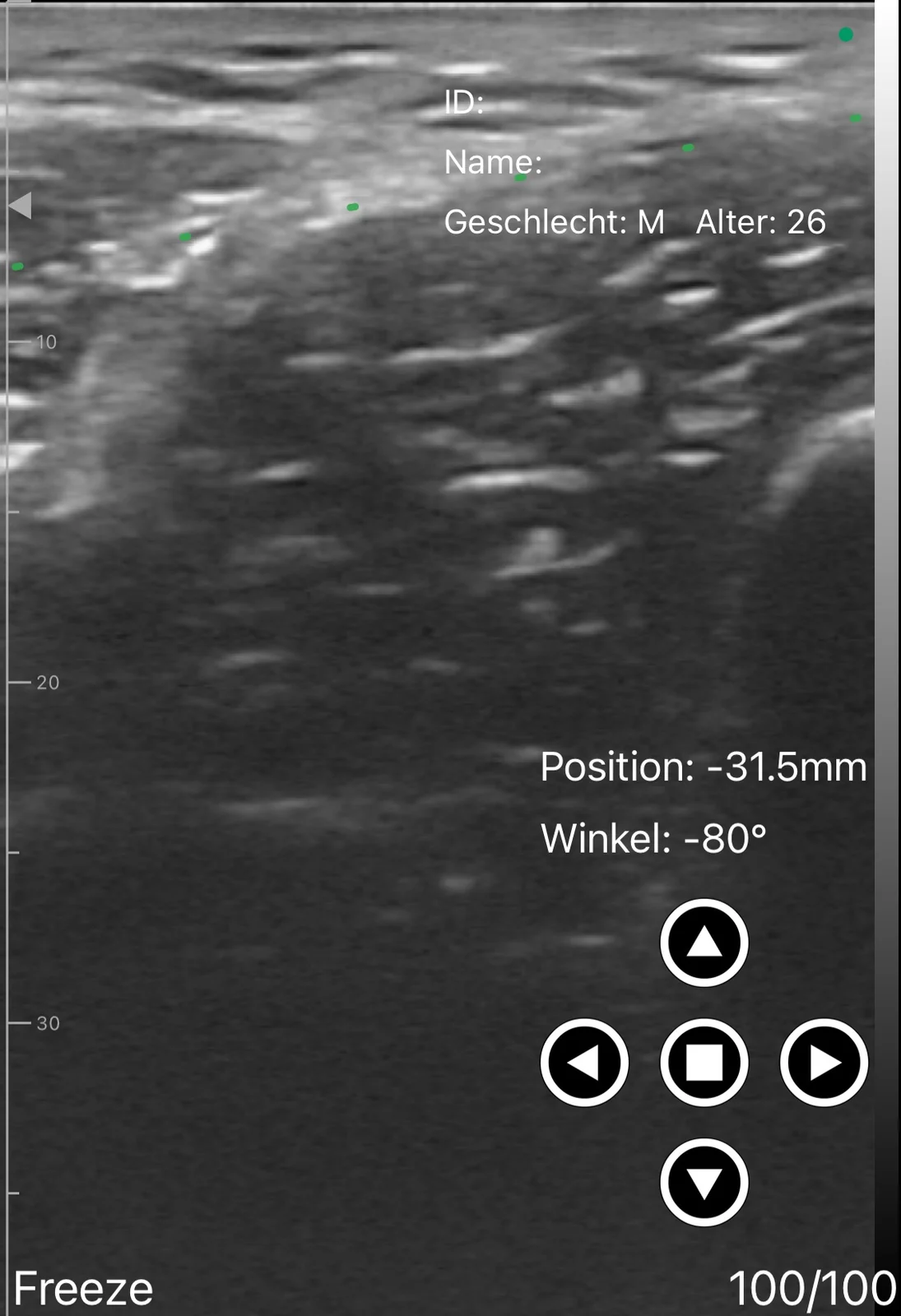
Puncture guide drawn over the needle path on the D3Ultra
The puncture guide draws a dotted path to the target and the app prints its position and angle on screen. An ultrasound-guided injection is set up on this screen before the needle moves.
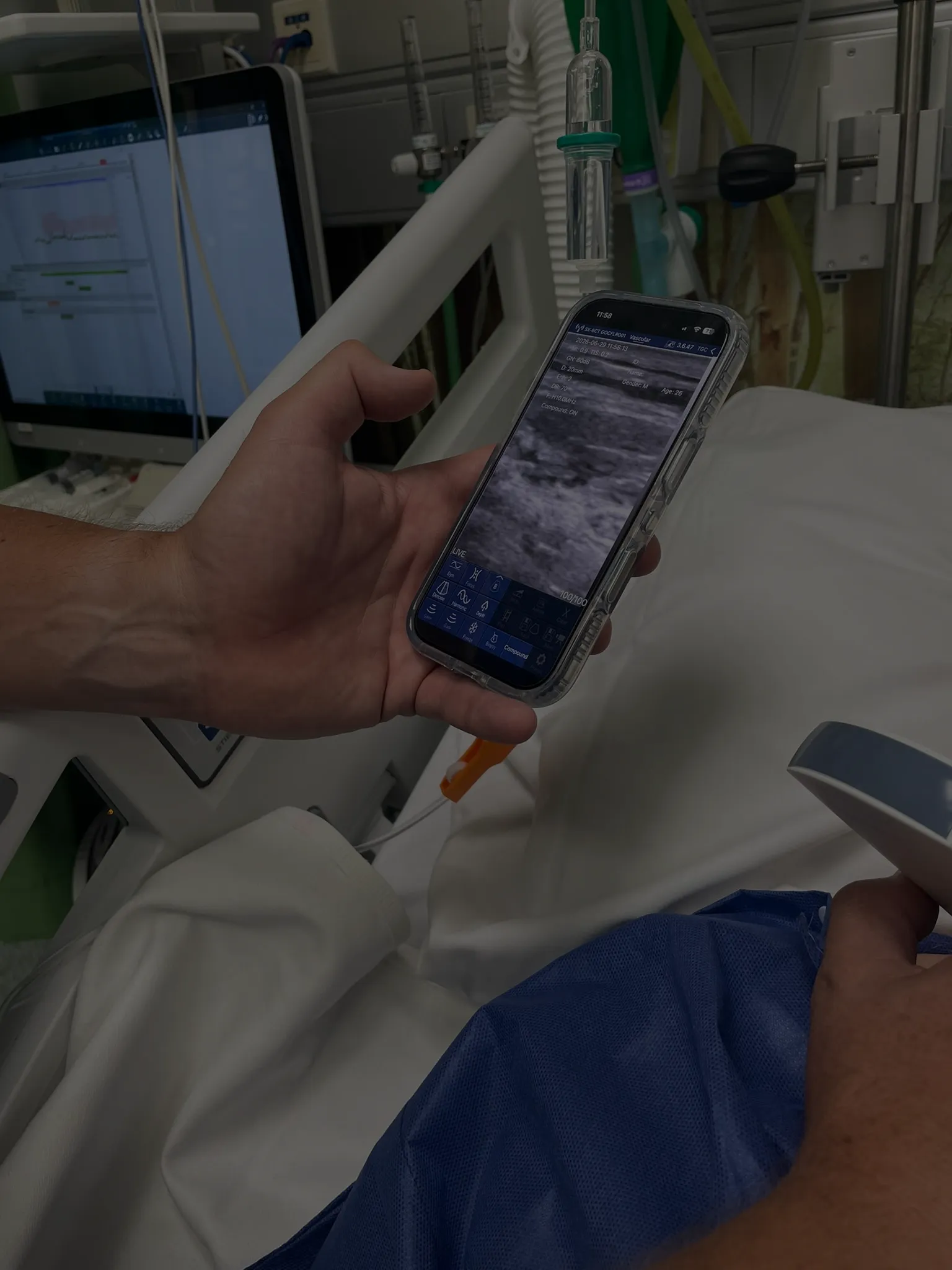
still frame on a D3Ultra during a suprainguinal fascia iliaca block, German app interface reading 'Position: -31.5mm' and 'Winkel: -80'; submitted by buyer David Heimpel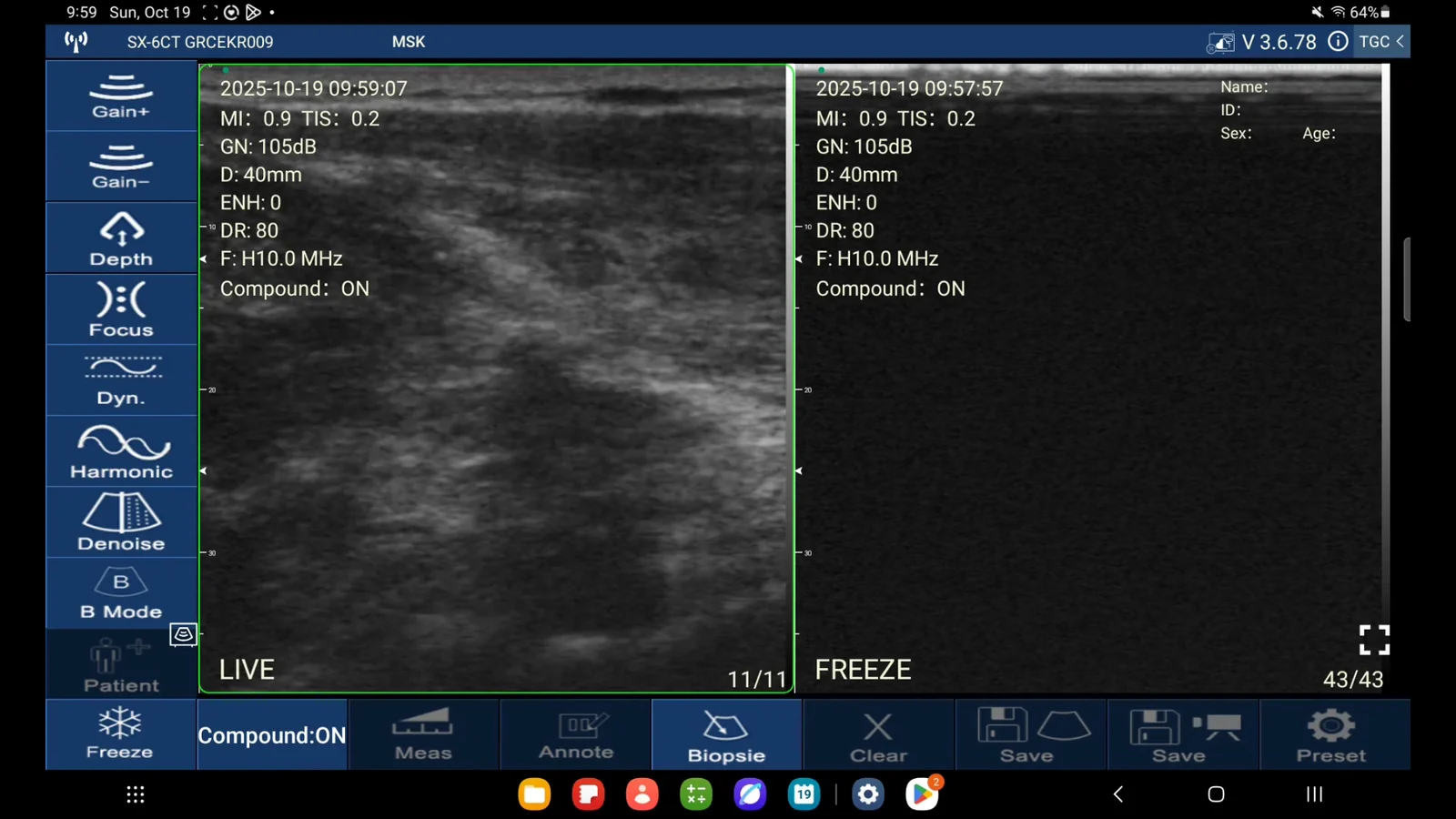
Select a card to switch capture
Technique basics
How the exam comes together, probe to report
- Set the frequency to the depth of the target.
The L20Pro images from 10 to 40 mm at 16/20 MHz for a plantar fascia or a finger pulley. The L14Pro reaches 80 mm at 10/14 MHz, and the L10SH and L10H reach 100 mm for a hamstring or a gluteal tendon.
10 mm to 100 mm across the linear models - Scan every tendon in two planes.
A tendon is followed in long axis for fibrillar continuity, then turned 90 degrees for the short-axis cross section. Anisotropy fakes a tear when the probe is off perpendicular, so the second plane settles it.
Long axis first, then short axis - Compare against the uninjured side.
Muscle and tendon thickness vary widely between athletes, so the contralateral limb is the reference. Saving both sides as a cine loop makes the follow-up scan a measurement rather than an impression.
Cine loops of 100 to 1,000 frames 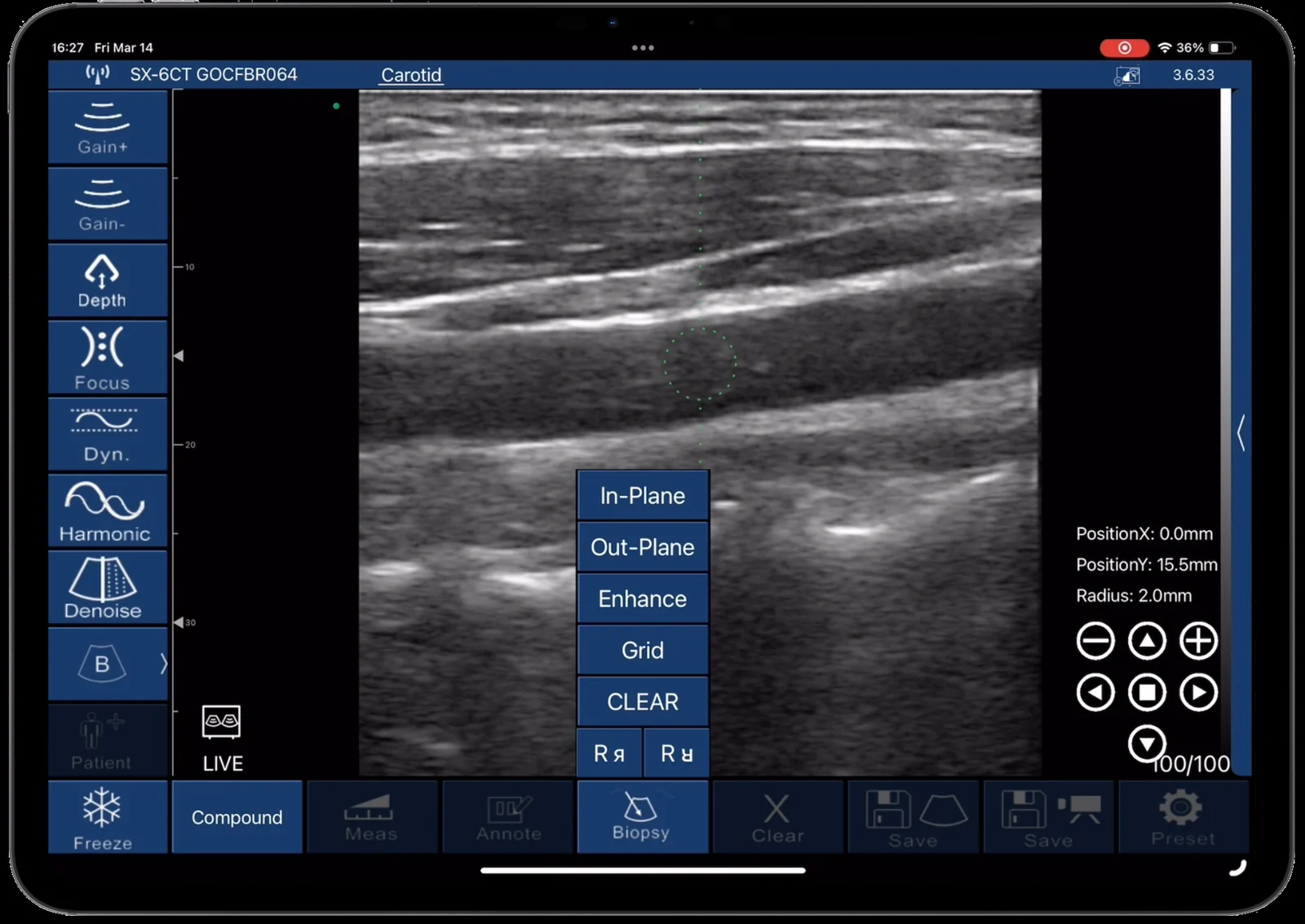 Put the needle in plane before the injection.
In-plane and out-of-plane puncture guides draw the needle path over the target, and the flip and grid tools keep the orientation honest. Needle Enhance sharpens the shaft on the L14Pro, L20Pro, L20, L24, L10SH, L10H and D3Ultra.
Puncture assist in the app
What the research says
The evidence, four studies checked
- Ultrasound outperformed MRI for chronic lateral ankle ligament injury.
Across 15 studies and 695 participants, pooled sensitivity for chronic anterior talofibular ligament injury was 0.99 for ultrasonography and 0.83 for MRI.
Cao et al., J Orthop Surg Res 2018 - Ultrasound read full-thickness rotator cuff tears as accurately in non-radiologist hands.
A British Journal of Sports Medicine meta-analysis reported sensitivity and specificity above 0.90 for ultrasonography in full-thickness rotator cuff tears. Accuracy was similar whether a radiologist, a sonographer or an orthopedist scanned.
Roy et al., Br J Sports Med 2015 - Ultrasound guidance improved knee aspiration and injection in a randomized trial.
In 64 randomized effusive knees, ultrasound guidance produced 48% less procedural pain and 183% more aspirated synovial fluid than palpation guidance, with better pain scores at two weeks.
Sibbitt et al., Scand J Rheumatol 2012 - Ultrasound diagnosed distal forearm fractures in children with high accuracy.
A meta-analysis of 16 studies and 1,204 patients reported pooled sensitivity of 97% and specificity of 95% for ultrasound in distal forearm fracture. The authors concluded that accuracy is high in children.
Douma-den Hamer et al., PLoS One 2016
Pick your model
Pick the model that fits your day
MOST CHOSEN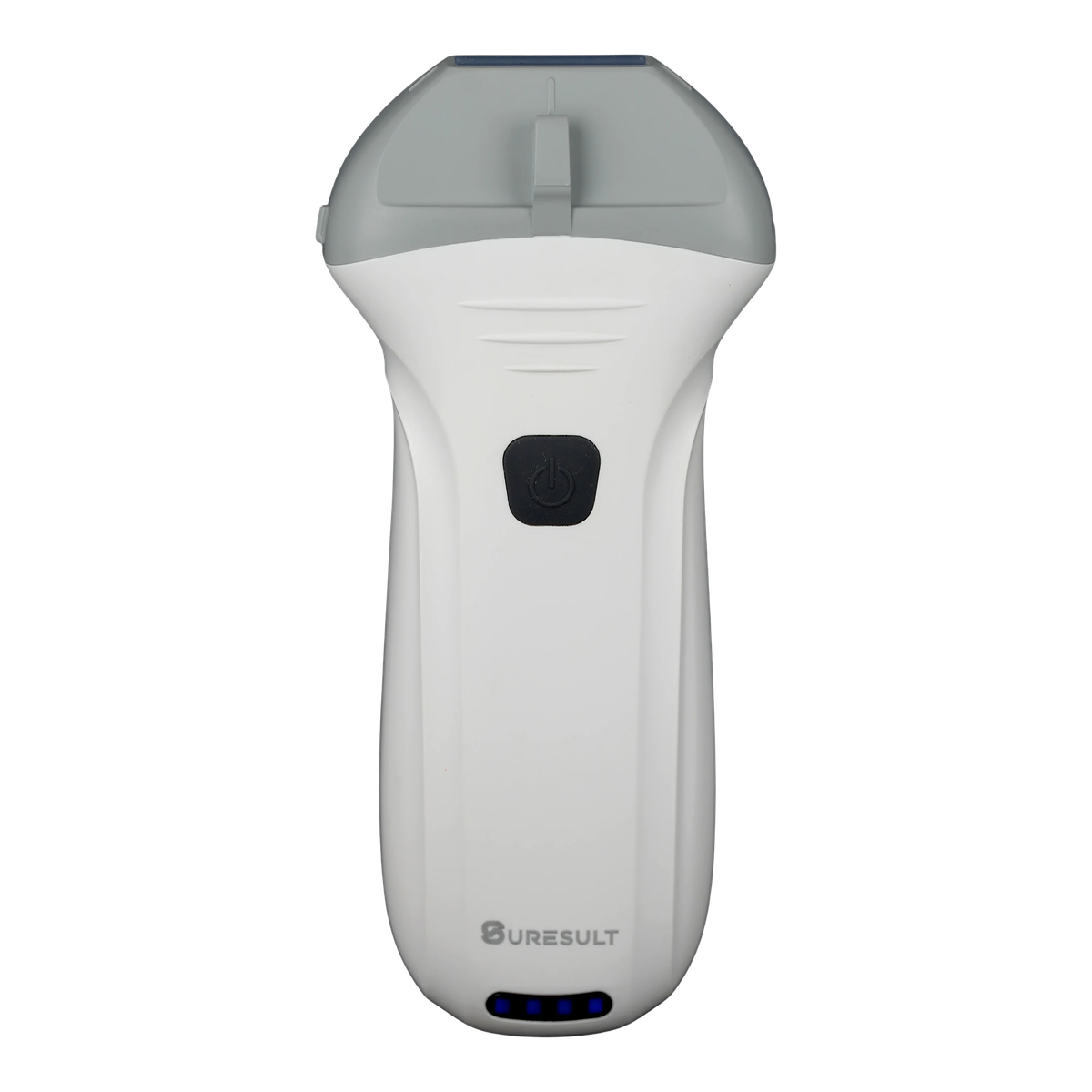 One probe for the whole sports clinicL14Pro
One probe for the whole sports clinicL14ProThe L14Pro runs 10/14 MHz across a 256-element array with 64 channels, and steps through 20, 40, 60 and 80 mm of depth. That covers a plantar fascia at one end and a proximal hamstring at the other.
256 elements, 64 channels, 10/14 MHz
$3,441 L14Pro · 10/14 MHz 256-Element Linear Ultrasound Probe for MSKBuy nowView L14Pro →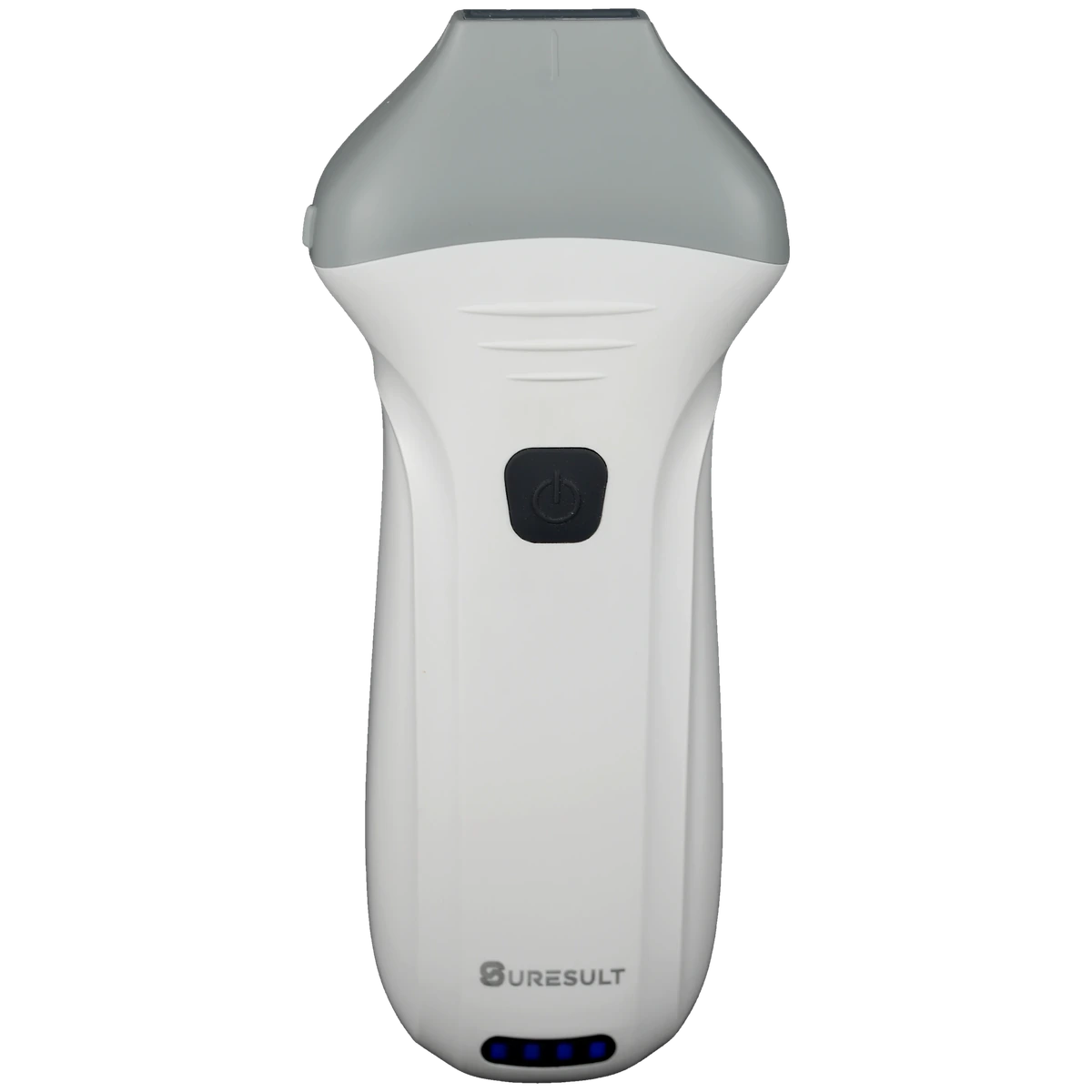 Ligaments and small tendons under the skinL20Pro
The L20Pro images from 10 to 40 mm at 16/20 MHz on a 256-element array. Lateral ankle ligaments, finger pulleys and the plantar fascia sit inside that window.
16/20 MHz, superficial detail
$3,720 L20Pro · 16/20 MHz High-Frequency Linear Ultrasound for Aesthetics, Skin & Superficial MSKBuy nowView L20Pro →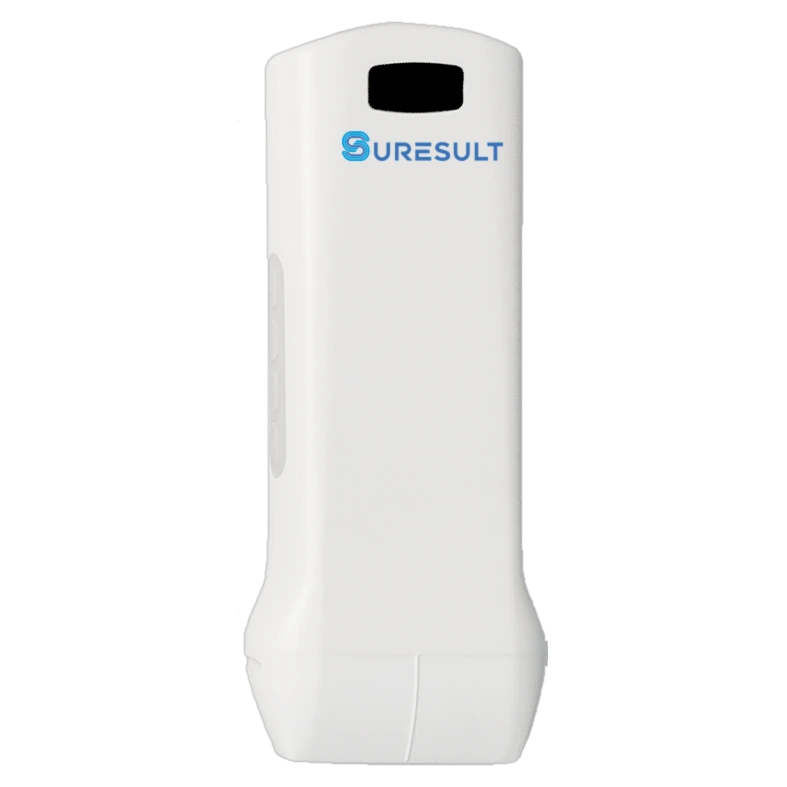 Injections are most of the weekL10H
The L10H is the only Suresult model listing Visualized Needle Guidance alongside the standard puncture guides. Its 5,600 mAh battery scans for five hours continuously, which is a full injection list.
five hours continuously, needle guidance
$2,325 L10H · 7.5/10 MHz 192 Element Linear Wireless Ultrasound High-Definition Diagnostic ToolBuy nowView L10H →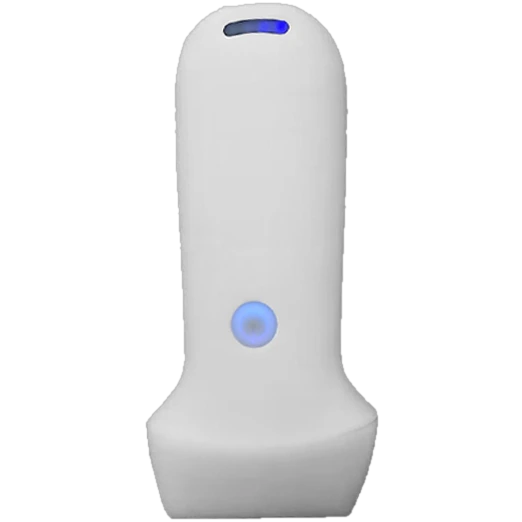 Deeper structures and a wider fieldL10SH
The L10SH pairs a 40 mm footprint with a 256-element array at 7.5/10 MHz and reaches 100 mm. Gluteal tendons, the proximal hamstring and a thick thigh sit inside that range.
40 mm footprint, reaches 100 mm
$3,534 L10SH · High-Definition 64 Channels Linear Wireless Ultrasound ScannerBuy nowView L10SH →Scanner comparison
Eight Suresult handheld scanners for sports medicine, compared
Swipe to see all columns →
| Model | Price | Frequency | Depth | Best for |
|---|---|---|---|---|
| L14Pro | $3,441 | Linear 10/14 MHz | 20/40/60/80 mm | The general sports clinic: 256 elements, 64 channels, 4-hour battery, 145 g |
| L20Pro | $3,720 | Linear 16/20 MHz | 10/20/30/40 mm | Ligaments, finger tendons and plantar fascia: 256 elements, 4-hour battery |
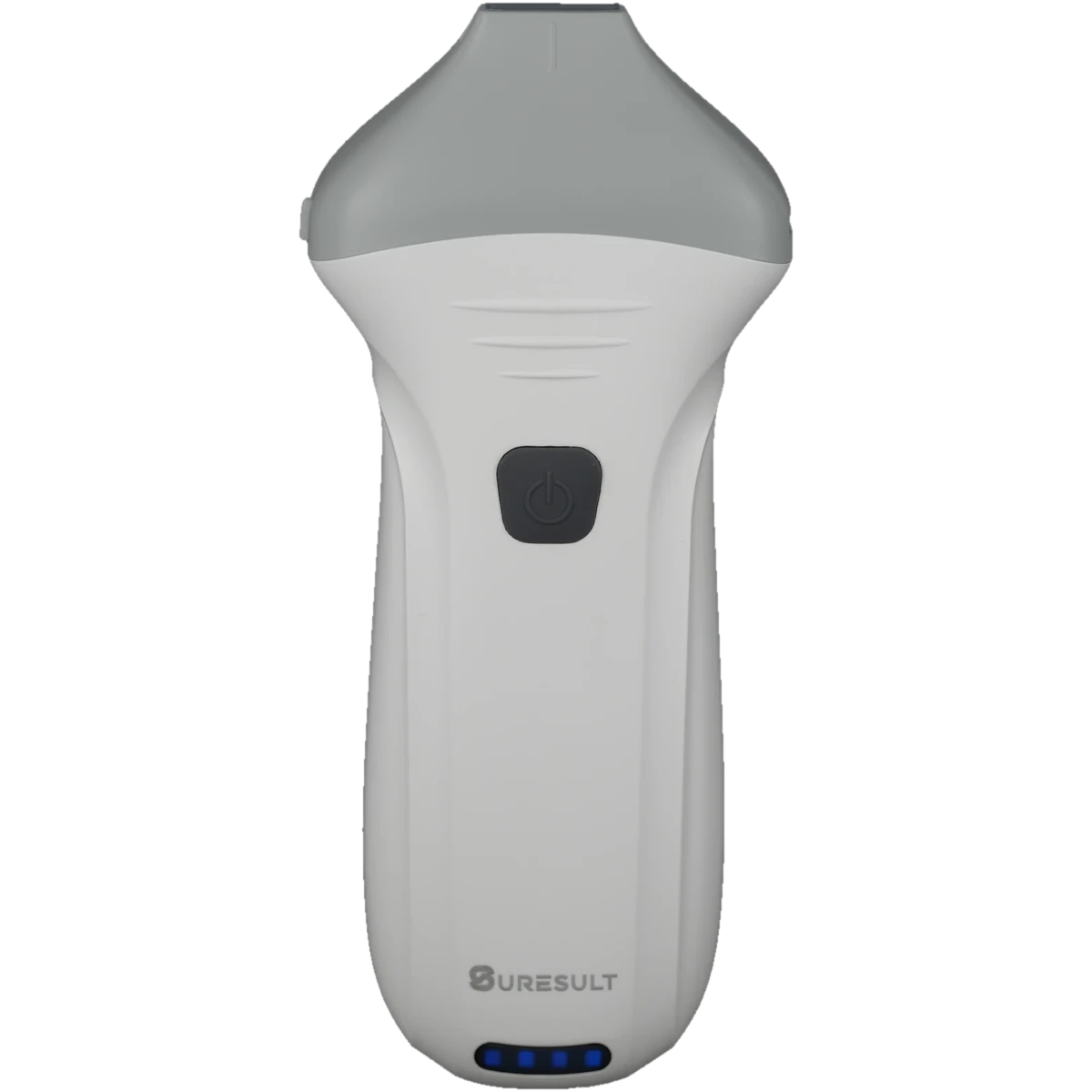 L24Pro L24Pro | $4,185 | Linear 18/24 MHz | 10/15/20/25 mm | The most superficial work: 256 elements, 64 channels, 4-hour battery, 145 g |
| L10SH | $3,534 | Linear 7.5/10 MHz | 20/40/60/100 mm | Deeper muscle and a 40 mm footprint: 256 elements, 64 channels |
| L10H | $2,325 | Linear 7.5/10 MHz | 20/40/60/100 mm | Injection lists: Visualized Needle Guidance, 5,600 mAh, 5-hour battery |
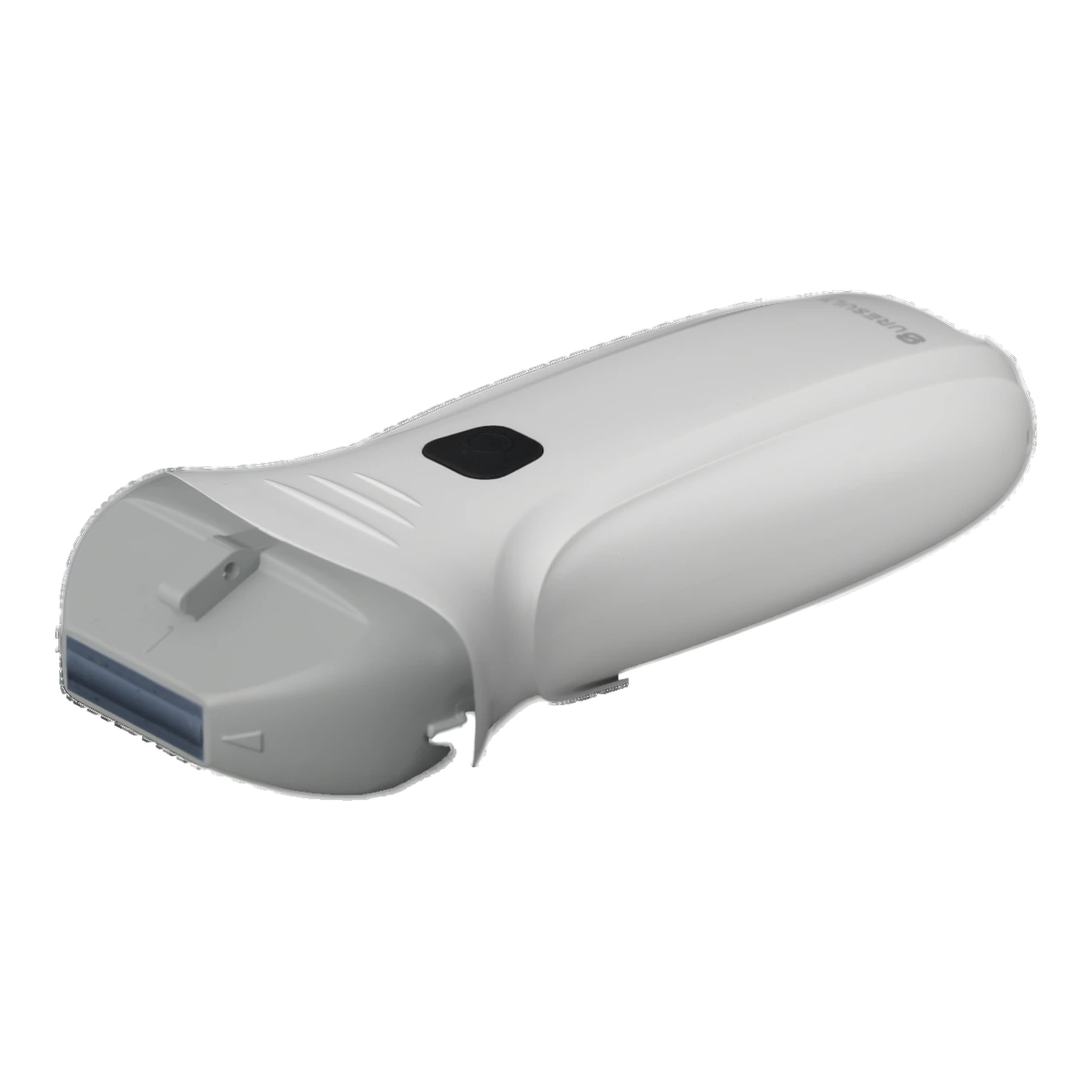 L14 L14 | $2,139 | Linear 10/14 MHz | 20-80 mm | The entry high-frequency model: 192 elements, 64 channels, 25 mm footprint |
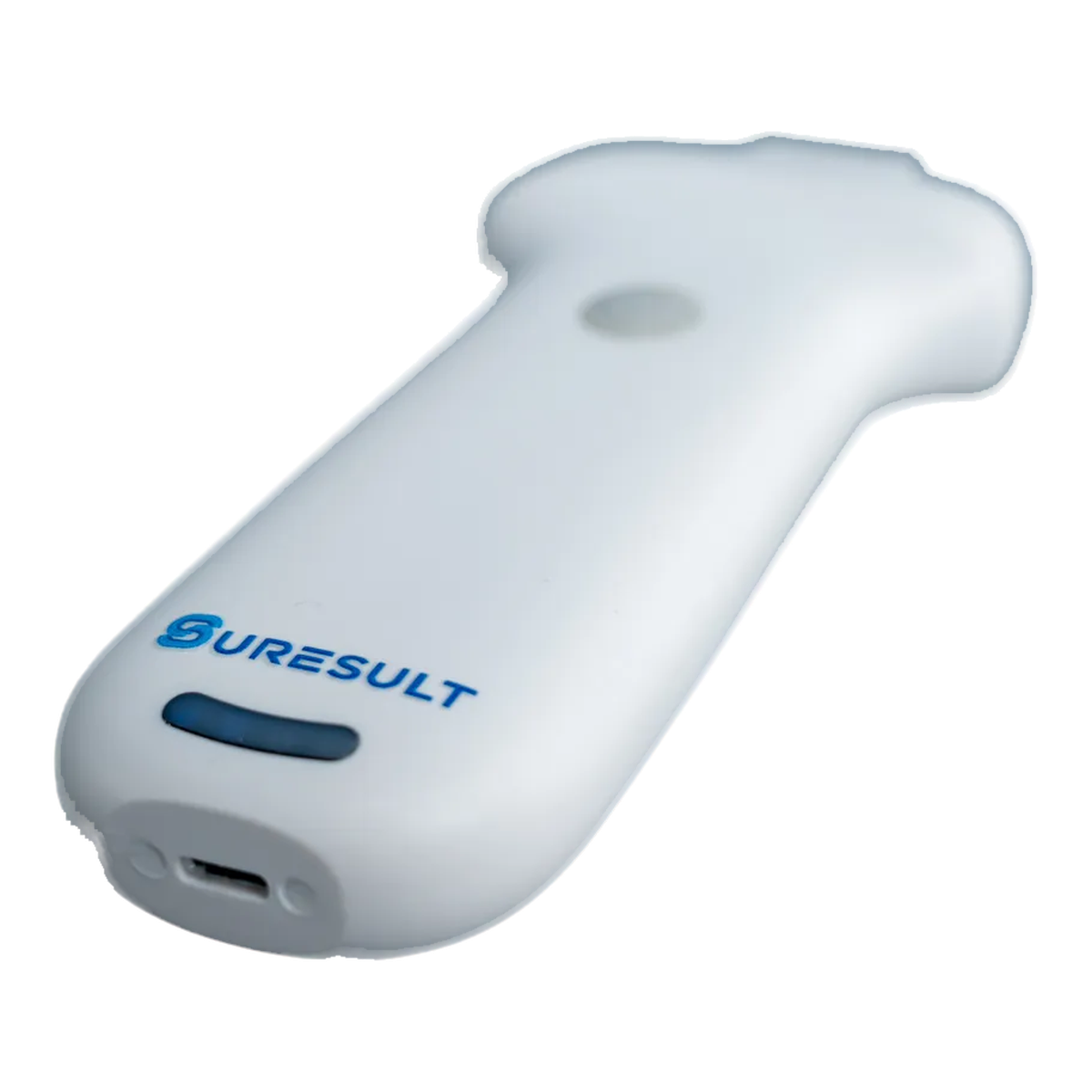 L20 L20 | $2,790 | Linear 16/20 MHz | 10/20/30/40 mm | Superficial detail on a 192-element array at 147 g |
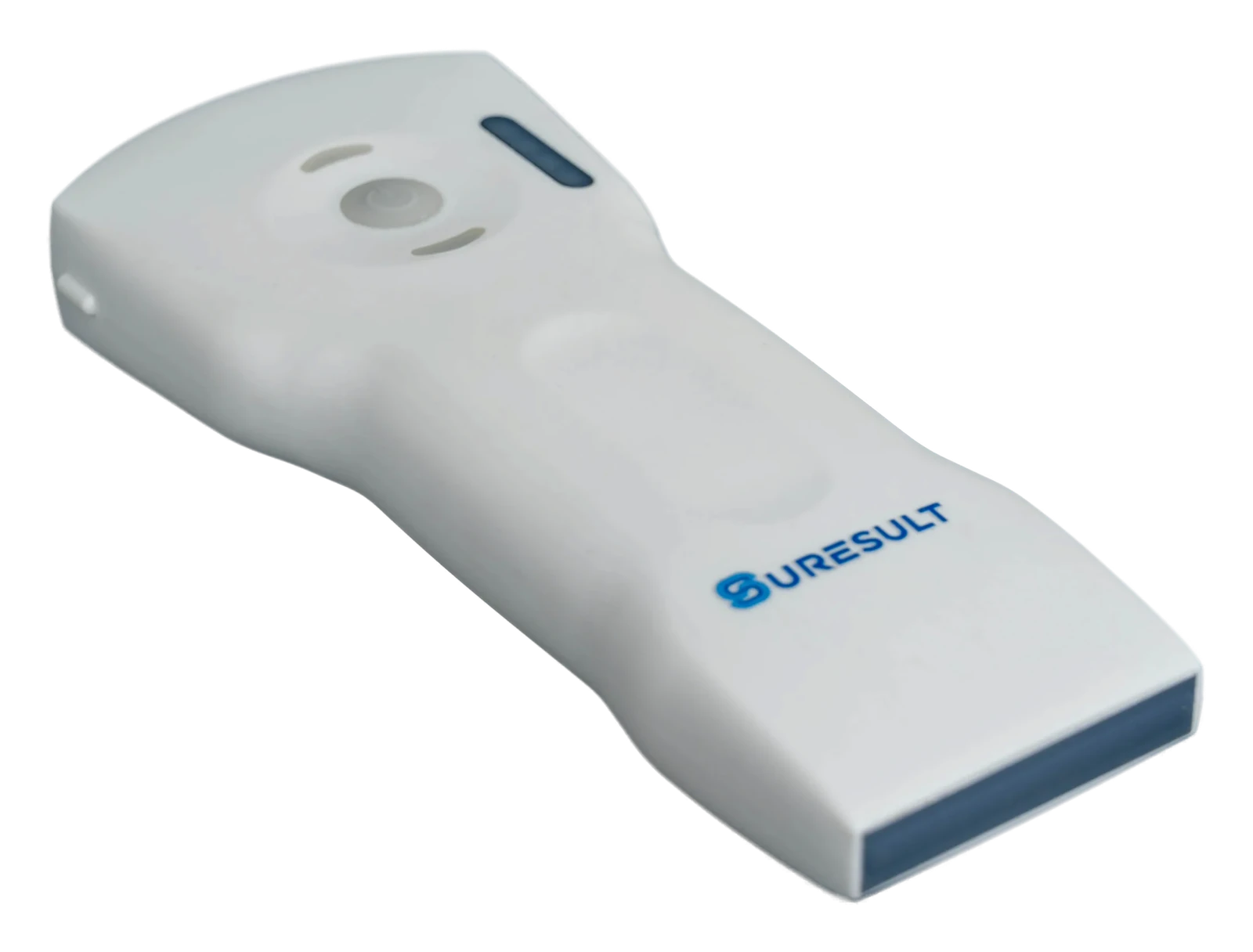 D3Ultra D3Ultra | $2,976 | Linear 7.5/10 + convex 3.2/5.0 + phased 3.2/5.0 MHz | Linear 20-100 mm, convex and phased 90-300 mm | A sports clinic that also scans hip, abdomen and lung on one head |
Against the known brands
Suresult vs Clarius L15 HD3, Butterfly iQ3 and GE Vscan Air CL for sports medicine
Swipe to see all columns →
| Suresult | Clarius L15 HD3 | Butterfly iQ3 | GE Vscan Air CL | |
|---|---|---|---|---|
| MSK imaging | Linear arrays from 7.5/10 MHz to 18/24 MHz; 256 elements and 64 channels on the L14Pro, L20Pro, L10SH and L24Pro | 5-15 MHz linear scanner, superficial imaging to 7 cm as published | 1-12 MHz single chip, 152 x 52 x 37 mm | Dual head: a 3-12 MHz linear array of 192 elements and a 2-5 MHz curved array of 128 elements |
| Depth range | 10 mm on the L20Pro and L24Pro up to 100 mm on the L10SH and L10H | Up to 7 cm on the L15 HD3; the L7 HD3 is published as optimized to 11 cm with a 15 cm maximum | MSK and MSK-Soft Tissue presets are published from 1 cm to 12 cm | Linear array published to 8 cm; the curved array reaches 24 cm |
| Device price | Published on every product page: the L14Pro is $3,441 and the L20Pro is $3,720 | $3,795 published; the L20 HD3 is $5,395 published | $3,899 published with a 3-year warranty; the iQ+ is $2,699 | Starting at $4,999 published with a 3-year warranty |
| Subscription | None. Software is included with the scanner. | Clarius Essentials is $695 a year, $1,785 for three years or $2,500 one time | Core is $299 a year and Advanced is $420 a year, or $1,500 once for Advanced, all plus the cost of the probe | GE sells Vscan Air Digital Tools separately from the probe and publishes no fee |
| Landed cost | Duties and shipping included in the checkout price, 1-7 day delivery | US list price; duties and shipping extra outside the US | US list price; duties and shipping extra outside the US | US list price; duties and shipping extra outside the US |
| Weight | The L14Pro, L20Pro and L24Pro weigh 145 g, and the L20 weighs 147 g | 290 g published for the L15 HD3 | 300 g published for the iQ3 | 205 g published for the Vscan Air CL |
| Regulatory registrations | FDA 510(k) · ISO 13485 · EU MDR (CE) · TGA · ANVISA · Health Canada | FDA 510(k) | FDA 510(k) | FDA 510(k) |
Where Suresult wins
- Nine musculoskeletal windows on this page are unedited captures from Suresult hardware, including a buyer's own popliteal measurement on a D3Ultra.
- Suresult linear models cover 7.5 MHz to 24 MHz, so one clinic can hold both a superficial ligament model and a deeper muscle model.
- Four linear models carry 256-element arrays with 64 channels: the L14Pro, L20Pro, L10SH and L24Pro.
- Color Doppler, power Doppler, pulsed-wave Doppler, M-mode and measurements ship with every model on this page at no extra charge.
- There is no membership to renew.Clarius Essentials is published at $695 a year and Butterfly Core at $299 a year.
- Cine loops of 100 to 1,000 frames and DICOM export come standard on every model on this page, so a return-to-play scan can be compared with the first one.
- The L10H lists Visualized Needle Guidance and scans for five hours continuously on a 5,600 mAh battery.
- The checkout price is the landed price: duties and shipping are included, with 1-7 day delivery.
The five-year math
Clarius Essentials at $695 a year reaches $3,475 by year five on top of the $3,795 L15 HD3, or $2,500 if paid once. Butterfly publishes Core at $299 a year, Advanced at $420 a year, and a $1,500 one-time Advanced payment that covers software access for five years. Suresult scanners carry no membership.
L14Pro, paid onceClarius L15 HD3: scanner + membership= $3,475 in fees alone by year five
Three models, one decision
Not sure which model fits your cases?
One conversation gets a direct recommendation: the right Suresult probe, or a straight “neither.”
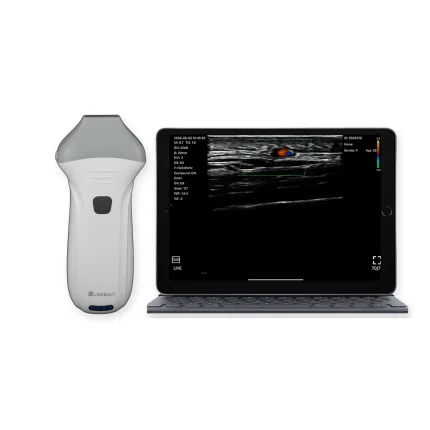
L20Pro
Suresult L20Pro High-Frequency Facial Ultrasound Probe – 16/20 MHz, 256 Elements, Wireless
Frequency: 16/20 MHz
Scanning Depth: 10/20/30/40 mm
Sports Medicine
buy scanner

L24Pro
L24Pro 18/24 MHz 256-Element Aesthetic Ultrasound Probe for Filler
Frequency: 18/24 MHz
Scanning Depth: 10/15/20/25mm
Sports Medicine
buy scanner

D3Ultra
D3Ultra Convex Linear Phased Multipurpose Handheld Ultrasound
Frequency: Convex / Phased Probe 3.2/5.0MHz Linear probe 7.5/10MHz
Scanning Depth: Linear: 20-100mm, Convex & Phased: 90-300mm
Sports Medicine
buy scanner


Expert Guidance
Talk to a Scanner Specialist
Tell Suresult about your daily workflow and get a personal scanner recommendation with an all-inclusive quote.
- Free scanner-fit consultation — probes, frequency and depth matched to your procedures
- All-inclusive quote — shipping, customs clearance and applicable taxes covered
- Fast delivery — ships within 24 hours, 1–7 days door to door
- No required software subscription — iOS, Android and Windows apps included
- 30-day returns and 24/7 support
Live chat opens right here — no forms, no waiting.
