
Jede Ultraschallaufnahme auf dieser Seite wurde mit dieser Suresult-Gerätefamilie erstellt: Aufnahmen von Käufern mit einem D3Ultra, Clips eines klinischen Schulungsleiters, der damit untersucht, und Schallfenster aus der gemeinsamen klinischen Referenzbibliothek von Suresult. Jeder Clip ist auf die eigentliche Ultraschallaufnahme zugeschnitten. ·8.717 Ärzte vertrauen darauf →
Kurze Antwort
Ein Ultraschallgerät für die Sportmedizin ist ein hochfrequentes Ultraschallgerät, das Sehnen, Bänder, Muskeln und Gelenkflächen direkt am Behandlungsort darstellt und die bildgestützte Führung bei der Injektion ermöglicht.
- Die Linearsonden von Suresult decken folgenden Frequenzbereich ab: 7.5 MHz bis 24 MHz, sodass Ärzte mit derselben Plattform eine Plantarfaszie in 20 mm Tiefe und die ischiokrurale Muskulatur in 80 mm Tiefe beurteilen können.
- Die Modelle L14Pro, L20Pro, L10SH und L24Pro verfügen über Arrays mit 256 Elementen und 64 Kanälen; mit dieser Elementanzahl lassen sich Sehnenfibrillen auflösen.
- Jedes bildgebende Modell auf dieser Seite bietet In-Plane- und Out-of-Plane-Punktionshilfen; das L10H bietet zusätzlich Visualisierte Nadelführung für Injektionen.
- Standbilder und Cine-Loops mit 100 bis 1.000 Bildern lassen sich als DICOM, JPEG, PNG oder MP4 exportieren, sodass eine Folgeuntersuchung mit der ersten verglichen werden kann.
Der Bildatlas
Neun muskuloskelettale Schallfenster, jedes Bild eine unbearbeitete Aufnahme mit einem Suresult-Gerät
Unbearbeitete klinische Aufnahmen · wählen Sie ein Bild zum Vergrößern
3 windows
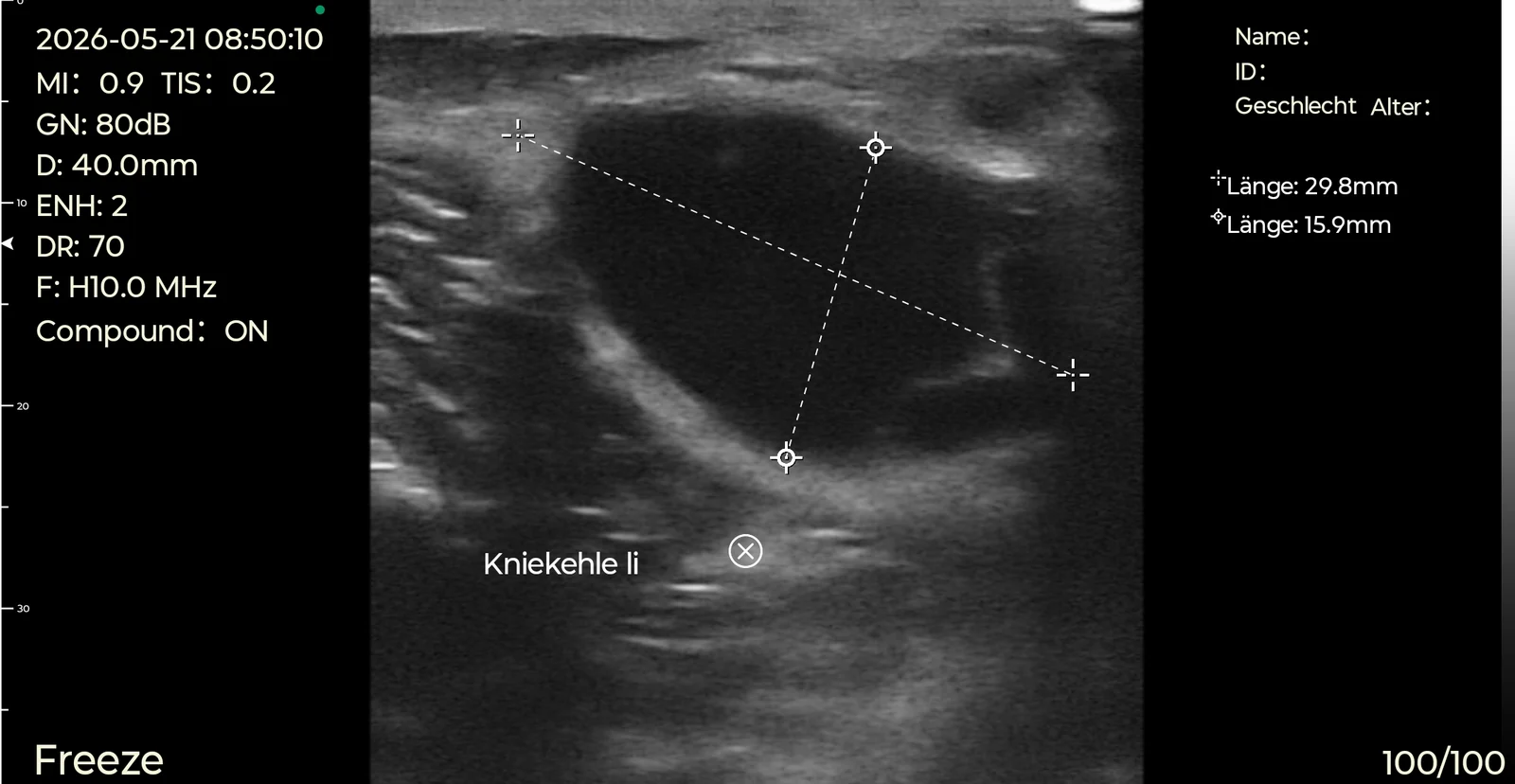
Zystische Struktur in der Kniekehle, gemessen mit dem D3Ultra
Hinter dem linken Knie liegt eine echofreie Flüssigkeitsansammlung, die auf dem Bildschirm mit 29,8 mm × 15,9 mm vermessen wird. Eine Schwellung in der Kniekehle, die wie eine Wadenzerrung wirkt, lässt sich mit diesem Schallfenster in weniger als einer Minute abklären.
Standbild mit einem D3Ultra bei H10.0 MHz, 40 mm Tiefe, 80 dB Verstärkung, Compound-Bildgebung eingeschaltet, vom untersuchenden Arzt mit „Kniekehle li“ beschriftet; eingereicht vom Käufer Stefan Goepfert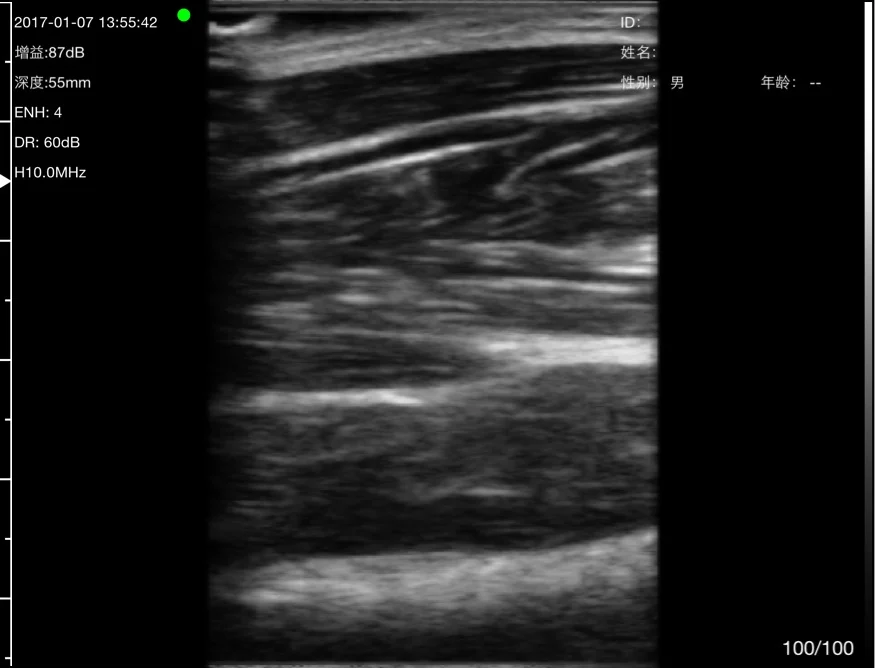
Gefiederte Muskelarchitektur im Längsschnitt
Helle fibroadipöse Septen verlaufen schräg zwischen dunkleren Muskelbündeln und bilden das normale gefiederte Muster. Ein Riss zeigt sich als Unterbrechung dieser Linien mit Flüssigkeit, die sich entlang der Gewebeebene ausbreitet.
Aufnahme aus der gemeinsam genutzten klinischen Referenzbibliothek, aufgenommen mit einer kabellosen Suresult-Sonde; die Kopfzeile auf dem Bildschirm zeigt 87 dB Verstärkung, 55 mm Tiefe, H10.0 MHz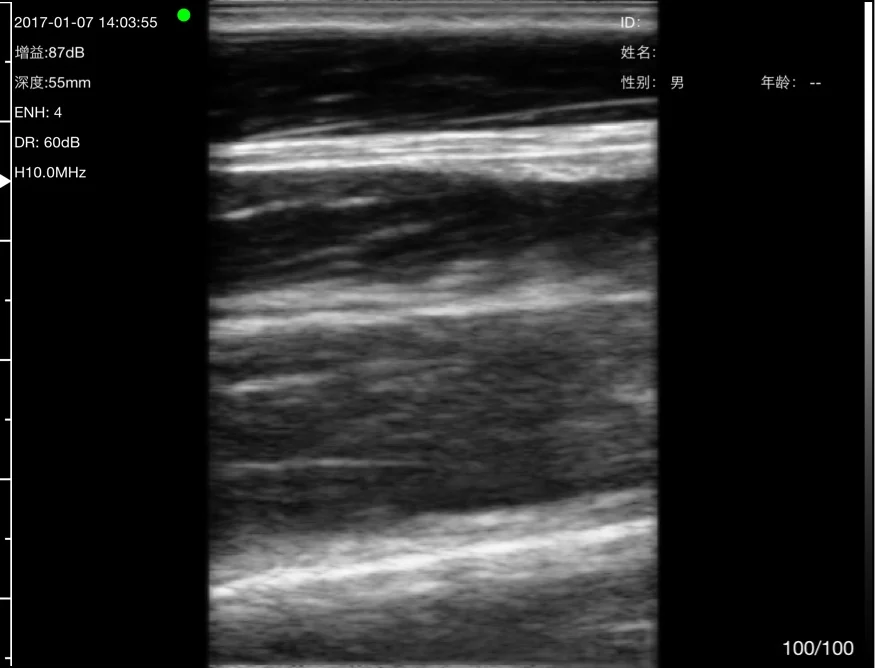
Sehne mit fibrillärer Struktur im Längsschnitt
Eine Sehne stellt sich als kompaktes Band paralleler heller Linien dar, die durch schmale dunkle Zwischenräume getrennt sind. Der Verlust dieses fibrillären Musters ist der Befund, der eine Tendinopathie von einer normalen Sehne unterscheidet.
Aufnahme aus der gemeinsam genutzten klinischen Referenzbibliothek, aufgenommen mit einer kabellosen Suresult-Sonde; die Kopfzeile auf dem Bildschirm zeigt 87 dB Verstärkung, 55 mm Tiefe, H10.0 MHz3 windows
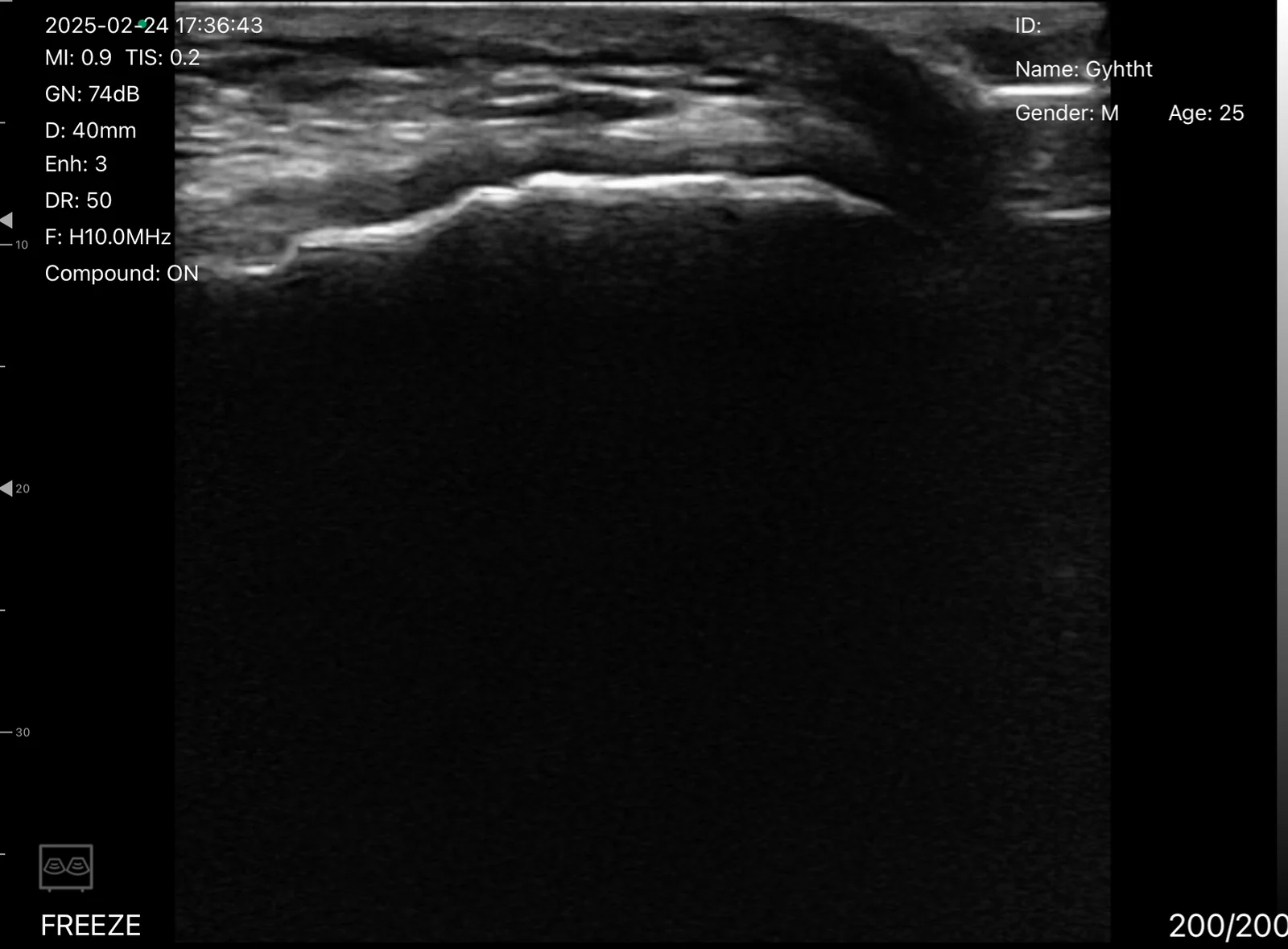
Knochenkortikalis mit Schallschatten, dargestellt mit dem D3Ultra
Eine durchgehende helle Linie markiert die Kortikalisoberfläche; darunter liegt ein Schallschatten. Eine Stufe in der Kortikalis oder eine Unterbrechung dieser Linie zeigt im Ultraschall eine Fraktur an, die im ersten Röntgenbild übersehen wurde.
Standbild mit einem D3Ultra bei H10.0 MHz, 40 mm Tiefe, 74 dB Verstärkung, Compound-Bildgebung eingeschaltet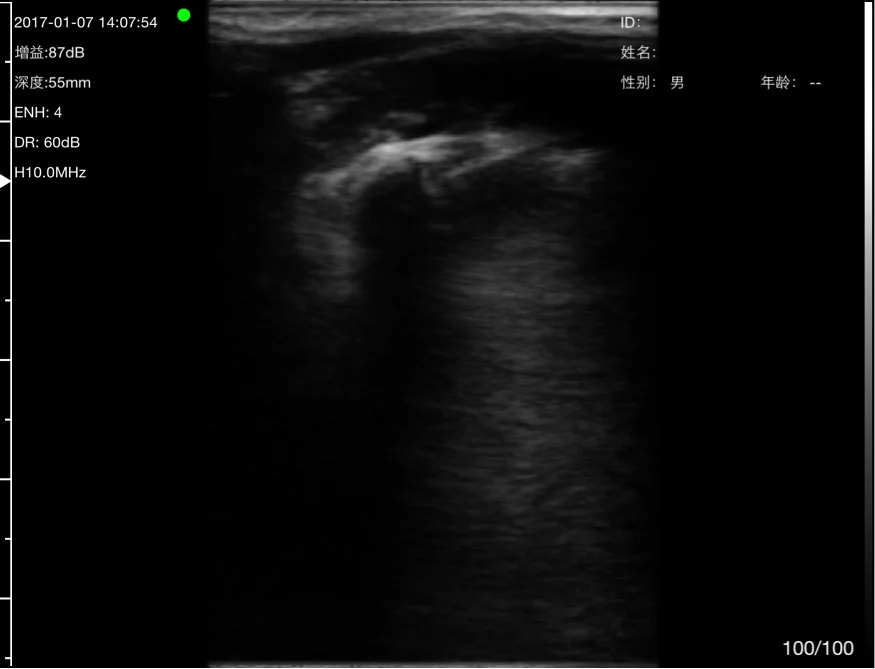
Knöcherne Gelenkfläche mit unregelmäßiger Kontur
Der helle Kortikalisrand biegt ab und senkt sich dort, wo zwei Knochenflächen an einem Gelenk aufeinandertreffen. In der Sportmedizin wird diese Linie auf einen knöchernen Ausriss oder einen Erguss untersucht, der die darüberliegende Gelenkkapsel anhebt.
Aufnahme aus der gemeinsam genutzten klinischen Referenzbibliothek, aufgenommen mit einer kabellosen Suresult-Sonde; die Kopfzeile auf dem Bildschirm zeigt 87 dB Verstärkung, 55 mm Tiefe, H10.0 MHz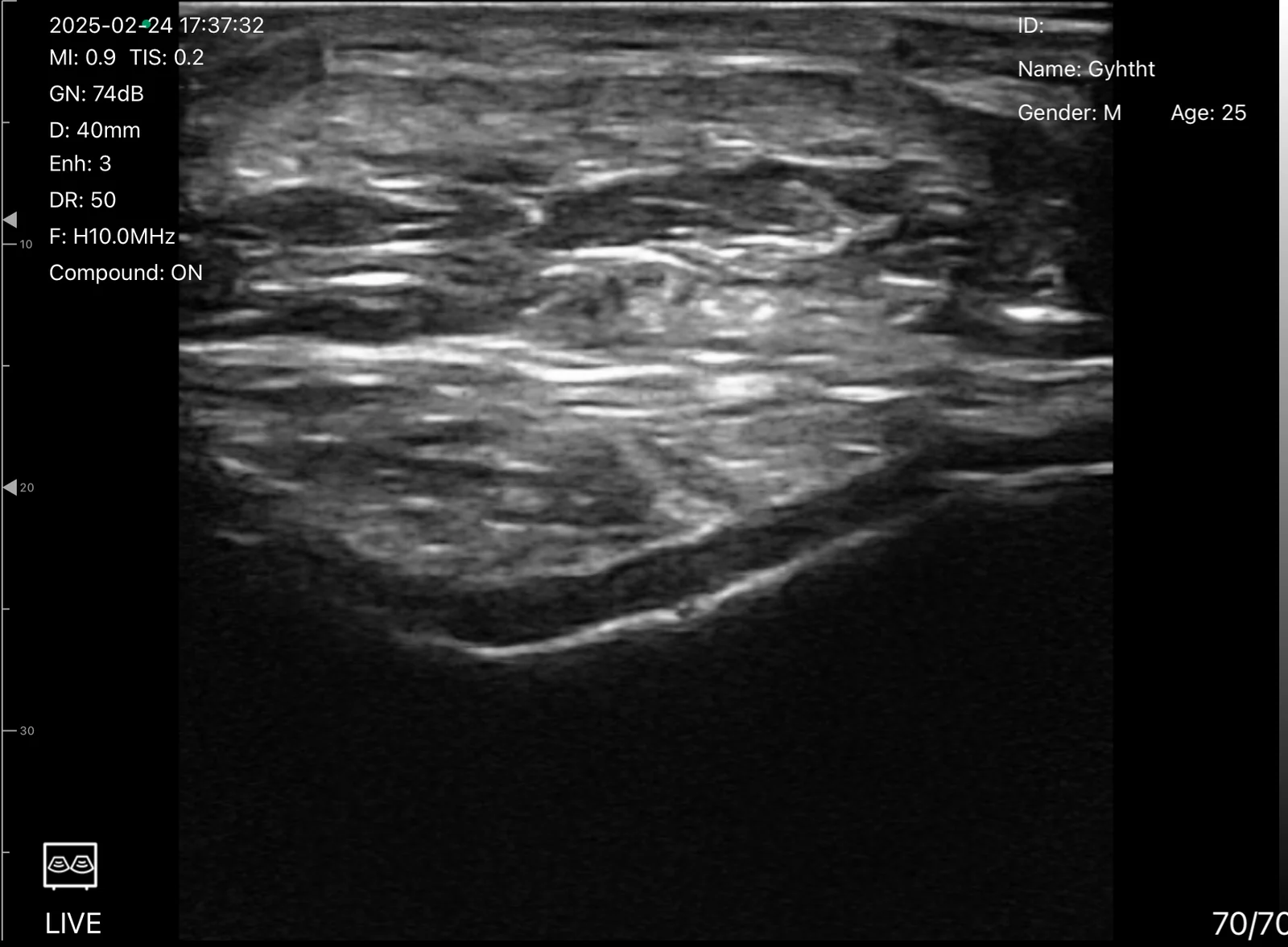
Oberflächliches Weichteilgewebe über der Knochenkortikalis, dargestellt mit dem D3Ultra
Geschichtetes fibrilläres Gewebe liegt über einer hellen Kortikalislinie, wobei die Schichten klar voneinander abgegrenzt sind. Durch die systematische Beurteilung der einzelnen Schichten lässt sich Druckschmerz einer bestimmten Struktur statt nur einer Region zuordnen.
Standbild mit einem D3Ultra bei H10.0 MHz, 40 mm Tiefe, 74 dB Verstärkung, Compound-Bildgebung eingeschaltet3 windows
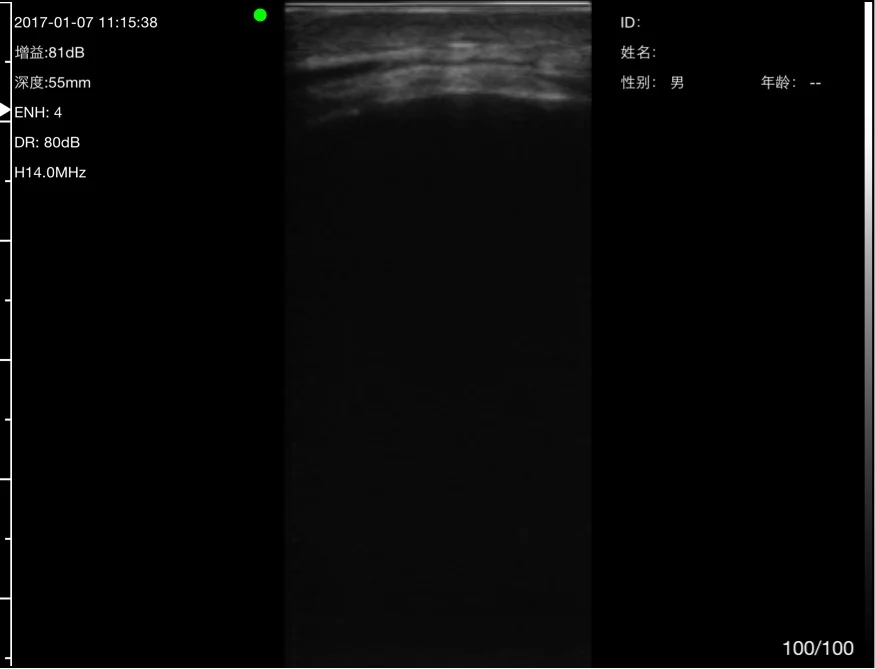
Knochenoberfläche mit vollständiger Schallauslöschung
Die gekrümmte, helle Kortikalis reflektiert nahezu den gesamten Schallstrahl, sodass der Bereich darunter vollständig schwarz erscheint. Aufgrund dieses Schallschattens lässt sich mit Ultraschall die Knochenoberfläche beurteilen, nicht aber das dahinterliegende Knochenmark.
aufgenommen mit einer kabellosen Suresult-Sonde, aus der gemeinsamen klinischen Referenzbibliothek; die Bildschirmkopfzeile zeigt 81 dB Verstärkung, 55 mm Tiefe, Dynamikbereich 80 dB, H14.0 MHzFarbdoppleruntersuchung am Handgelenk mit dem D3Ultra
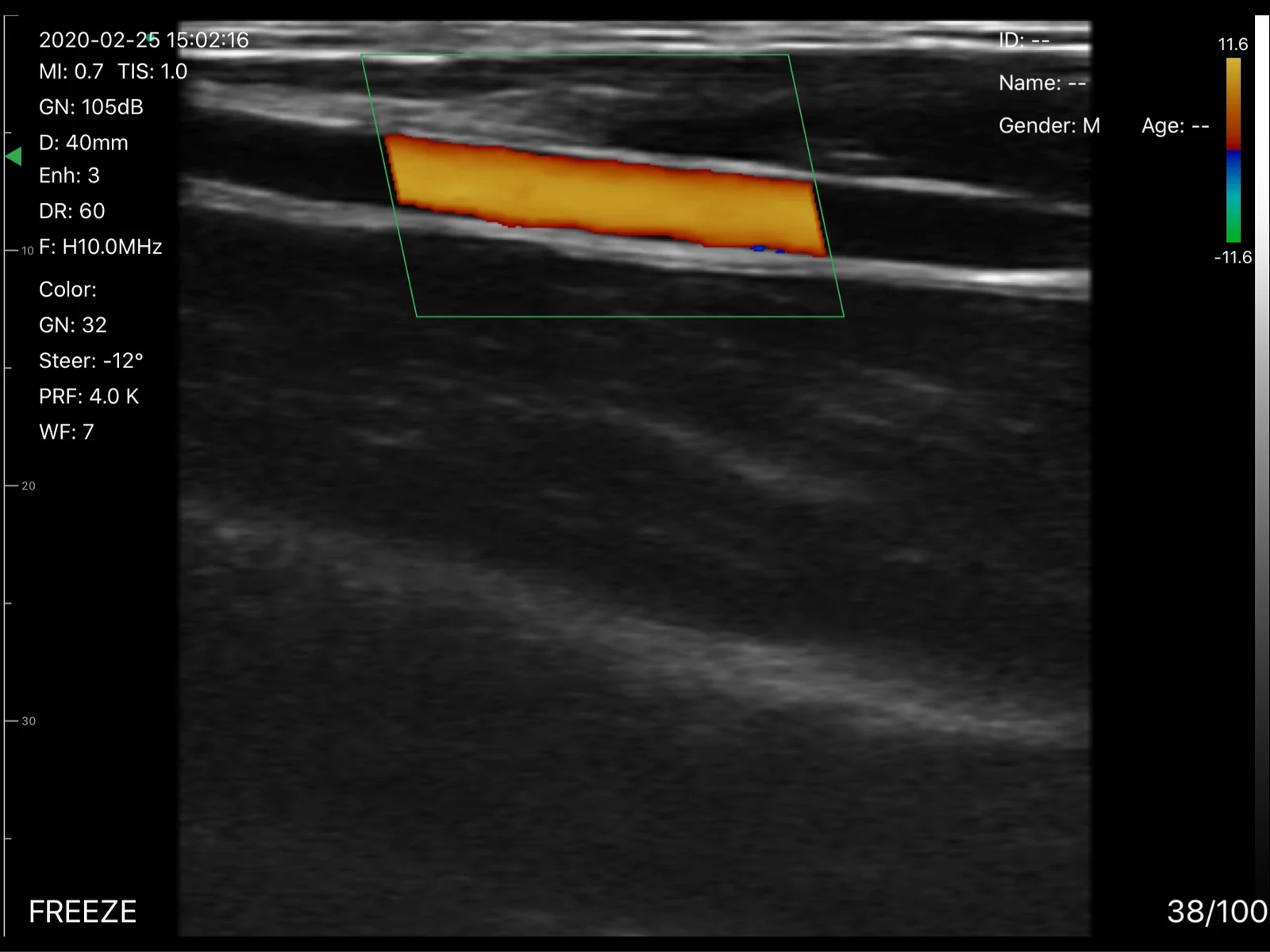
Im Farbfenster wird der Blutfluss in einem oberflächlichen Gefäß farbig dargestellt, während das umgebende Gewebe grau bleibt. Dieselben Farbeinstellungen zeigen die Neovaskularisation, die eine symptomatische Sehne kennzeichnet.
Standbild einer D3Ultra aus der gemeinsamen klinischen D3-Demobibliothek; die Bildschirmkopfzeile zeigt 105 dB Verstärkung, 40 mm Tiefe, H10.0 MHz, Farbverstärkung 32, PRF 4.0 K, Schwenkwinkel -12 Grad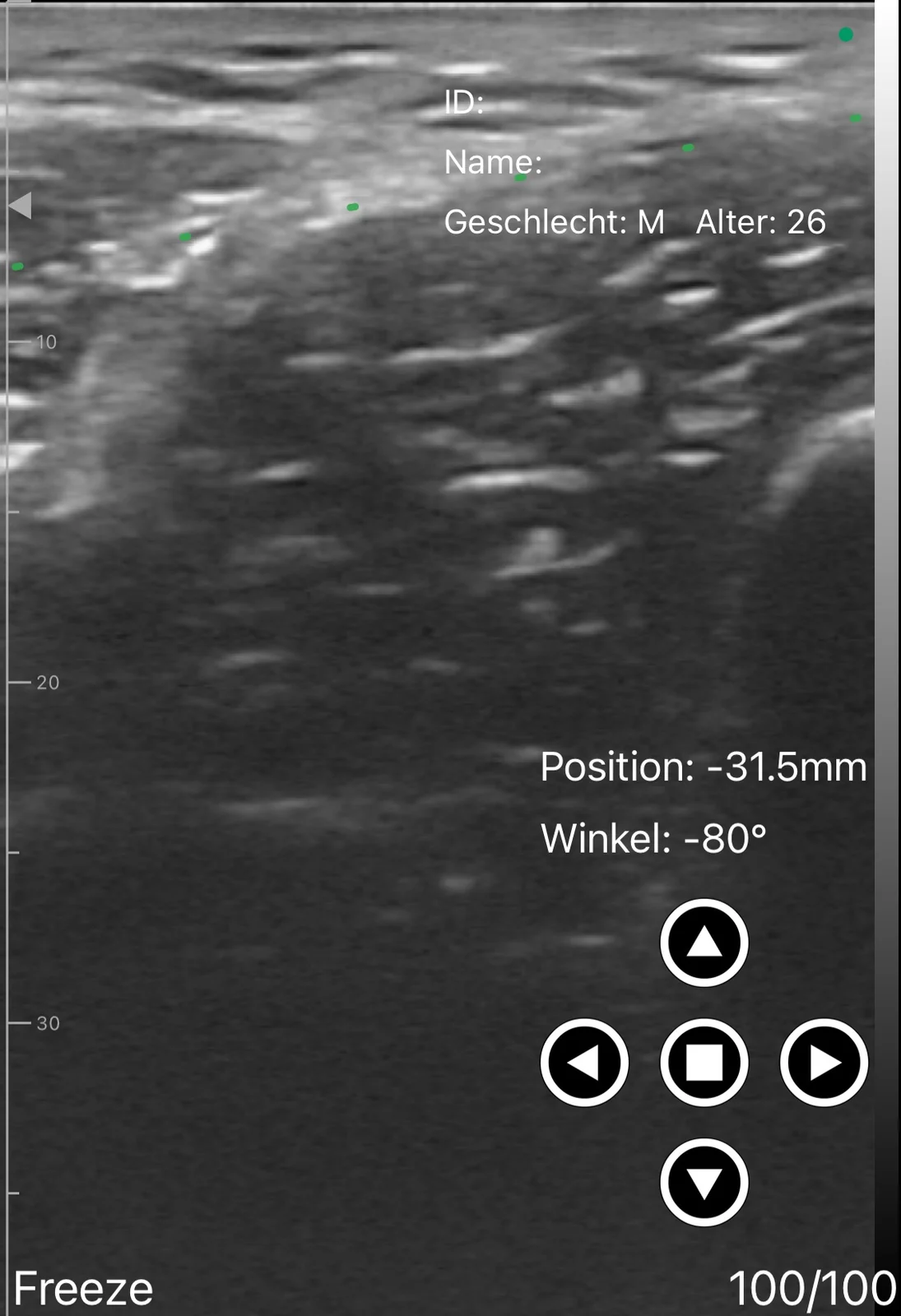
Über dem Nadelverlauf eingeblendete Punktionshilfe beim D3Ultra
Die Punktionshilfe zeichnet einen gepunkteten Weg zum Ziel, und die App zeigt dessen Position und Winkel auf dem Bildschirm an. Auf diesem Bildschirm wird die ultraschallgeführte Injektion vorbereitet, bevor die Nadel bewegt wird.
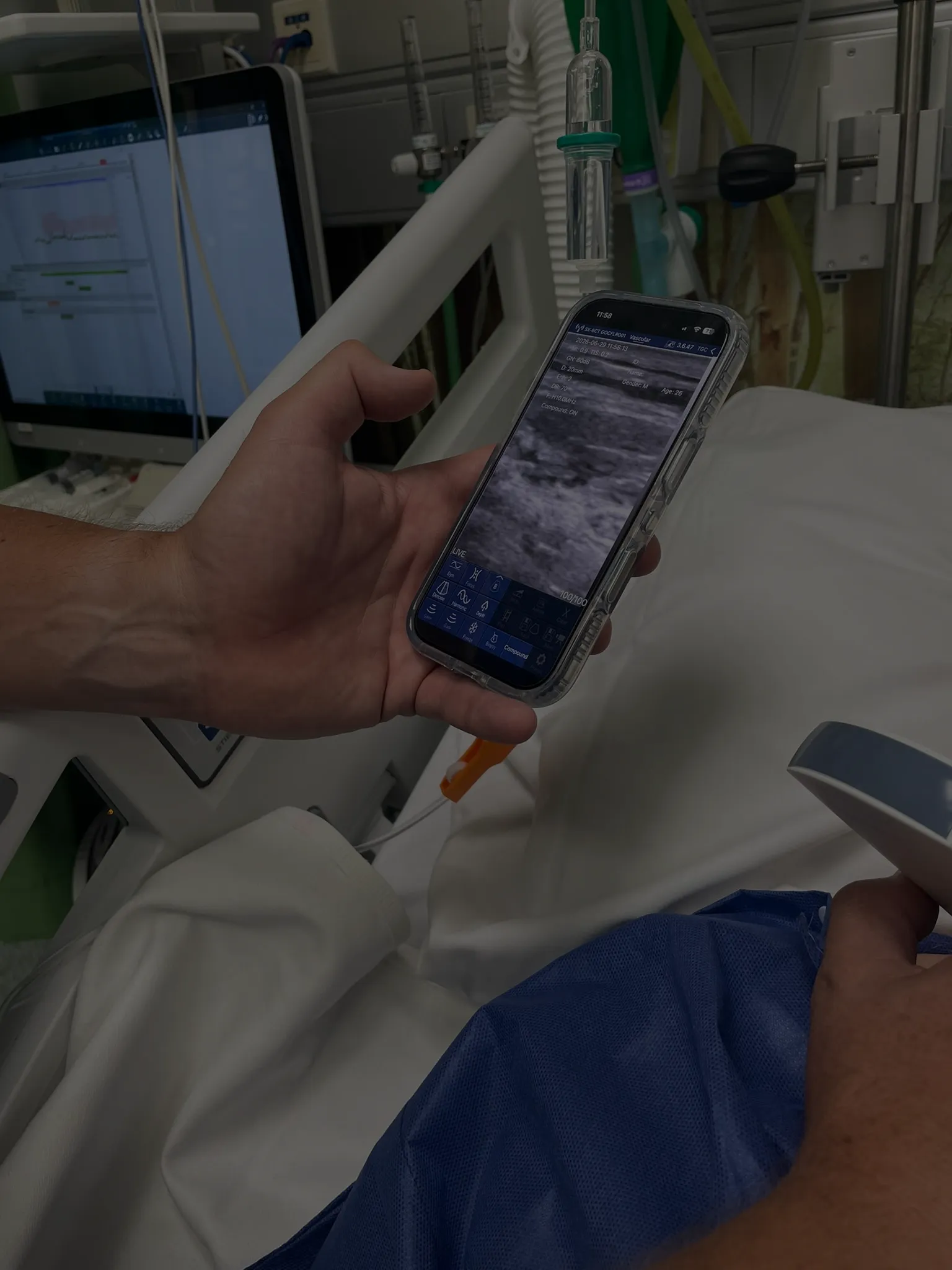
Standbild einer D3Ultra während einer suprainguinalen Fascia-iliaca-Blockade, deutsche App-Oberfläche mit den Angaben „Position: -31.5mm“ und „Winkel: -80“; eingereicht vom Käufer David Heimpel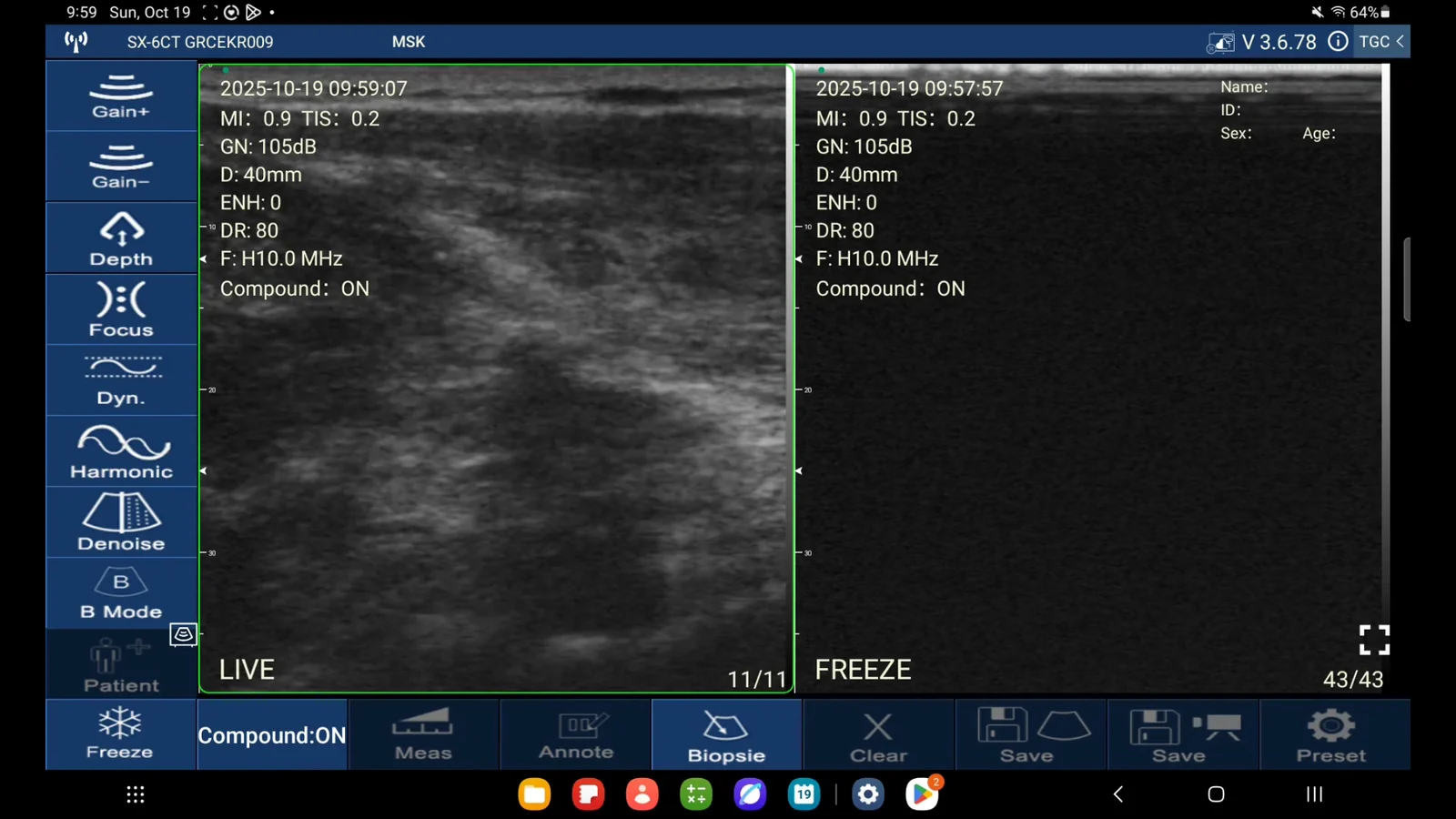
Wählen Sie eine Karte, um die Aufnahme zu wechseln
Grundlagen der Untersuchungstechnik
So läuft die Untersuchung ab, von der Sonde bis zum Befundbericht
- Passen Sie die Frequenz an die Tiefe der Zielstruktur an.
Die L20Pro bildet mit 16/20 MHz in 10 bis 40 mm Tiefe ab, etwa für die Plantarfaszie oder ein Ringband am Finger. Die L14Pro erreicht mit 10/14 MHz eine Tiefe von 80 mm, die L10SH und L10H erreichen 100 mm für die ischiokrurale Muskulatur oder eine Glutealsehne.
Je nach Linearsondenmodell 10 mm bis 100 mm - Untersuchen Sie jede Sehne in zwei Ebenen.
Die Sehne wird im Längsschnitt verfolgt, um die Kontinuität der Fasern zu beurteilen. Anschließend wird die Sonde um 90 Grad gedreht, um den Querschnitt darzustellen. Bei nicht senkrechter Schallausrichtung täuscht Anisotropie einen Riss vor; die zweite Ebene klärt den Befund.
Zuerst Längsschnitt, dann Querschnitt - Vergleichen Sie mit der unverletzten Seite.
Muskel- und Sehnendicke unterscheiden sich zwischen Sportlern erheblich, daher dient die kontralaterale Extremität als Referenz. Werden beide Seiten als Cine-Schleife gespeichert, beruht die Verlaufskontrolle auf einer Messung statt auf einem bloßen Eindruck.
Cine-Schleifen mit 100 bis 1.000 Bildern 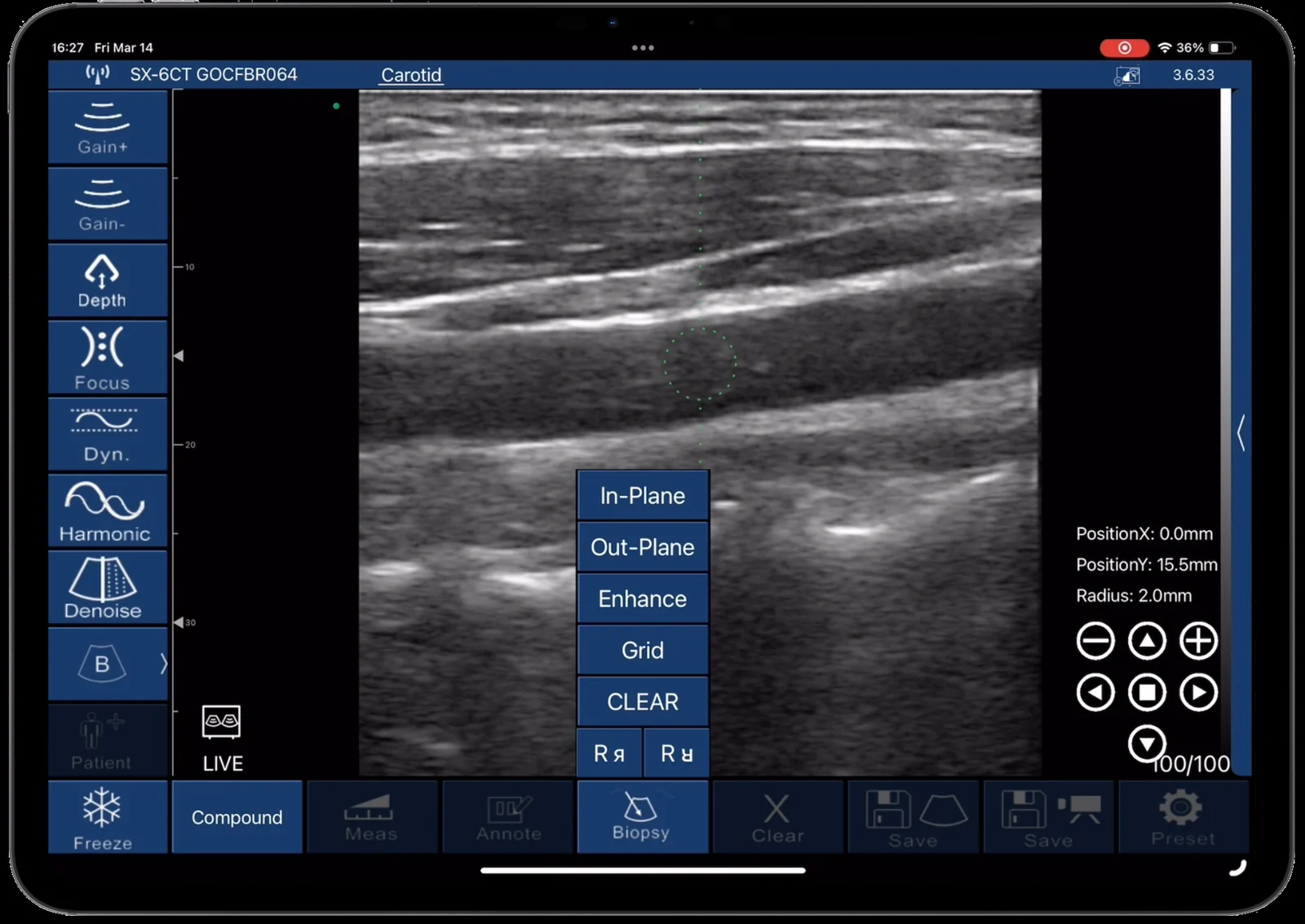 Positionieren Sie die Nadel vor der Injektion in der Bildebene.
In-Plane- und Out-of-Plane-Punktionshilfen blenden den Nadelweg über der Zielstruktur ein; die Spiegelungs- und Rasterfunktionen sichern die korrekte Orientierung. Die Nadelverstärkung stellt den Nadelschaft bei L14Pro, L20Pro, L20, L24, L10SH, L10H und D3Ultra schärfer dar.
Punktionshilfe in der App
Was die Forschung zeigt
Die Evidenz, vier Studien geprüft
- Ultraschall war der MRT bei chronischen Außenbandverletzungen des Sprunggelenks überlegen.
In 15 Studien mit 695 Teilnehmenden betrug die gepoolte Sensitivität bei chronischen Verletzungen des Ligamentum talofibulare anterius 0,99 für die Sonografie und 0,83 für die MRT.
Cao et al., J Orthop Surg Res 2018 - Auch bei Untersuchenden außerhalb der Radiologie erkannte Ultraschall komplette Rotatorenmanschettenrupturen ebenso genau.
Eine Metaanalyse im British Journal of Sports Medicine berichtete für die Sonografie bei kompletten Rotatorenmanschettenrupturen eine Sensitivität und Spezifität von jeweils über 0,90. Die Genauigkeit war vergleichbar, unabhängig davon, ob Radiologen, Sonografiefachkräfte oder Orthopäden die Untersuchung durchführten.
Roy et al., Br J Sports Med 2015 - Ultraschallführung verbesserte in einer randomisierten Studie die Aspiration und Injektion am Kniegelenk.
Bei 64 randomisiert zugeteilten Kniegelenken mit Erguss führte die Ultraschallführung gegenüber der palpationsgestützten Durchführung zu 48 % weniger Schmerzen während des Eingriffs und zu 183 % mehr aspirierter Synovialflüssigkeit. Auch die Schmerzwerte nach zwei Wochen waren besser.
Sibbitt et al., Scand J Rheumatol 2012 - Ultraschall diagnostizierte distale Unterarmfrakturen bei Kindern mit hoher Genauigkeit.
Eine Metaanalyse von 16 Studien mit 1.204 Patienten berichtete für Ultraschall bei distalen Unterarmfrakturen eine gepoolte Sensitivität von 97 % und eine Spezifität von 95 %. Die Autoren kamen zu dem Schluss, dass die Genauigkeit bei Kindern hoch ist.
Douma-den Hamer et al., PLoS One 2016
Wählen Sie Ihr Modell
Wählen Sie das Modell, das zu Ihrem Alltag passt
AM HÄUFIGSTEN GEWÄHLT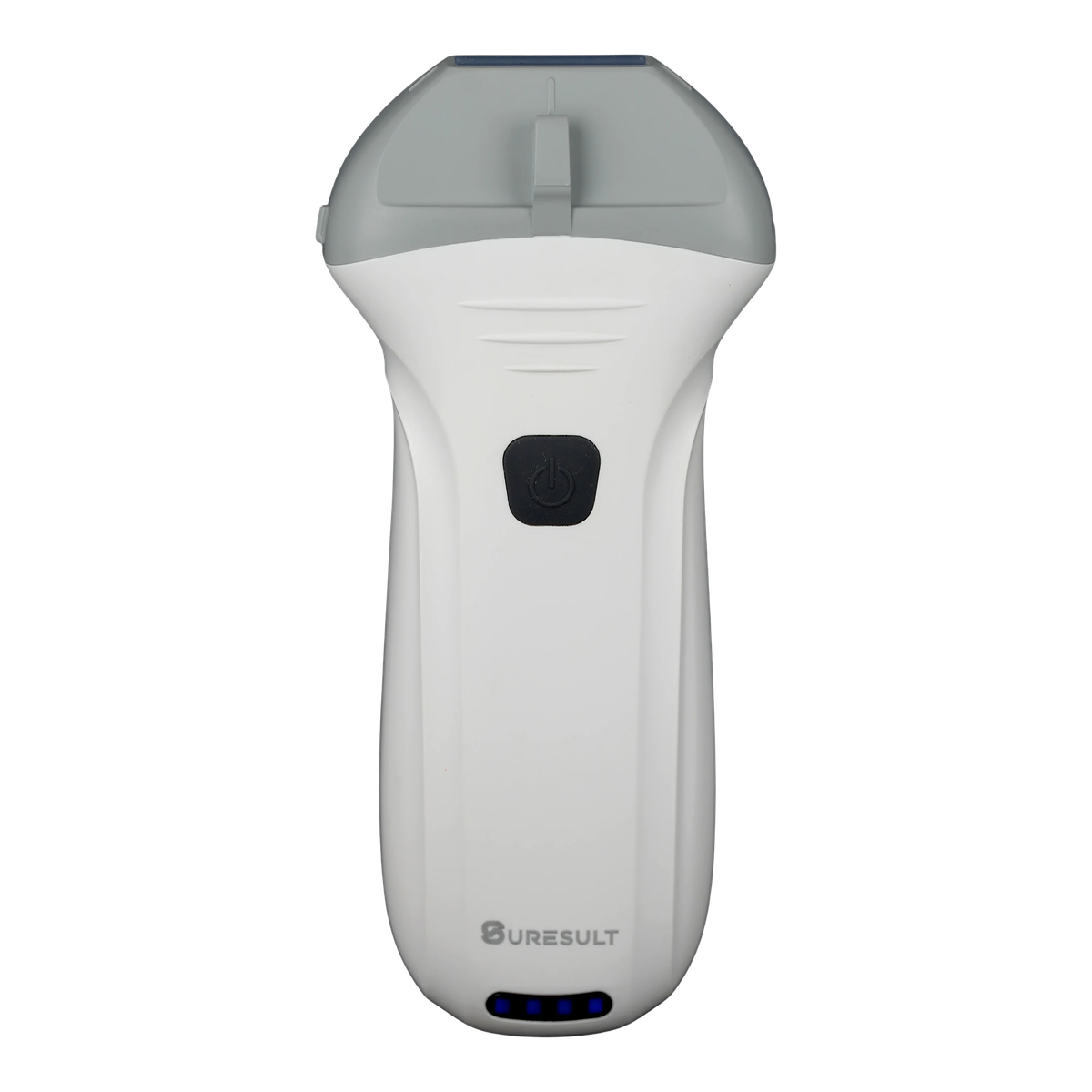 Eine Sonde für die gesamte sportmedizinische PraxisL14Pro
Eine Sonde für die gesamte sportmedizinische PraxisL14ProDie L14Pro arbeitet mit 10/14 MHz über ein Array mit 256 Elementen und 64 Kanälen. Die Bildtiefe lässt sich auf 20, 40, 60 und 80 mm einstellen. Damit reicht das Einsatzspektrum von der Plantarfaszie bis zur proximalen ischiokruralen Muskulatur.
256 Elemente, 64 Kanäle, 10/14 MHz
$3,441 L14Pro · Linearsonde mit 10/14 MHz und 256 Elementen für MSKJetzt kaufenL14Pro ansehen →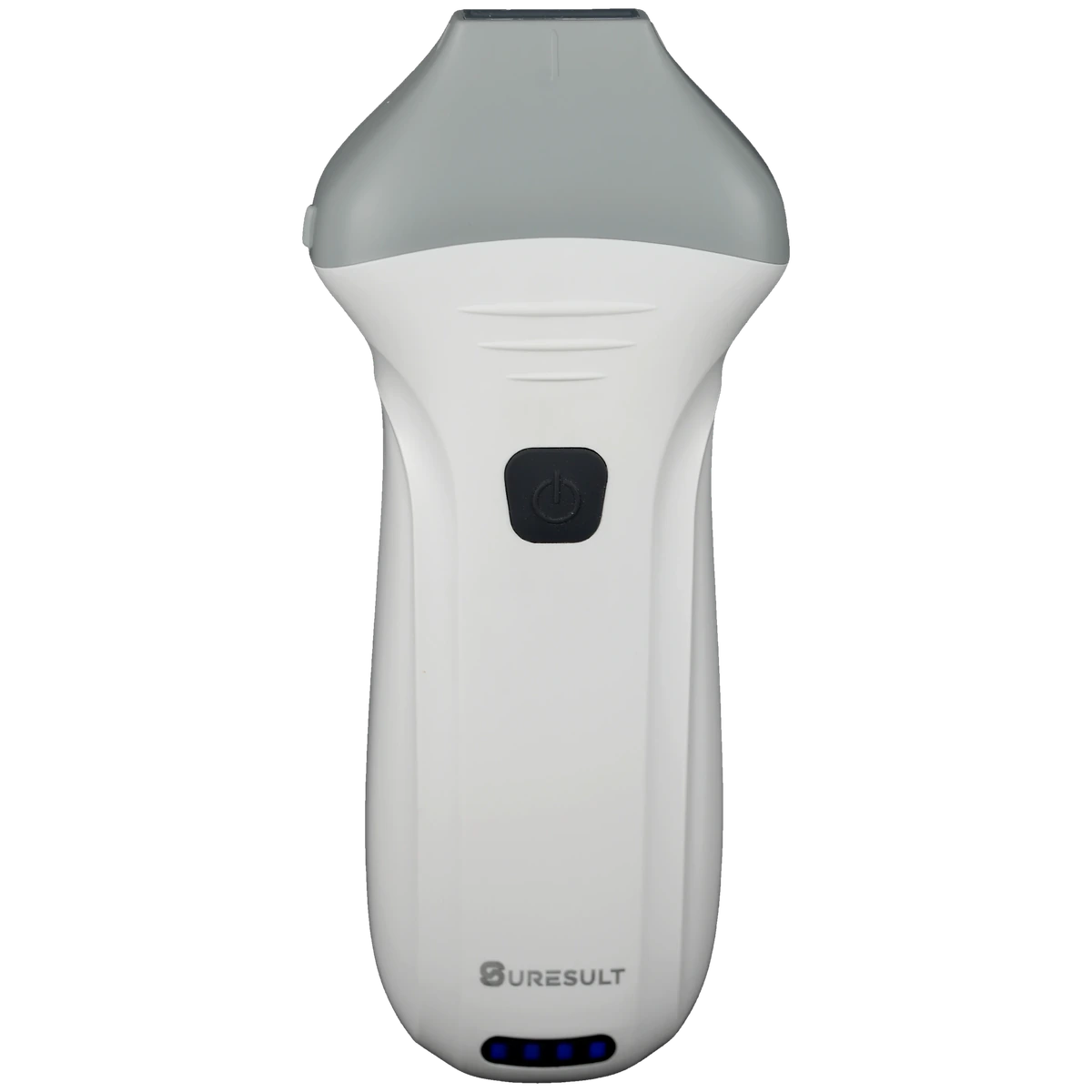 Bänder und kleine Sehnen unter der HautL20Pro
Die L20Pro bildet mit einem Array aus 256 Elementen bei 16/20 MHz in 10 bis 40 mm Tiefe ab. Die Außenbänder des Sprunggelenks, die Ringbänder der Finger und die Plantarfaszie liegen in diesem Bereich.
16/20 MHz, oberflächennahe Details
$3,720 L20Pro · 16/20 MHz Hochfrequenz-Linearultraschall für ästhetische Medizin, Haut & oberflächliche muskuloskelettale StrukturenJetzt kaufenL20Pro ansehen →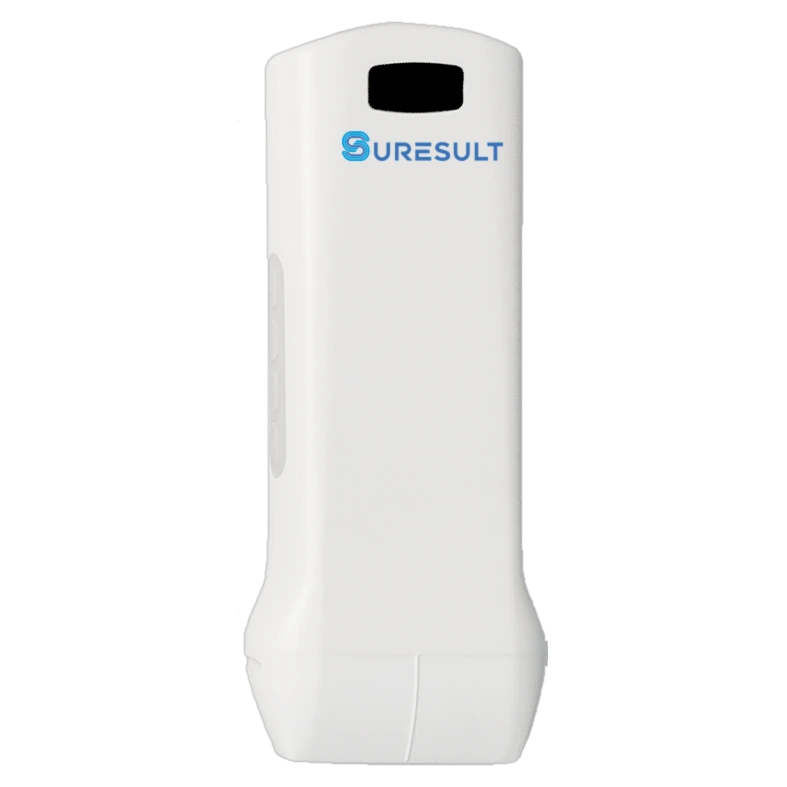 Wenn Injektionen den Großteil der Woche ausmachenL10H
Die L10H ist das einzige Suresult-Modell, bei dem neben den Standard-Punktionshilfen eine visualisierte Nadelführung aufgeführt ist. Ihr 5.600-mAh-Akku ermöglicht fünf Stunden kontinuierliche Ultraschalluntersuchung und deckt damit ein komplettes Injektionsprogramm ab.
fünf Stunden im Dauerbetrieb, Nadelführung
$2,325 L10H · Kabelloses hochauflösendes Linear-Ultraschallgerät mit 7.5/10 MHz und 192 Elementen für die DiagnostikJetzt kaufenL10H ansehen →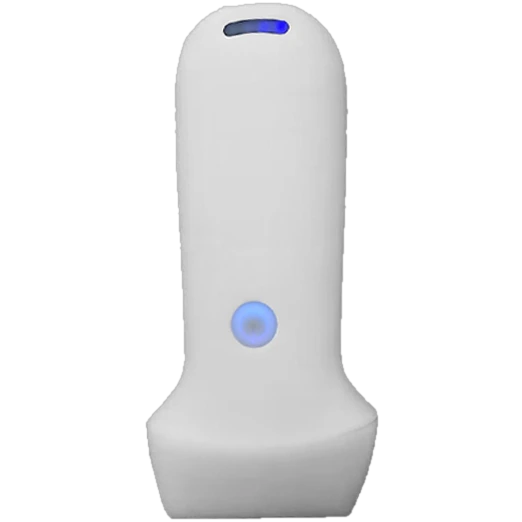 Tiefere Strukturen und ein breiteres BildfeldL10SH
Die L10SH kombiniert eine 40 mm breite Kontaktfläche mit einem Array aus 256 Elementen bei 7.5/10 MHz und erreicht eine Tiefe von 100 mm. Glutealsehnen, die proximale ischiokrurale Muskulatur und ein kräftiger Oberschenkel liegen in diesem Bereich.
40 mm breite Kontaktfläche, erreicht 100 mm
$3,534 L10SH · Hochauflösendes kabelloses Linear-Ultraschallgerät mit 64 KanälenJetzt kaufenL10SH ansehen →Ultraschallgeräte im Vergleich
Acht Handheld-Ultraschallgeräte von Suresult für die Sportmedizin, im Vergleich
Wischen Sie, um alle Spalten zu sehen →
| Modell | Preis | Frequenz | Tiefe | Am besten geeignet für |
|---|---|---|---|---|
| L14Pro | $3,441 | Linear 10/14 MHz | 20/40/60/80 mm | Für die allgemeine sportmedizinische Praxis: 256 Elemente, 64 Kanäle, 4 Stunden Akkulaufzeit, 145 g |
| L20Pro | $3,720 | Linear 16/20 MHz | 10/20/30/40 mm | Bänder, Fingersehnen und Plantarfaszie: 256 Elemente, 4 Stunden Akkulaufzeit |
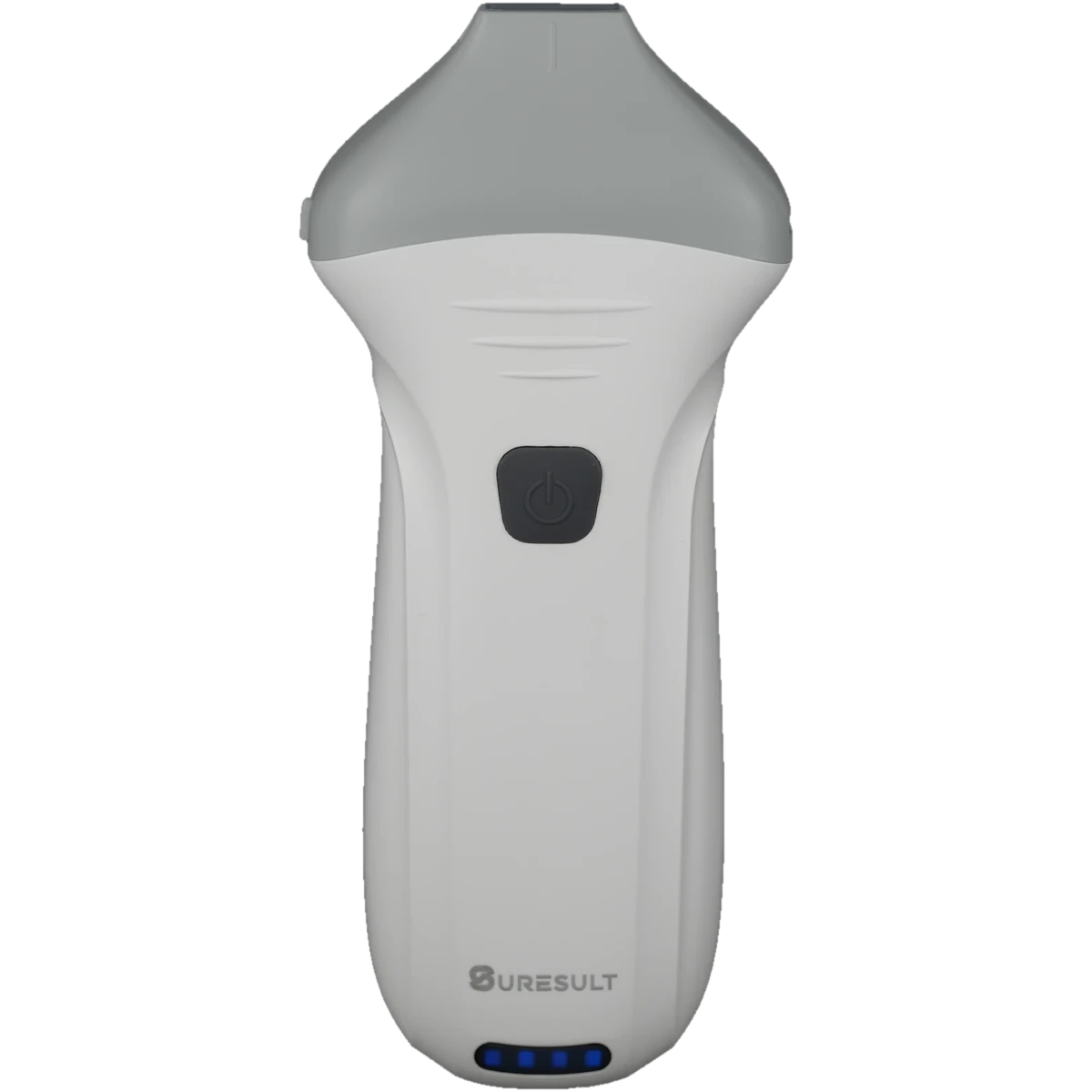 L24Pro L24Pro | $4,185 | Linear 18/24 MHz | 10/15/20/25 mm | Für die oberflächlichsten Strukturen: 256 Elemente, 64 Kanäle, 4 Stunden Akkulaufzeit, 145 g |
| L10SH | $3,534 | Linear 7.5/10 MHz | 20/40/60/100 mm | Tiefere Muskulatur und eine 40 mm breite Kontaktfläche: 256 Elemente, 64 Kanäle |
| L10H | $2,325 | Linear 7.5/10 MHz | 20/40/60/100 mm | Injektionssprechstunden: visualisierte Nadelführung, 5.600 mAh, 5 Stunden Akkulaufzeit |
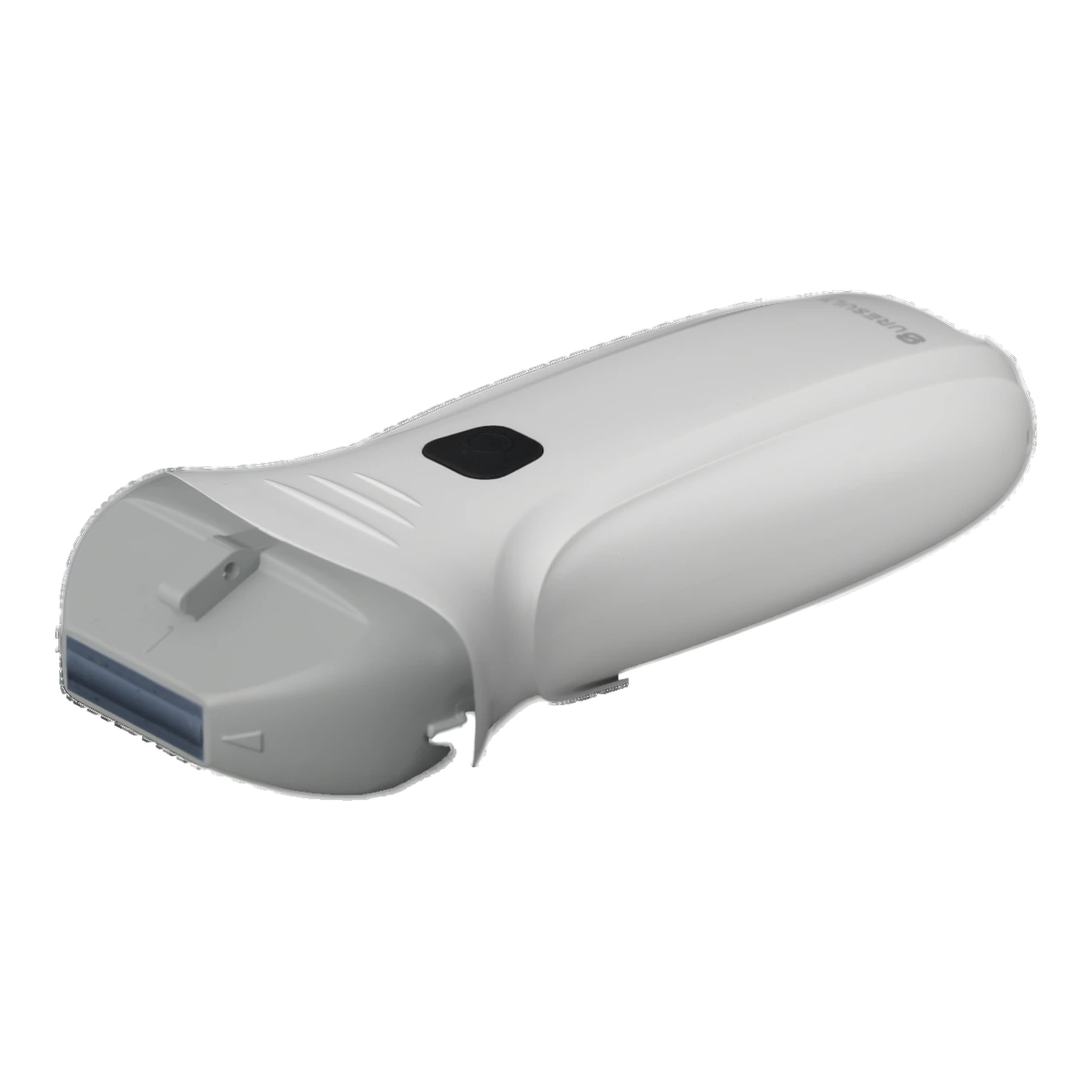 L14 L14 | $2,139 | Linear 10/14 MHz | 20-80 mm | Das Hochfrequenz-Einstiegsmodell: 192 Elemente, 64 Kanäle, 25 mm breite Kontaktfläche |
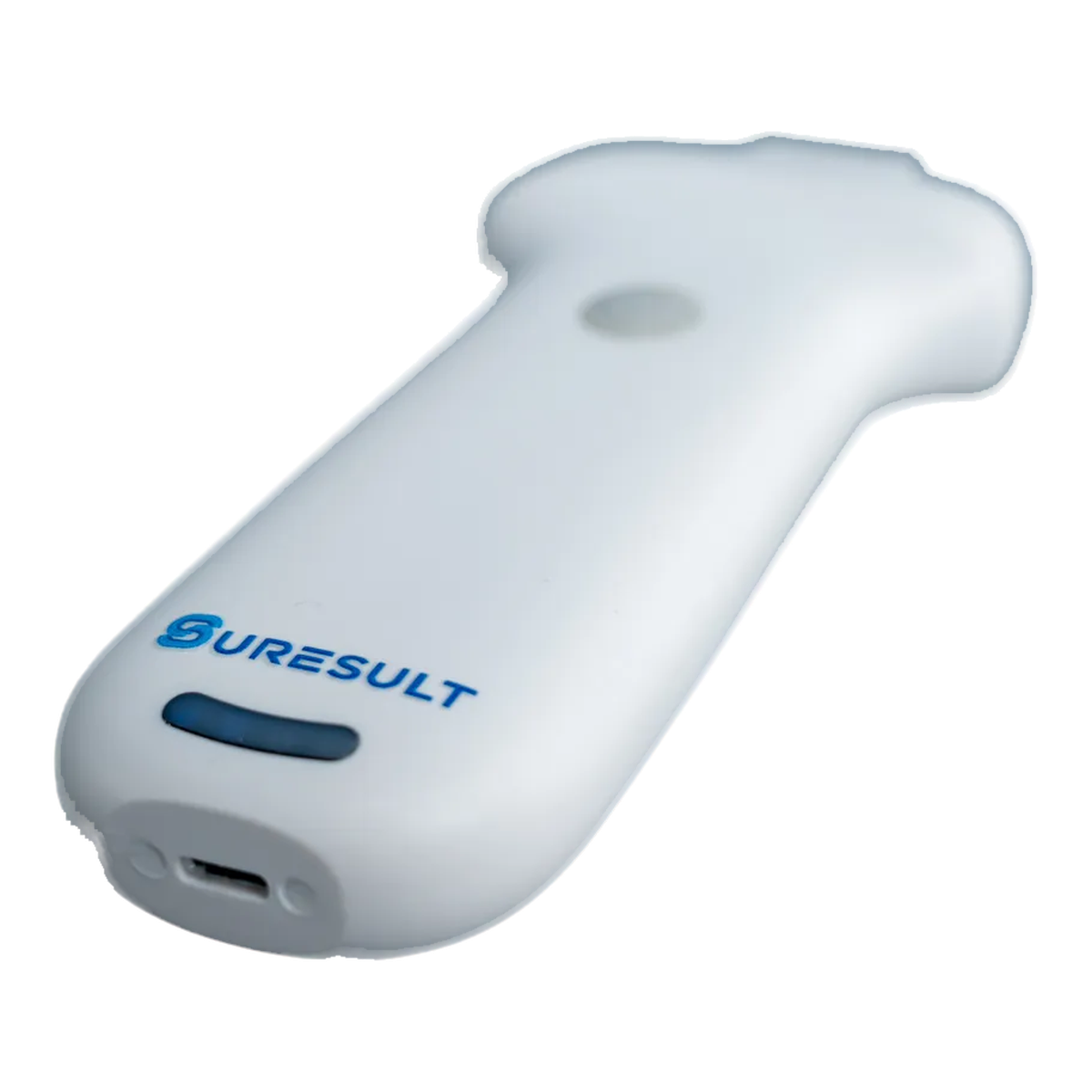 L20 L20 | $2,790 | Linear 16/20 MHz | 10/20/30/40 mm | Oberflächennahe Details mit einem Array aus 192 Elementen bei 147 g |
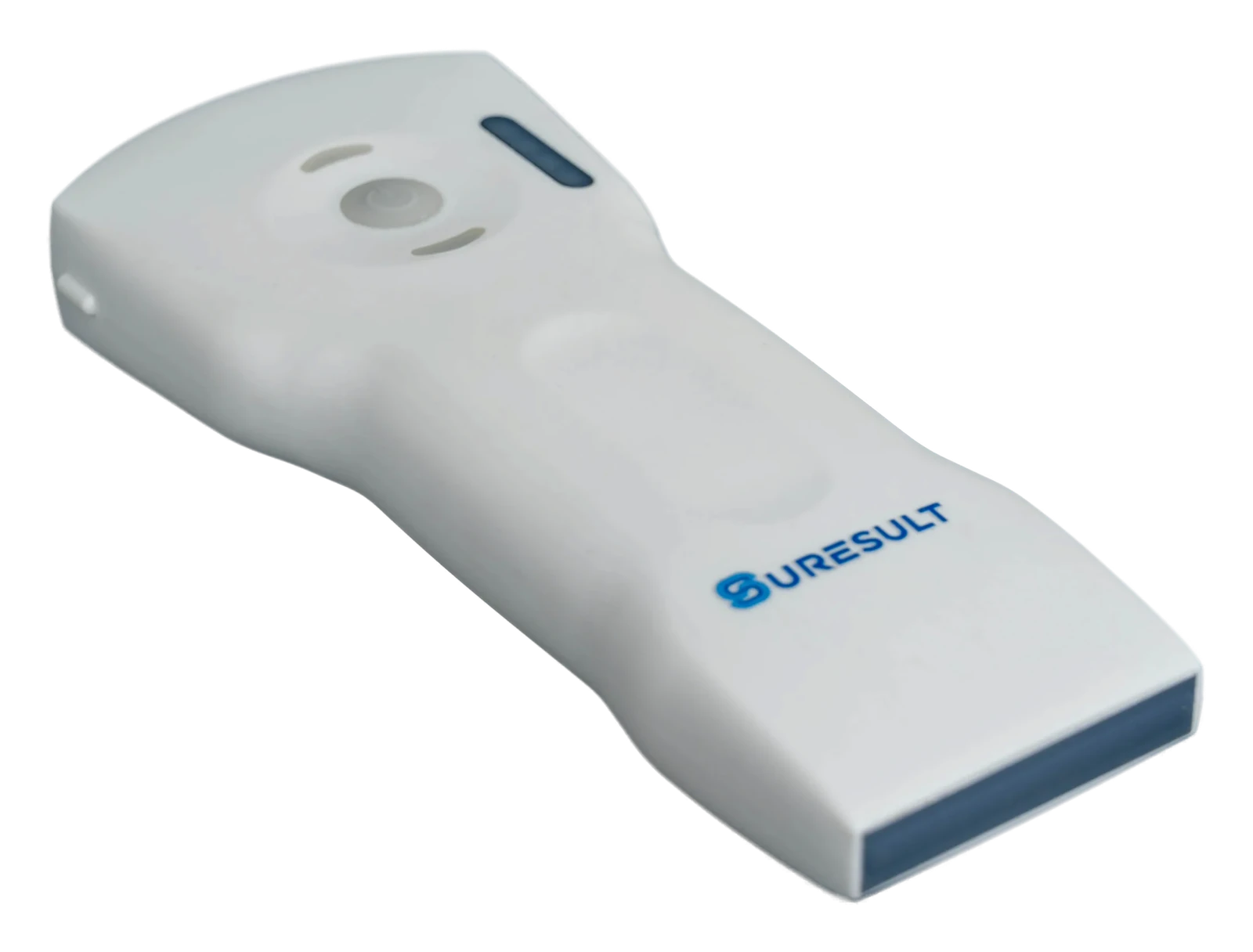 D3Ultra D3Ultra | $2,976 | Linear 7.5/10 + konvex 3.2/5.0 + Phased-Array 3.2/5.0 MHz | Linear 20-100 mm, konvex und Phased-Array 90-300 mm | Für sportmedizinische Praxen, die mit einem Schallkopf auch Hüfte, Abdomen und Lunge untersuchen |
Im Vergleich mit bekannten Marken
Suresult im Vergleich mit Clarius L15 HD3, Butterfly iQ3 und GE Vscan Air CL für Sportmedizin
Wischen Sie, um alle Spalten zu sehen →
| Suresult | Clarius L15 HD3 | Butterfly iQ3 | GE Vscan Air CL | |
|---|---|---|---|---|
| MSK-Bildgebung | Lineararrays von 7.5/10 MHz bis 18/24 MHz; 256 Elemente und 64 Kanäle bei L14Pro, L20Pro, L10SH und L24Pro | 5-15 MHz Linearsonde, oberflächennahe Bildgebung bis 7 cm gemäß veröffentlichten Angaben | 1-12 MHz Einzelchip, 152 x 52 x 37 mm | Doppelkopfsonde: ein 3-12 MHz Lineararray mit 192 Elementen und ein 2-5 MHz Konvexarray mit 128 Elementen |
| Eindringtiefenbereich | Von 10 mm bei L20Pro und L24Pro bis zu 100 mm bei L10SH und L10H | Bis zu 7 cm bei der L15 HD3; die L7 HD3 ist laut veröffentlichten Angaben für Tiefen bis 11 cm optimiert und erreicht maximal 15 cm | Die Voreinstellungen für MSK und MSK-Weichteile sind mit einem Tiefenbereich von 1 cm bis 12 cm angegeben | Linearschallkopf mit einer angegebenen Tiefe von bis zu 8 cm; der Konvexschallkopf erreicht 24 cm |
| Gerätepreis | Auf jeder Produktseite angegeben: Der L14Pro kostet $3,441 und der L20Pro $3,720 | Angegebener Preis: $3,795; für den L20 HD3 sind $5,395 angegeben | Angegebener Preis: $3,899 mit 3 Jahren Garantie; der iQ+ kostet $2,699 | Angegebener Einstiegspreis: $4,999 mit 3 Jahren Garantie |
| Abonnement | Keine. Die Software ist im Lieferumfang des Ultraschallgeräts enthalten. | Clarius Essentials kostet $695 pro Jahr, $1,785 für drei Jahre oder einmalig $2,500 | Core kostet $299 pro Jahr und Advanced $420 pro Jahr oder einmalig $1,500 für Advanced, jeweils zuzüglich der Kosten für die Sonde | GE verkauft Vscan Air Digital Tools separat von der Sonde und veröffentlicht keinen Preis |
| Gesamtkosten bis zur Lieferung | Zoll und Versand sind im Preis an der Kasse enthalten, Lieferung in 1–7 Tagen | US-Listenpreis; außerhalb der USA zuzüglich Zoll und Versand | US-Listenpreis; außerhalb der USA zuzüglich Zoll und Versand | US-Listenpreis; außerhalb der USA zuzüglich Zoll und Versand |
| Gewicht | Der L14Pro, L20Pro und L24Pro wiegen jeweils 145 g, der L20 wiegt 147 g | Angegebenes Gewicht des L15 HD3: 290 g | Angegebenes Gewicht des iQ3: 300 g | Angegebenes Gewicht des Vscan Air CL: 205 g |
| Regulatorische Registrierungen | FDA 510(k) · ISO 13485 · EU MDR (CE) · TGA · ANVISA · Health Canada | FDA 510(k) | FDA 510(k) | FDA 510(k) |
Wo Suresult überzeugt
- Neun muskuloskelettale Schallfenster auf dieser Seite sind unbearbeitete Aufnahmen von Suresult-Geräten, darunter eine eigene Messung eines Käufers in der Kniekehle mit einem D3Ultra.
- Die Linearmodelle von Suresult decken 7.5 MHz bis 24 MHz ab, sodass eine Praxis sowohl ein Modell für oberflächliche Bänder als auch eines für tiefer liegende Muskeln einsetzen kann.
- Vier Linearmodelle verfügen über Arrays mit 256 Elementen und 64 Kanäle: der L14Pro, L20Pro, L10SH und L24Pro.
- Farbdoppler, Power-Doppler, PW-Doppler, M-Mode und Messfunktionen sind bei jedem Modell auf dieser Seite im Preis enthalten.
- Die Nutzung erfolgt ohne Verlängerung einer Mitgliedschaft.Der angegebene Preis für Clarius Essentials beträgt $695 pro Jahr und für Butterfly Core $299 pro Jahr.
- Cine-Loops mit 100 bis 1.000 Bilder und DICOM-Export gehören bei jedem Modell auf dieser Seite zum Standardumfang, sodass eine Untersuchung vor der Rückkehr zum Sport mit der Erstuntersuchung verglichen werden kann.
- Der L10H bietet laut Funktionsliste eine visualisierte Nadelführung und ermöglicht fünf Stunden kontinuierliches Scannen mit einem 5,600 mAh Akku.
- Der Preis an der Kasse ist der Endpreis inklusive Zoll und Versand, bei 1–7 Tage Lieferzeit.
Die Fünfjahresrechnung
Clarius Essentials kostet $695 pro Jahr und summiert sich über fünf Jahre auf $3,475 zusätzlich zum L15 HD3 für $3,795; bei Einmalzahlung kostet es $2,500. Butterfly gibt für Core $299 pro Jahr, für Advanced $420 pro Jahr und für Advanced eine Einmalzahlung von $1,500 an, die den Softwarezugang für fünf Jahre umfasst. Suresult-Ultraschallgeräte sind ohne Mitgliedschaft nutzbar.
L14Pro, einmalige ZahlungClarius L15 HD3: Ultraschallgerät + Mitgliedschaft= $3,475 allein an Gebühren bis zum fünften Jahr
Drei Modelle, eine Entscheidung
Sie fragen sich, welches Modell zu Ihren Fällen passt?
In einem Gespräch erhalten Sie eine klare Empfehlung: den passenden Suresult-Schallkopf oder ein klares “keiner von beiden.”
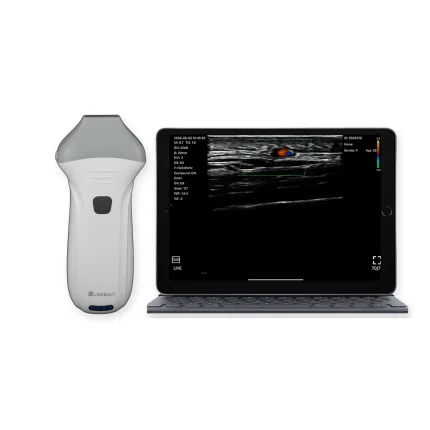
L20Pro
Hochfrequenz-Ultraschallkopf Suresult L20Pro für das Gesicht – 16/20 MHz, 256 Elemente, kabellos
Frequenz: 16/20 MHz
Bildgebungstiefe: 10/20/30/40 mm
Sportmedizin
buy scanner

L24Pro
L24Pro 18/24 MHz Ultraschallsonde mit 256 Elementen für ästhetische Medizin und Filler
Frequenz: 18/24 MHz
Bildgebungstiefe: 10/15/20/25mm
Sportmedizin
buy scanner

D3Ultra
D3Ultra Mehrzweck-Handheld-Ultraschall mit Konvex-, Linear- und Phased-Array-Funktion
Frequenz: Konvex- / Phased-Array-Sonde 3.2/5.0MHz Linearsonde 7.5/10MHz
Bildgebungstiefe: Linearsonde: 20–100 mm, Konvexsonde & Phased-Array-Sonde: 90–300 mm
Sportmedizin
buy scanner


Fachkundige Beratung
Sprechen Sie mit einem Spezialisten für Ultraschallgeräte
Beschreiben Sie Suresult Ihren täglichen Arbeitsablauf und erhalten Sie eine individuelle Geräteempfehlung mit einem Komplettangebot.
- Kostenlose Beratung zur Gerätewahl — Schallköpfe, Frequenz und Tiefe auf Ihre Verfahren abgestimmt
- Komplettangebot — Versand, Zollabfertigung und anfallende Steuern inklusive
- Schnelle Lieferung — Versand innerhalb von 24 Stunden, Lieferung bis an Ihre Tür in 1–7 Tagen
- Kein Software-Abonnement erforderlich — Apps für iOS, Android und Windows inklusive
- 30 Tage Rückgaberecht und Support rund um die Uhr
Der Live-Chat öffnet sich direkt hier — Sie können sofort losschreiben.
