

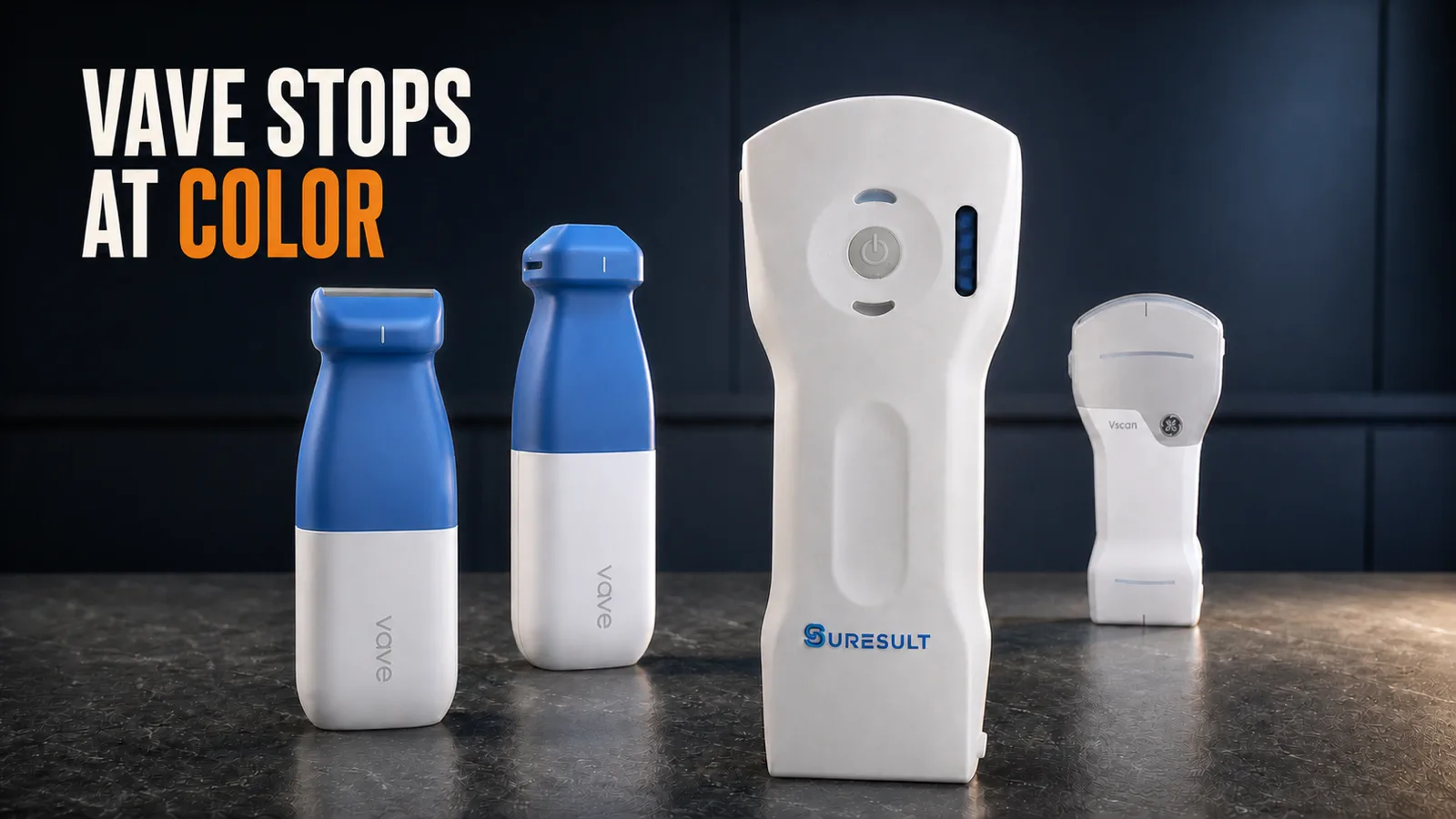
Vave’s 2026 buying case is straightforward: cable-free scanning between the probe and display, a swappable battery, and a core imaging app without a required recurring subscription. The harder question is whether Universal or Phased fits the exam list, and whether Color Doppler is enough.
 Fernando Mariz, MD
 Jailyn Avila, MD
Verified authors
Updated July 13, 2026
Quick Answer
Universal · $4,400Mixed superficial and deep exams from one cable-free probe.
Phased · $3,500Deep POCUS; the current store says not MSK or vascular access.
Ownership$129 optional battery · iOS + Android · no required recurring core-app fee.
Weak fitIf the workflow needs Power, PW, CW, or TDI, choose a spectral-Doppler platform from the alternatives instead. High-volume back-to-back scanning: plan around the documented thermal pattern.
Vave Universal costs $4,400 and Vave Phased costs $3,500 in the United States. Both are cable-free between the probe and display: the probe creates its own Wi-Fi network. Both have removable batteries, iOS and Android apps, B-mode, M-mode, Color Doppler, Deep Mode, local saving, and documented DICOM workflows. The core imaging app is included for the life of the probe without a required recurring subscription.
Universal is the better Vave purchase for a mixed exam list because its 2–8 MHz probe combines linear and sector-style imaging for superficial and deep presets. Phased is the narrower 1–5 MHz option for cardiac, abdominal, FAST, lung, and OB/GYN work. Its current store page explicitly says it is not meant for MSK or vascular access.
Vave is most compelling when cable-free movement, a swappable battery, and predictable core-app cost matter more than spectral Doppler. It is a poor fit when Power Doppler, pulsed-wave Doppler, continuous-wave Doppler, or tissue Doppler is required; none of those modes is documented in the current buyer materials or manual. It is also a weak fit for back-to-back high-volume scanning unless the buyer accepts the manual’s thermal-management pattern.
Fast route: compare Universal vs Phased, read the battery and heat limits, or jump to alternatives with documented Power or PW Doppler, or CW/TDI when the workflow requires them. For the broad market definition, use the separate wireless handheld ultrasound guide.
 Vave Universal2–8 MHz · superficial + deep · $4,400
 Vave Phased1–5 MHz · deep imaging · $3,500
Updated July 13, 2026 from Vave’s current U.S. storefront, User Manual Rev. K, release notes, legal terms, FDA K241051, and current manufacturer pages for each alternative.
The mode line · Color is not spectral
Choose the exam list first, then choose the Vave.
Both probes share the same ownership story, but they do not solve the same clinical problem. The $900 gap buys superficial coverage and a wider preset roster, not an extra Doppler tier.
 Universal · $4,4002–8 MHz
Sector 5–24 cm · linear 2–8 cm · cardiac, lung, abdomen, bladder, OB/GYN, vascular, MSK, soft tissue
Phased · $3,5001–5 MHz
Depth 5–24 cm · cardiac, abdomen, FAST, lung, OB/GYN · current store says not MSK or vascular access
Documented
B-mode
M-mode
Deep Mode
Color Doppler
Not documented
Power
PW
CW
TDI
FDA K241051 uses pulsed-Doppler-class product codes, but its listed operating modes and the current Vave manual enumerate B, M, B+M/B+C, and Color Doppler. A regulatory classification name is not a buyer-facing PW feature. Confirm any newly offered mode in the current app and written quote before purchase.
The verdict
Vave is easy to understand, but not universal in capability
Vave has a clear ownership proposition. The probe creates its own Wi-Fi network, the battery can be removed and replaced, the core app does not require an annual payment, and the store publishes actual prices instead of forcing every individual buyer into a sales call. Those details reduce four common sources of friction at once: cables, charging downtime, software renewals, and quote opacity.
The strongest model is Universal. It provides a credible one-probe route for clinicians who move between cardiac, lung, abdominal, bladder, vascular, MSK, and soft-tissue presets and who want to scan from a supported phone or tablet. At $4,400, it is no longer a budget probe. Its value depends on whether the wireless workflow and model breadth are more useful to the buyer than the advanced Doppler, enterprise software, or specialty transducer options available elsewhere.
Buy Phased at $3,500 only for a focused cardiac, abdominal, FAST, lung, or OB/GYN workflow. If vascular access or MSK may enter the exam list, spend the extra $900 on Universal now instead of buying a second device later.
Strongest reason to buyTrue wireless scanning plus a swappable battery and no required recurring core-app fee.
Strongest reason to passThe current feature set stops at Color Doppler; Power and spectral Doppler are not documented.
Best model for most Vave buyersUniversal, when both superficial and deep examinations are part of the real workflow.
Best Phased buyerA focused cardiac, lung, FAST, abdominal, or OB/GYN user who will not need MSK or vascular access.
Vave is easiest to justify when cable freedom and ownership simplicity matter more than spectral Doppler.
Price and ownership
The purchase price is clear; the full service package is not automatically all-inclusive
Vave’s live U.S. storefront lists Universal at $4,400 and Phased at $3,500. Each standard kit includes the selected probe, one rechargeable battery and charger, wrist strap, VaveCare support, and the advertised core app access. Adding a spare battery produces a visible starting checkout calculation of $4,529 for Universal or $3,629 for Phased, before tax.
Universal base$4,400
With one optional $129 spare battery: $4,529 before tax. Public price is for U.S. customers.
Phased base$3,500
With one optional $129 spare battery: $3,629 before tax. Same core-app ownership structure.
The required recurring software cost for core imaging is currently $0. Vave says app access lasts for the life of the probe and core imaging updates arrive without an extra subscription. That is a meaningful contrast with platforms that charge annually to maintain scanning tiers or advanced tools.
Core imaging costs $0 per year under Vave’s current policy. Education, QA, credentialing, organizational tools, PACS, and modality worklist can require account configuration, implementation work, or a separate organization plan. Put every required workflow in the written quote before ordering.
Use a five-year planning baseline of $0 for mandatory core-app software while the current policy remains in force. Add the $4,400 or $3,500 hardware price, tax, the display device, optional services, batteries beyond the included one, damage, and hardware replacement. Vave’s five-year designed service life is separate from warranty coverage and maintenance cost.
Plan around the live U.S. prices
Budget $4,400 for Universal or $3,500 for Phased, before tax. The crossed-out compare-at field is not a verified historical selling price.
For a broad brand-by-brand cost comparison, use Suresult’s handheld ultrasound price guide. For renewal math and procurement questions across brands, use the five-year ownership guide. This page keeps the price analysis specific to Vave.
Universal review
Buy Vave Universal for one-probe superficial and deep coverage
Universal’s 2–8 MHz range covers sector imaging from 5 to 24 cm and linear imaging from 2 to 8 cm. That combination supports a broad preset roster: cardiac, lung, abdominal, bladder, OB/GYN, vascular, MSK, and soft tissue. A generalist can move from a deep abdominal window to a superficial vessel or tendon without changing probes.
Universal is a single PZT transducer with linear and sector-style behavior. It removes a probe swap and broadens one-probe coverage. For dedicated high-frequency linear, curved, or cardiac performance, require representative scans from the exact preset, depth, and body habitus the clinic expects to encounter.
The current store lists B-mode, M-mode, Color Doppler, and Deep Mode. Deep Mode is available in cardiac and abdominal presets and changes imaging parameters for deeper anatomy. It is useful when the standard preset lacks penetration, but it is not a second transducer and it is not spectral Doppler. This distinction matters when a buyer wants flow velocity, waveform analysis, or a power-sensitive low-flow display.
Universal measures 166 × 54 × 38 mm; if grams matter for long procedural sessions, have Vave state the loaded weight in the written quote.
Buy Universal for a mixed superficial-and-deep exam list. Choose another platform for vascular or regional-anesthesia work when Power Doppler, PW Doppler, needle-specific processing, or a dedicated high-frequency footprint is required.
Phased review
Vave Phased saves $900 by removing superficial versatility
Phased operates from 1 to 5 MHz with adjustable depth from 5 to 24 cm. Its preset list is cardiac, abdominal, FAST, lung, and OB/GYN. The narrow footprint is designed for deep windows and intercostal access, which makes the model easy to understand for emergency, critical-care, and cardiac-first buyers.
Phased is not the Vave for vascular access or MSK. Buy it only for its current cardiac, abdominal, FAST, lung, and OB/GYN preset list; choose Universal when superficial work is part of the plan.
Phased supports the same documented mode family as Universal: B, M, Deep, and Color. It does not list PW, CW, Power, or TDI. A cardiac buyer may therefore prefer Phased’s physical footprint yet still reject the platform because spectral Doppler is central to the intended work. In that case, the $3,500 price is not the relevant comparison; the relevant comparison is a platform that actually includes the required mode.
Choose Phased when the exam list is genuinely limited to deep POCUS and when Color Doppler is sufficient. Choose Universal when the team will also scan superficial vessels, soft tissue, tendons, joints, or other linear applications. If the scope is uncertain, the extra $900 for Universal is usually easier to defend than a second probe purchase later.
The workday reality
Wireless freedom does not remove battery and heat limits
Vave is truly wireless. The probe creates an ad-hoc Wi-Fi network and sends the image to the app without a cable between probe and display. External Wi-Fi is not needed for image acquisition. This is different from a corded handheld that contains a battery but still sends every frame over USB-C or Lightning.
The removable 3.6 V, 7000 mAh battery is Vave’s most operationally useful feature. One battery can be replaced by another charged unit, and Vave says the same battery is interchangeable across its probes. A spare costs $129. That makes downtime a stocking decision rather than a fixed charging interruption.
The current manual quantifies more than one hour of continuous B-mode scanning and less than four hours for a full recharge. It also describes typical use as five minutes of continuous scanning followed by ten minutes in standby or powered off. Sessions beyond 15 minutes are possible, but they can build heat and trigger automatic thermal shutdown; the manual specifies shutdown at 45°C.
Plan one battery around more than one hour of continuous B-mode scanning, not an undefined all-shift runtime. For intermittent use, validate the actual procedure list—including scanning, standby, cleaning, documentation, and battery swaps—before deployment.
>1 hourManual specification for continuous B-mode scanning, not an established mixed-mode shift duration.
<4 hoursSpecified empty-to-full charging time for the removable battery.
45°CDocumented probe shutdown temperature used to protect the system.
The battery specification also states 80% of initial capacity at the 1,000th discharge. That is useful lifecycle information, but it does not predict an individual battery’s calendar life. High-volume buyers should ask how replacement batteries are stocked, whether multiple chargers are available, and what happens to workflow when a probe enters thermal protection even though a charged battery is ready.
Before buying, run the intended preset for the full expected session and check probe temperature, connection stability, battery changeover, and recovery time. A ten-minute demo does not reproduce a procedure list.
Software and data
The core app is simple; organization workflow still needs a quote
Vave’s imaging app runs on iOS and Android phones and tablets. The display device is not included with the probe, so compatibility is part of the purchase. Current minimum guidance is one operating-system version behind the latest public release, with A13 and 3 GB RAM on iOS or a quad-core processor and 3 GB RAM on Android. Vave recommends the latest OS and stronger processors with 6 GB or more.
The tested-device list is narrower than the universe of phones that meet those minimums. Buyers should check the exact model, operating system, and institutional mobile-device policy rather than assuming that every recent phone is supported. There is no documented Windows scanning client. A Windows browser or administrative portal is not the same as controlling the probe from Windows.
Scanning itself does not need external Wi-Fi. Vave requires periodic Internet access for authentication and software access. A remote program should validate the authentication cycle before deployment.
For data handling, the documentation supports local saving, camera-roll and email export, DICOM file export, PACS sending, modality worklist configuration, portfolios, optional Vave Cloud, and VaveCast view-only screen sharing. Cloud sync can be disabled. Turning it off also removes cloud-dependent discussion and sharing features, which is a normal tradeoff rather than a hidden failure.
PACS and worklist should not be treated as instant consumer-app features. They require the organization to supply valid server details, network access, and account configuration. The core imaging app may be subscription-free while enterprise setup, credentialing, education, or QA services carry separate implementation work or fees.
Vave lists TLS 1.2 for data in transit and AES-256 for data at rest. Those are useful controls, but they are not a substitute for the buyer’s security review. The procurement team still needs to decide whether local export, optional cloud, mobile-device management, authentication, user offboarding, and PACS routing fit institutional policy.
Current software release
Vave software version 4.6 is the current release as of July 13, 2026. Confirm the installed version during acceptance testing.
Terms and clearance
Put the three-year warranty and return terms in the written offer
Vave advertises a three-year, or 36-month, standard warranty for manufacturer defects. The original quotation or written offer controls the actual warranty period and applies to the original client. Put the 36-month term and battery and accessory coverage in writing before payment.
The written offer also controls the return window. If the advertised 30-day return matters, put permitted use, shipping cost, restocking status, and refund timing in that offer. Current legal terms distinguish sealed or unused products from opened devices that have never been clinically used.
The Vave Wireless Ultrasound System received FDA 510(k) clearance as a Class II device under K241051 on August 30, 2024. The proper term is FDA-cleared, not FDA-approved. The labeled users are qualified and trained healthcare professionals, with supervised medical students included. Public U.S. checkout is restricted to licensed practitioners or facilities permitted to perform diagnostic ultrasound; the device is not offered as a consumer product.
Use Vave only for applications in the current model labeling. For ophthalmic or endocavitary work, require current written labeling for the exact configuration before purchase; the manual specifies external use and excludes rectal, vaginal, and esophageal scanning.
Buyer fit
Who should buy Vave, and who should not buy it first
Buy Vave when
- Cable-free movement is a hard workflow requirement, not a marketing preference.
- A removable battery reduces downtime or supports mobile and remote use.
- Core scanning without an annual app fee matters to the budget.
- Universal’s superficial-plus-deep preset list matches the actual exam mix.
- iOS and Android support is enough; Windows probe control is not needed.
- Color Doppler answers the intended questions and spectral Doppler is not required.
Who should not buy Vave first
- Power, PW, CW, or tissue Doppler is required.
- Phased must also perform MSK or vascular-access work.
- Back-to-back scanning cannot tolerate documented heat management.
- The buyer needs a public non-U.S. checkout price or a standardized global configuration.
- Enterprise QA, credentialing, cloud, and PACS costs must be fully bundled at the advertised probe price.
- A specialty-specific high-frequency, curved, or cardiac probe is the safer fit.
The decision is not “wireless or not.” It is whether Vave’s specific wireless implementation solves a real problem without removing a required clinical mode. A clinic that uses only B, M, and Color may benefit more from the swappable battery than from a long list of unused software. A cardiology or vascular buyer who needs spectral measurements reaches the opposite conclusion immediately.
Alternatives
Five Vave alternatives, organized by the reason to switch
Switch from Vave for one of five concrete reasons: Power/PW Doppler, cordless dual-ended hardware, AI-guided workflow, a mature single-probe ecosystem, or CW/TDI cardiac capability. Compare the complete workflow and software cost, then buy the platform that covers the required mode.

Suresult D3Ultra Power + PW Doppler · 3 platforms
$3,200 base price · advertised 7% checkout saving calculates to $2,976 (July 13, 2026; verify before payment) · convex + linear + phased heads · iOS + Android + Windows · B/M/Color/Power/PW · 263 g · FDA-certified · no required core-app subscription
The D3Ultra answers Vave’s biggest gap directly: Power and PW Doppler, three physical scanning heads (convex, linear and phased), local DICOM, and iOS, Android and Windows support. Suresult advertises a sitewide 7% auto saving at checkout. Applied to the $3,200 base price, that calculates to $2,976 as of July 13, 2026 — $1,424 below Vave Universal before tax — with no required core-app subscription; verify the discount appears before payment. For a buyer who needs Power or PW Doppler, Windows support, three physical heads and no required core-app fee, this is the strongest move among the systems compared here.
Suresult manufactures D3Ultra. Its included warranty is one year; three-year coverage costs $375 at checkout.

GE Vscan Air CL or SL Dual-ended wireless
$4,999 current U.S. starting price · CL curved+linear · SL sector+linear · B/M/Color/PW · iOS + Android · 3-year warranty
Choose Vscan Air when a cordless dual-ended probe, PW Doppler, and GE’s established service environment outweigh Vave’s one-aperture simplicity. CL suits an abdomen-plus-superficial mix; SL suits cardiac-plus-superficial work.
GE states up to 50 minutes of continuous scanning with a new battery under an 80% grayscale and 20% Color Doppler test mix. Vave states more than one hour in continuous B-mode. Because the test conditions differ, those figures should not be used as a direct battery-life ranking. Optional digital and AI tools have their own economics. Read the Vscan Air price and model guide before treating the probe price as the full program cost.

Exo Iris AI-guided · Power + PW Doppler
$4,999 Essential bundle · plan-specific $1,200/year renewal after selected term; confirm order terms · one wired pMUT probe · B/M/Color/Power/PW · iOS
Choose Iris when guided acquisition, integrated documentation, 1 TB cloud, DICOM/PACS, and Power/PW Doppler matter more than cable freedom and recurring cost. Its one-probe architecture covers linear, curved, and phased-array use cases.
The tradeoffs are direct: Iris uses a physical Duo cable, supports Apple mobile devices rather than Android, and renews annually after the selected initial term. The full breakdown is in the Exo Iris review.

Butterfly iQ3 Mature one-probe ecosystem
$3,899 probe + membership · Core $299/year · Advanced $420/year or $1,500 for five-year access · 1–12 MHz · iOS + Android
Choose iQ3 when the buyer wants a mature single-probe workflow, education, cloud tools, and advanced automation. B, M, and Color sit in Core; Power/PW and iQ3’s advanced tools require Advanced.
Butterfly is corded to the display and its software economics must be included in the comparison. It can cost less than Universal at checkout but more over time depending on the selected plan. See the Butterfly iQ3 review.

EchoNous Kosmos Advanced cardiac platform
Quote-based · Kosmos Plus less than $20,000 in the current manufacturer FAQ · iOS/Android/Bridge · configuration-dependent PW/CW/TDI + AI · 5-year warranty
Choose Kosmos when CW, PW, TDI, cardiac measurements, and AI-assisted workflows justify a tablet-centered, multi-component platform. It is closer to a compact cart replacement than to Vave’s minimalist probe purchase.
The tradeoff is price and configuration complexity. Probe and platform capabilities vary, so the quote must identify the transducer, tablet or Bridge, AI, Doppler modes, integrations, service, and warranty. It is not a like-for-like $3,500 alternative.
Frequently asked
Vave ultrasound questions, answered
Is Vave ultrasound worth it in 2026?
Buy Vave when a U.S. clinician needs cable-free scanning, a swappable battery, iOS/Android support, and no required recurring core-app fee. Choose another platform when Power or spectral Doppler, back-to-back high-volume scanning, or a fully bundled enterprise workflow is required.
How much does Vave Universal cost?
Vave Universal costs $4,400 for U.S. customers as of July 13, 2026. One battery and charger are included; an optional spare battery costs $129. The public price excludes tax, the phone or tablet, optional services, and any organization-specific implementation in the written quote.
How much does Vave Phased cost?
Vave Phased costs $3,500 for U.S. customers as of July 13, 2026. Adding one optional $129 spare battery produces a $3,629 starting hardware calculation before tax. Confirm the final price, warranty, return terms, and account services in the written offer.
What is the difference between Vave Universal and Vave Phased?
Universal operates at 2–8 MHz and combines linear and sector-style imaging for superficial and deep presets. Phased operates at 1–5 MHz for cardiac, abdominal, FAST, lung, and OB/GYN work. The current Phased store page says it is not meant for MSK or vascular access.
Does Vave ultrasound require a subscription?
Vave includes the core imaging app for the life of the probe without a required recurring subscription. Education, QA, credentialing, cloud-dependent collaboration, PACS, and organization configuration can require account setup, implementation work, or a separate plan.
Does Vave support Power Doppler or pulsed-wave Doppler?
As of July 13, 2026, current Universal and Phased buyer materials document B-mode, M-mode, Deep Mode, and Color Doppler only; they do not document Power, PW, CW, or tissue Doppler. Choose another platform when any of those modes is required.
Does Vave work with iPhone and Android?
Yes. Vave supports iOS and Android phones and tablets that meet its current requirements, but the display device is purchased separately. Check the exact phone or tablet, operating system, processor, RAM, and institutional mobile-device policy against Vave’s current compatibility guidance before ordering.
How long does the Vave battery last, and can it be swapped?
Yes. The removable 7000 mAh battery is interchangeable between Vave probes. Plan for more than one hour of continuous B-mode scanning and less than four hours to recharge; longer sessions can trigger thermal protection.
Is Vave ultrasound FDA approved?
Vave is FDA-cleared, not FDA-approved. The Vave Wireless Ultrasound System received Class II 510(k) clearance under K241051 on August 30, 2024; use the current configuration only for its labeled users and applications.
What warranty and return policy does Vave provide?
Vave advertises a three-year standard warranty and a 30-day return. The written offer controls both periods and return eligibility; put coverage, permitted use, shipping cost, restocking status, and refund timing in that offer before payment.
Methodology, evidence boundaries, and date control
We verified Vave prices, modes, dimensions, battery, and workflow against the current store and manual; FDA status against K241051; and warranty and return terms against current legal terms. All current prices were rechecked July 13, 2026.
The purchase decision turns on required modes, platform support, ownership cost, warranty, and implementation terms.
Sources & verification dates
- Vave Universal official U.S. store, price, kit, presets, modes, dimensions, battery, return headline, and warranty headline. Accessed Jul 13, 2026.
- Vave Phased official U.S. store, price, presets, model limitation, modes, dimensions, battery, return headline, and warranty headline. Accessed Jul 13, 2026.
- Vave FAQ, buyer eligibility, core app access, compatibility, cloud choice, DICOM, VaveCast, and account features. Accessed Jul 13, 2026.
- Vave Universal & Phased User Manual Rev. K, operating limits, battery, thermal protection, modes, platform requirements, DICOM/PACS/MWL, security, device models, indications, and service life. Accessed Jul 13, 2026.
- Vave release notes, current app release 4.6. Accessed Jul 13, 2026.
- Vave terms and conditions, quotation-controlled warranty and return language. Accessed Jul 13, 2026.
- FDA K241051 database record and decision package, Class II 510(k), decision date, labeled users, applications, and operating modes. Accessed Jul 13, 2026.
- Comparison of six handheld ultrasound devices, independent comparative context, not a current price source. Accessed Jul 13, 2026.
- Peachtree POCUS Vave review, independent May 2025 workflow video; historical price superseded by current store. Accessed Jul 13, 2026.
- Suresult D3Ultra, current price, transducers, modes, platforms, weight, software terms, and warranty; FDA-status wording follows the owner’s documented certification audit dated Jul 11, 2026. Reviewed Jul 13, 2026.
- GE Vscan Air CL and GE Vscan Air SL, current price, probe configuration, modes, platforms, battery test conditions, and warranty. Accessed Jul 13, 2026.
- Exo Iris pricing and specifications, current Essential entry price, modes, platform, included services, and plan-specific renewal basis; confirm order terms. Accessed Jul 13, 2026.
- Butterfly pricing, current iQ3 hardware price, Core/Advanced software costs, modes, and platforms. Accessed Jul 13, 2026.
- EchoNous Kosmos FAQ, quote basis, Kosmos Plus price boundary, platform-dependent Doppler modes, and warranty. Accessed Jul 13, 2026.
Still deciding between Universal, Phased, and a platform with the Doppler modes your workflow requires?
Share the exam mix, required Doppler modes, phone or tablet platform, user count, PACS needs, and longest expected scan session. Suresult’s product team will give you a direct recommendation in one conversation — Vave, D3Ultra, or neither — based on the exams you actually run.

