
Jede Ultraschallaufnahme auf dieser Seite wurde mit dieser Suresult-Gerätefamilie erstellt – von Ärzten, die sie gekauft haben, und von einem klinischen Trainer, der damit untersucht. Jeder Clip ist auf die eigentliche Ultraschallaufnahme zugeschnitten. ·8.717 Ärzte vertrauen darauf →
Kurze Antwort
Ein tragbares MSK-Ultraschallgerät ist ein hochfrequentes Ultraschallgerät mit Linearsonde, das Sehnen, Bänder, Nerven und Gelenkflächen direkt am Patientenbett darstellt. Diagnose und ultraschallgeführte Injektion erfolgen dann in einem einzigen Termin — beides beim selben Besuch.
- Zwei Frequenzbereiche decken die muskuloskelettale Sonografie ab: die L14Pro arbeitet mit 10/14 MHz bis 80 mm, das L20Pro arbeitet mit 16/20 MHz bis 40 mm.
- Punktionshilfen sind bei allen Suresult Linearmodellen enthalten, und Nadelverstärkung ist bei L14Pro, L20Pro, L10SH, L10H, L20 und D3Ultra enthalten.
- Die App zeigt ein Livebild neben einem Standbild, sodass die schmerzhafte Seite im Vergleich zur gesunden Seite beurteilt wird.
- Farbdoppler und PW-Doppler sind bei L14, L14Pro, L20, L20Pro, L10H, L10SH und D3Ultra enthalten, sodass das Gefäß neben der Zielstruktur zuerst lokalisiert wird.
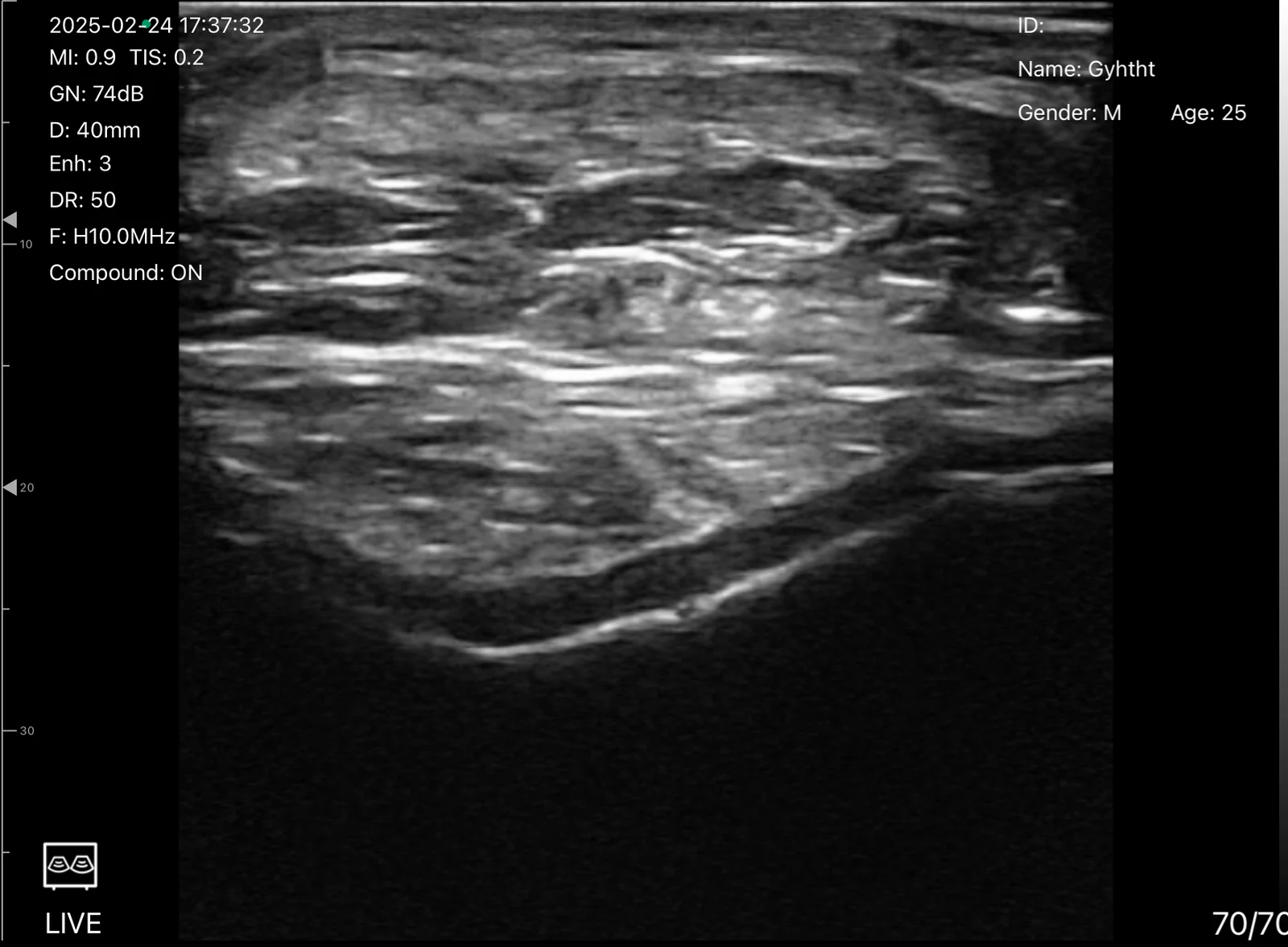
Der Bildatlas
Neun reale MSK-Schallfenster, mit Suresult-Handheld-Geräten aufgenommen
Unbearbeitete klinische Aufnahmen · wählen Sie ein Bild zum Vergrößern
Fuß und Sprunggelenk3 windows
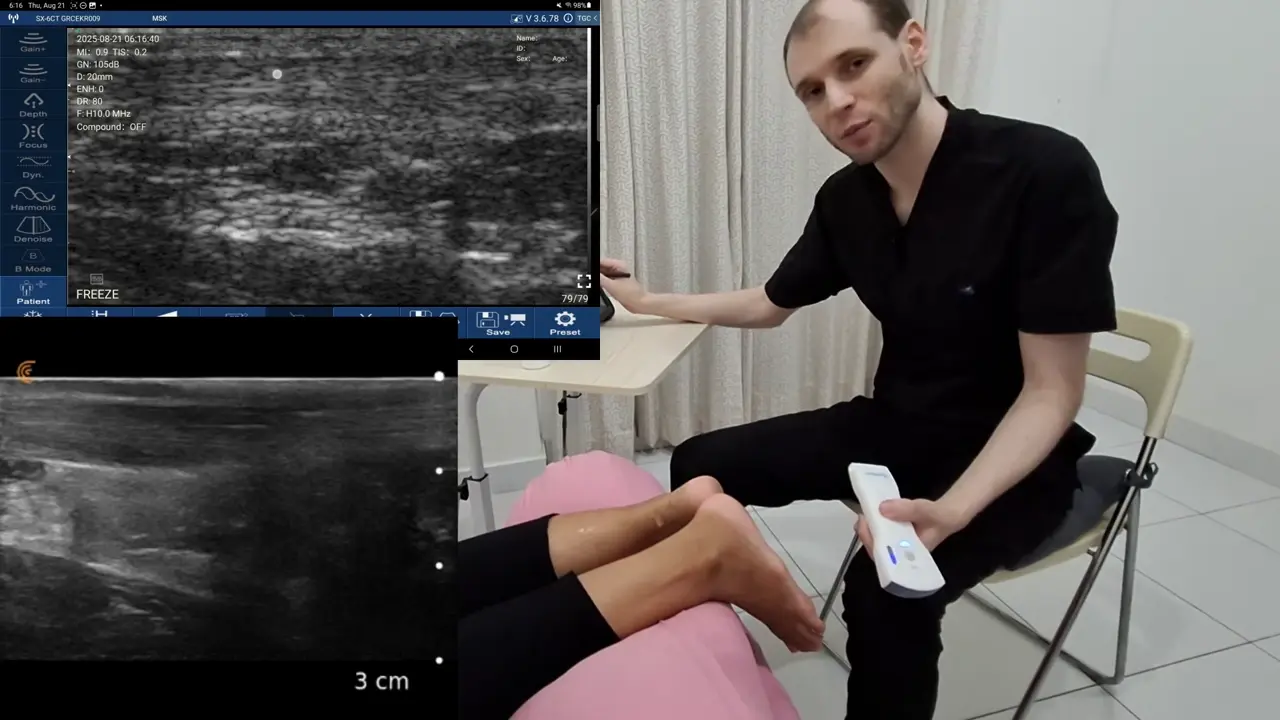
Achillessehne im Längsschnitt
Das fibrilläre Muster der Achillessehne erstreckt sich über die gesamte Bildlänge, mit dem Ansatz am Kalkaneus an einem Ende. In dieser Ansicht lassen sich Sehnendicke und Faserunterbrechungen beurteilen.
aufgenommen vom ärztlichen Reviewer Brandon Ramakko mit einem Suresult Handheld-Ultraschallgerät, MSK-Voreinstellung mit der Kopfzeilenanzeige GN: 105dB, D: 20mm, DR: 80, F: H10.0 MHz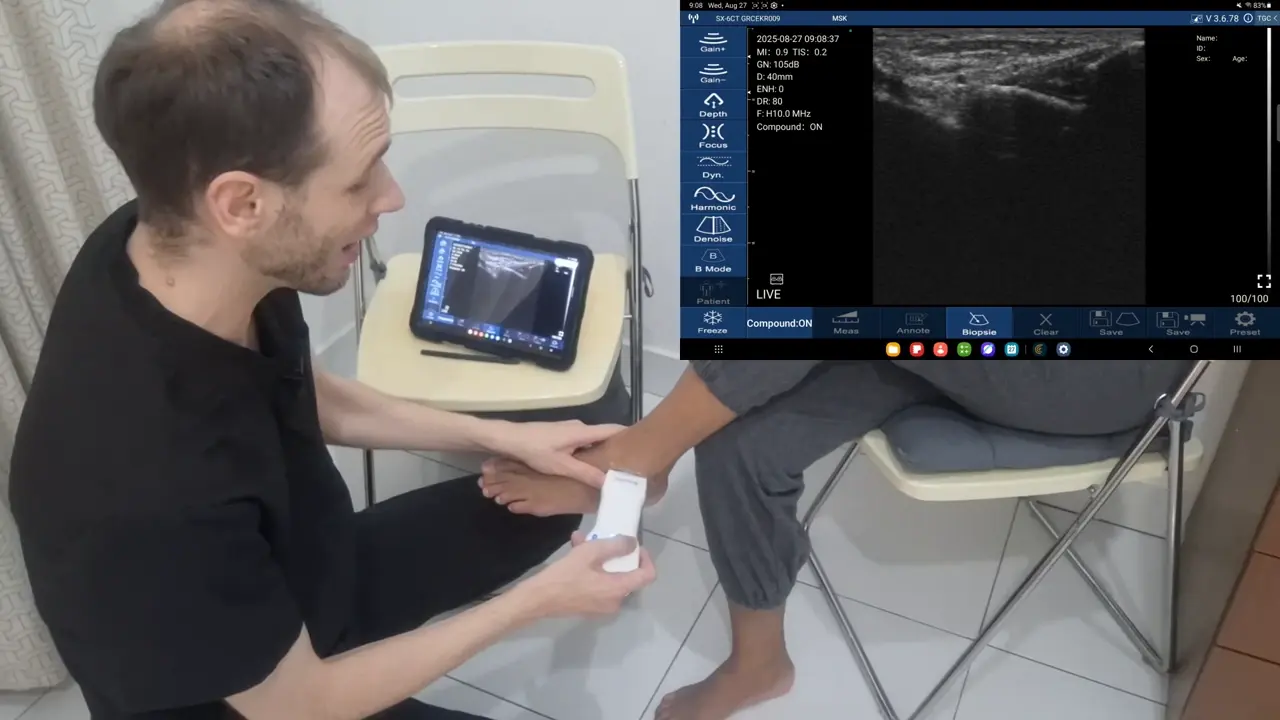
ATFL nach lateraler Sprunggelenksdistorsion
Das Ligamentum talofibulare anterius wird zwischen Fibula und Talus dargestellt – das Band, das bei einem Inversionstrauma verletzt wird. Bei einer ATFL-Ruptur geht der straffe fibrilläre Verlauf verloren.
aufgenommen vom ärztlichen Reviewer Brandon Ramakko mit einem Suresult Handheld-Ultraschallgerät, veröffentlicht als POCUS-Lehraufnahme des ATFL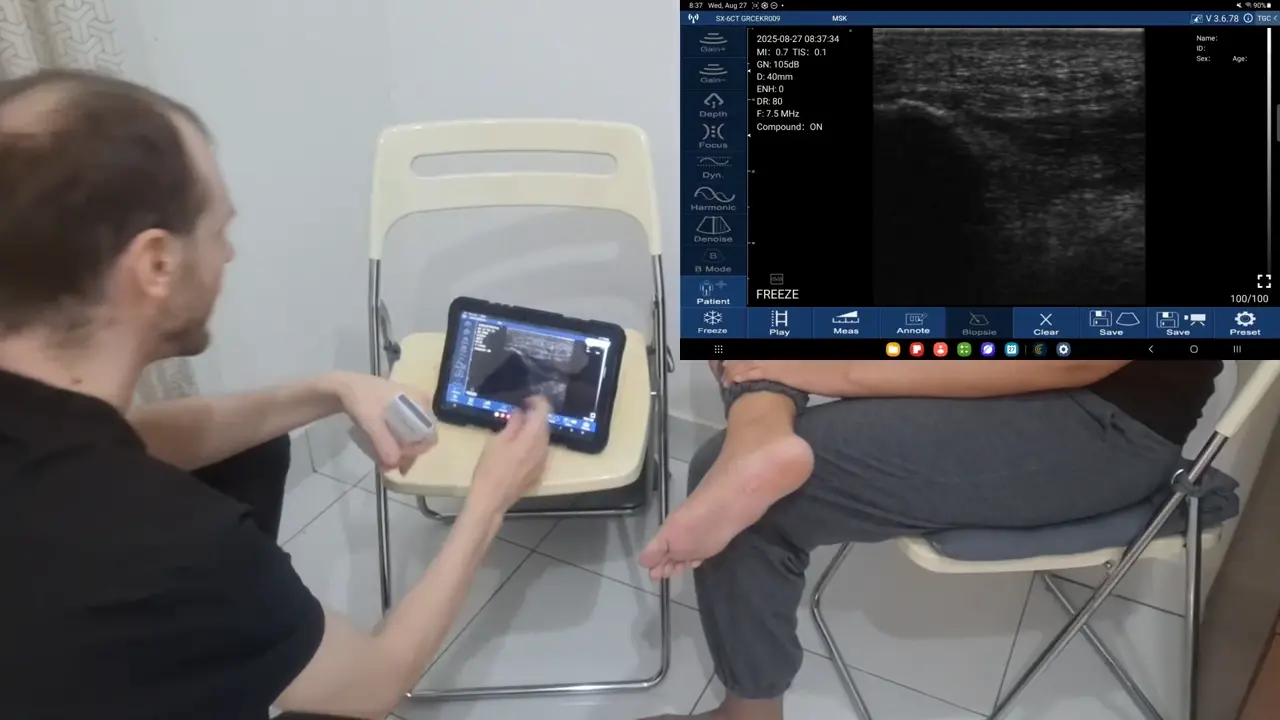
Plantarfaszie an ihrem Ursprung am Fersenbein
Die Plantarfaszie wird an ihrem Ursprung am Kalkaneus gemessen, wo sie sich bei einer Plantarfasziose verdickt. Mit einem Messmarker in der App lässt sich ihre Dicke bestimmen.
aufgenommen vom ärztlichen Reviewer Brandon Ramakko mit einem Suresult Handheld-Ultraschallgerät, veröffentlicht als Untersuchung bei Plantarfasziitis und PlantarfaszioseEllenbogen2 windows
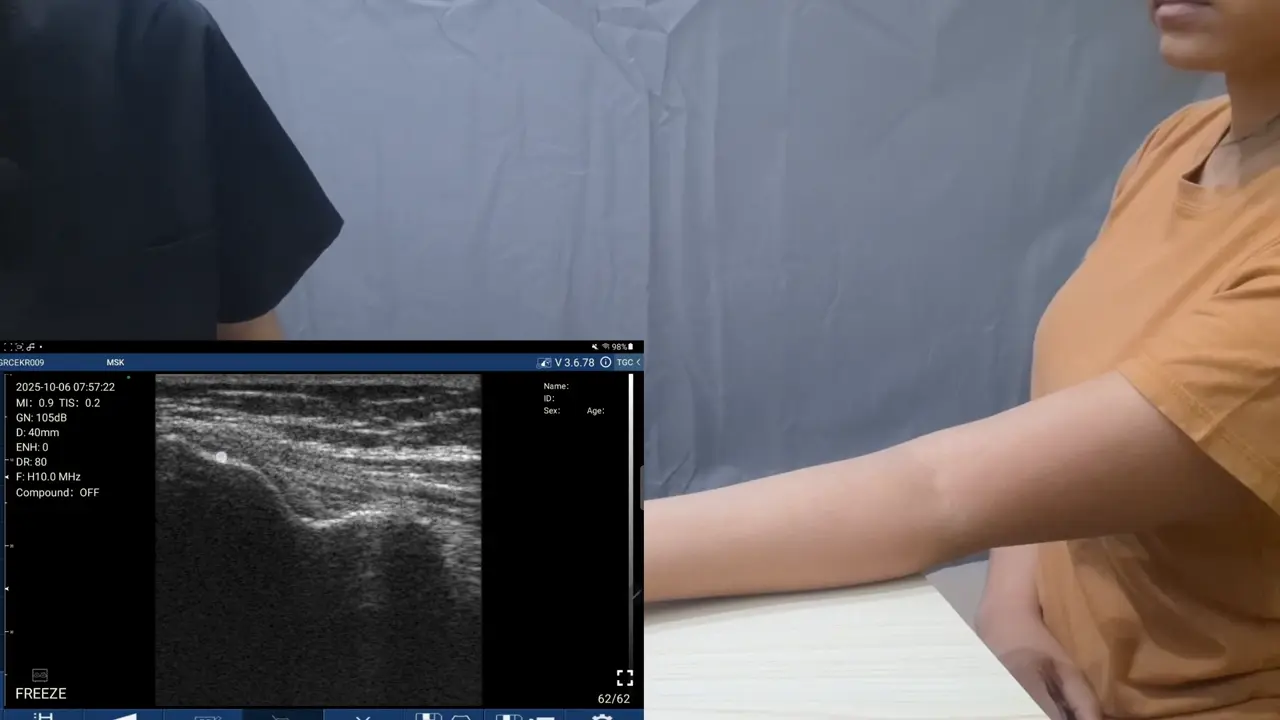
Medialer Ellenbogen beim Golferellenbogen
Der gemeinsame Beugersehnenursprung am medialen Epikondylus ist die Zielstruktur bei medialer Epikondylitis. Die Ultraschalluntersuchung unterscheidet eine Sehnenverdickung von einer Teilruptur am Knochenübergang.
aufgenommen vom ärztlichen Reviewer Brandon Ramakko mit einem Suresult Handheld-Ultraschallgerät, Kopfzeilenanzeige: 40 mm Tiefe, 10.0 MHz, Verstärkung 105 dB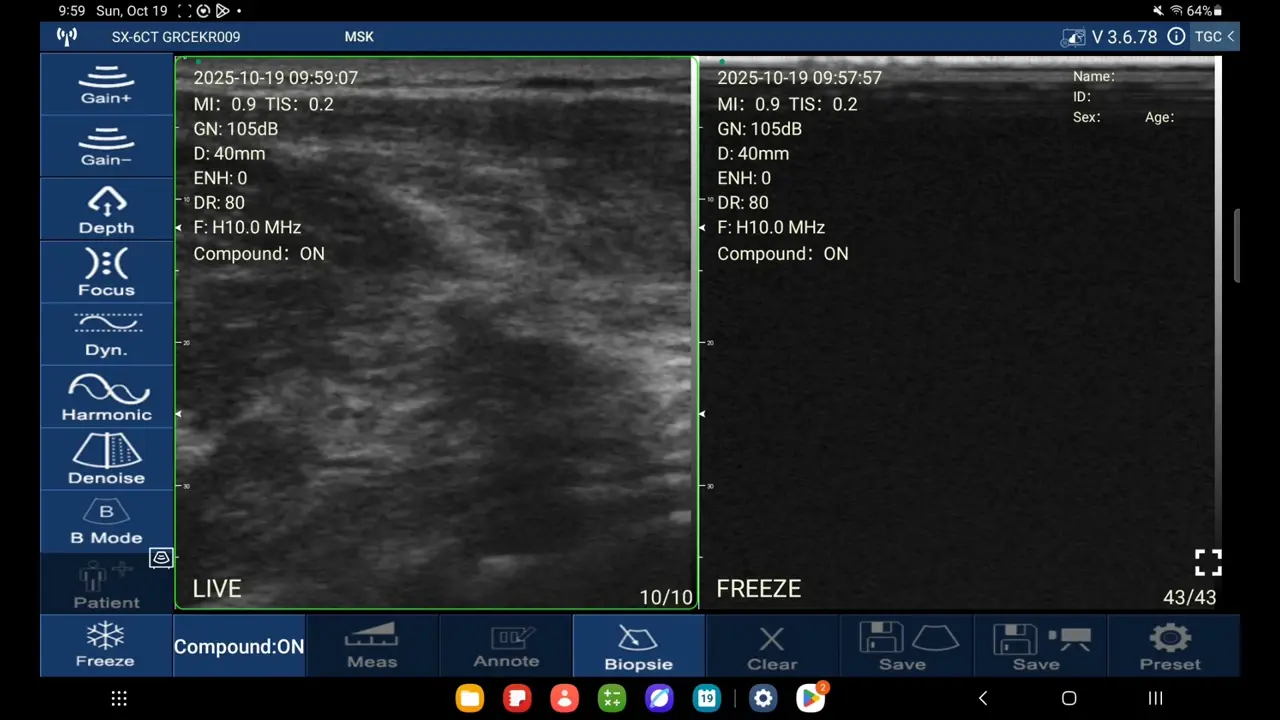
UCL des Ellenbogens – Live-Aufnahme neben einem Standbild
Das ulnare Kollateralband ist das für Wurfsportler entscheidende Band. Die App zeigt das Livebild zum direkten Vergleich neben einem Standbild. Während der Untersuchung lässt sich dynamischer Valgusstress ausüben.
aufgenommen vom ärztlichen Reviewer Brandon Ramakko mit einem Suresult Handheld-Ultraschallgerät, MSK-Voreinstellung, 40 mm Tiefe, 10.0 MHz, Dynamikbereich 80Handgelenk und Hand2 windows
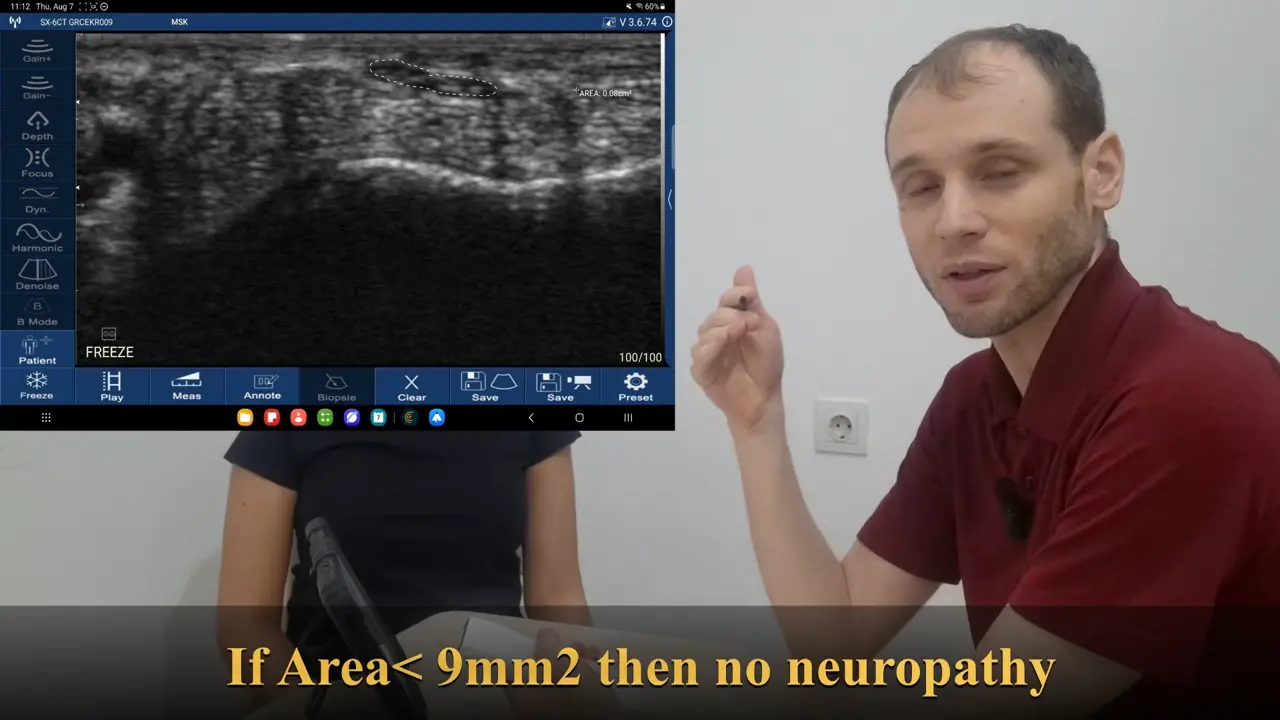
Medianusnerv im Karpaltunnel
Der Nervus medianus liegt als ovale, wabenartig strukturierte Formation oberhalb der Beugesehnen zwischen Kahnbein und Erbsenbein. Entscheidend ist die Messung seiner Querschnittsfläche am Karpaltunneleingang.
aufgenommen vom ärztlichen Reviewer Brandon Ramakko mit einem Suresult Handheld-Ultraschallgerät, veröffentlicht als Untersuchung zum Karpaltunnelsyndrom mit eingeblendeter anatomischer Legende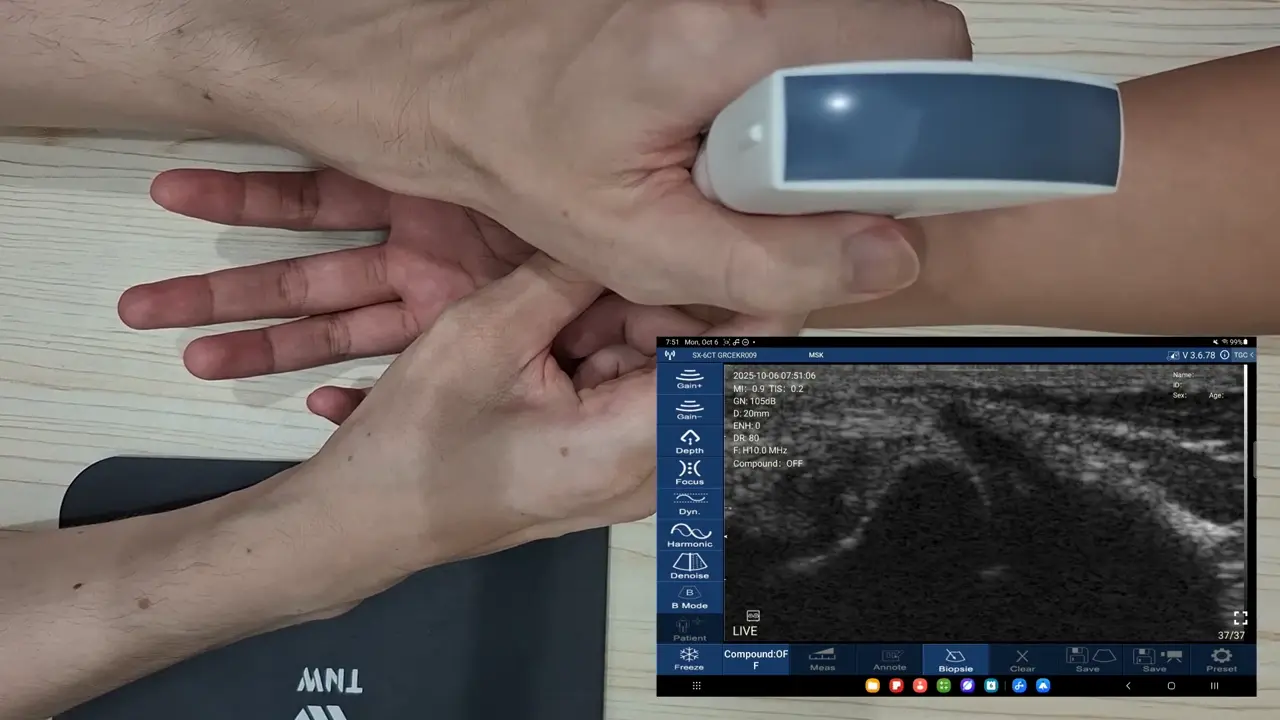
Kahnbein an der radialen Seite des Handgelenks
Nach einem Sturz auf die ausgestreckte Hand wird die Kortikalis des Kahnbeins auf eine Stufe, einen Spalt oder ein darüberliegendes Hämatom untersucht. Ultraschall kommt hier zum Einsatz, wenn die erste Röntgenaufnahme unauffällig ist.
aufgenommen vom ärztlichen Reviewer Brandon Ramakko mit einem Suresult Handheld-Ultraschallgerät, veröffentlicht als Ultraschallaufnahme einer KahnbeinfrakturKnie und Injektionsplanung2 windows
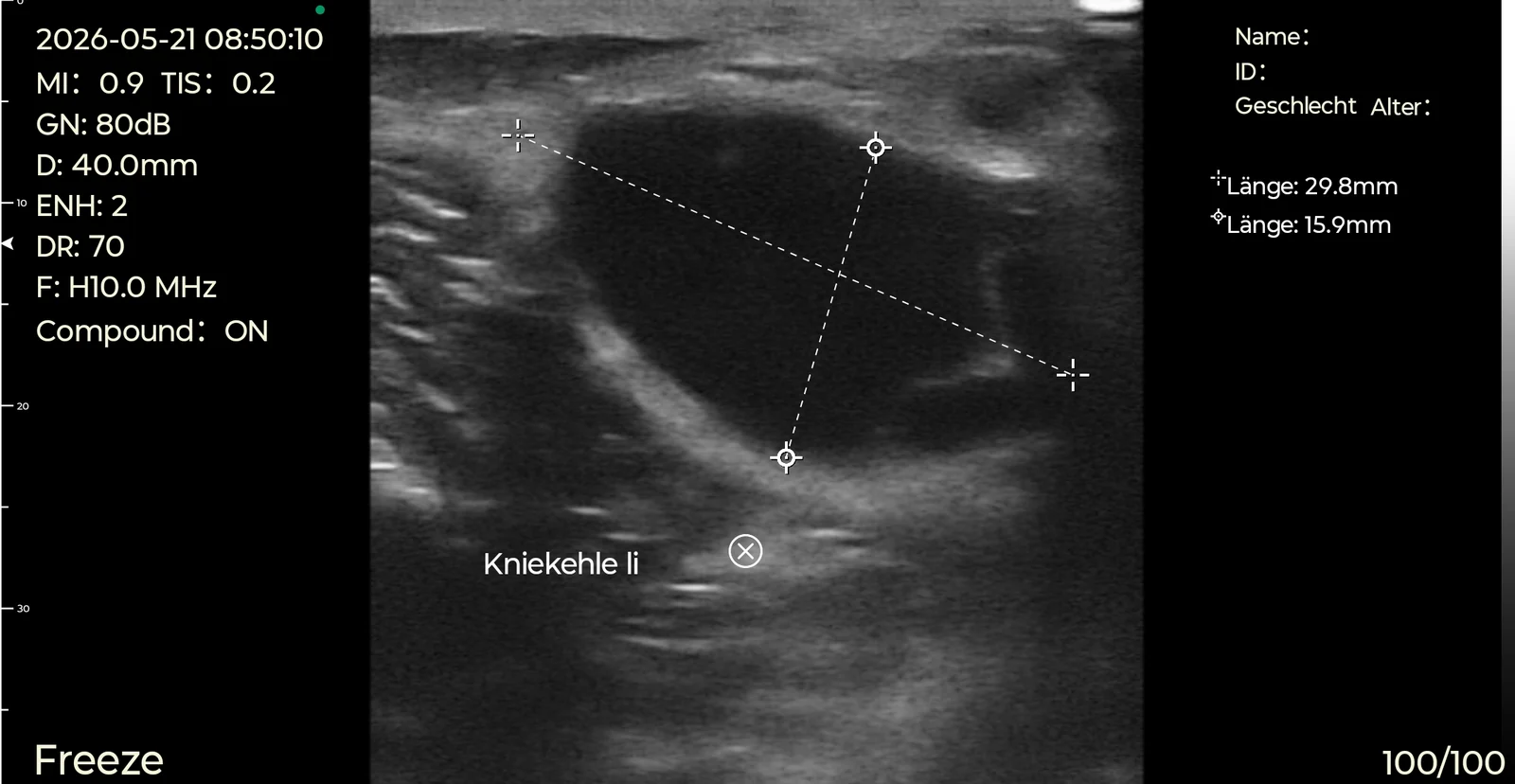
Zystische Struktur im Kniekehlenbereich, gemessen mit einem D3Ultra
Ein deutscher Käufer beschriftete dieses Bild mit „Kniekehle li“, also linke Kniekehle, und maß die echofreie Struktur mit 29,8 mm mal 15,9 mm. Die Kopfzeile zeigt 10.0 MHz bei 40 mm Tiefe.
Aufnahme eines Käufers mit einer D3Ultra, Verstärkung 80 dB, Dynamikbereich 70, Compound Imaging eingeschaltet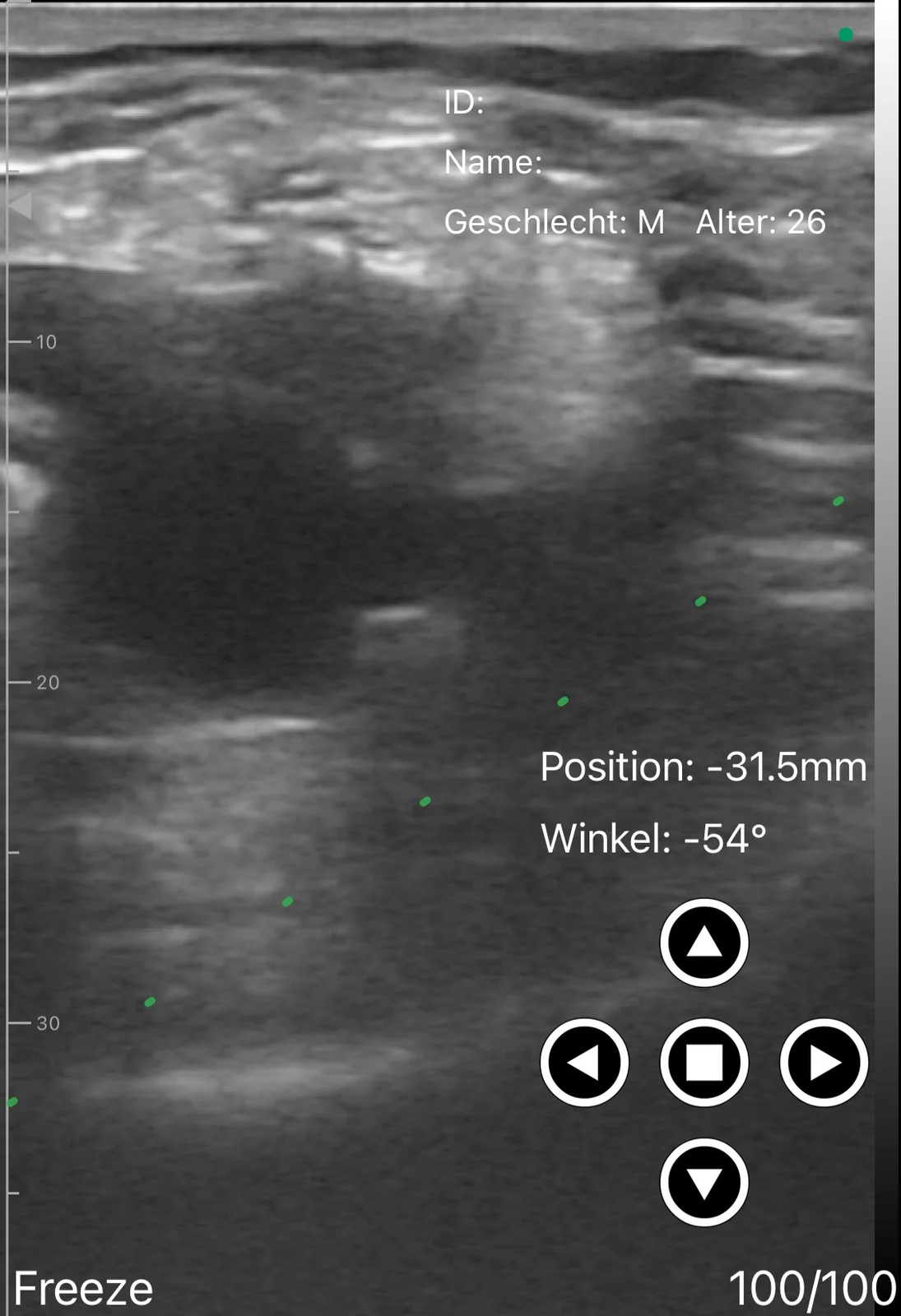
Punktionshilfe im hinteren Kniebereich
Die gepunktete Führungslinie verläuft durch die Gewebeschichten; daneben werden Position -31,5 mm und Winkel -54 Grad angezeigt. Der Käufer nutzte diese Ansicht für eine IPACK-Blockade hinter dem Knie.
Aufnahme eines Käufers mit einer D3Ultra, eingeblendete Nadelführung mit Positions- und WinkelanzeigeWählen Sie eine Karte, um die Aufnahme zu wechseln
Grundlagen der Untersuchungstechnik
So läuft die Untersuchung ab, von der Sonde bis zum Befundbericht
- Beginnen Sie mit einem hochfrequenten Linearschallkopf.
Die meisten MSK-Zielstrukturen liegen höchstens 40 mm unter der Haut. Eine Linearsonde mit 10 MHz oder höher löst Sehnenfasern und Nervenfaszikel auf, die ein konvexer Schallkopf unscharf darstellt.
Linear, 10/14 MHz oder 16/20 MHz - Wählen Sie die MSK-Voreinstellung und eine Tiefe von 40 mm.
Das MSK-Preset startet mit aktiviertem Compound Imaging. Reduzieren Sie die Tiefe auf etwa 20 mm, sobald die Sehne oder der Nerv das Nahfeld ausfüllt, und erhöhen Sie die Verstärkung für eine tief liegende Zielstruktur an der Hüfte.
D: 40 mm, F: H10.0 MHz in der Kopfzeile der App 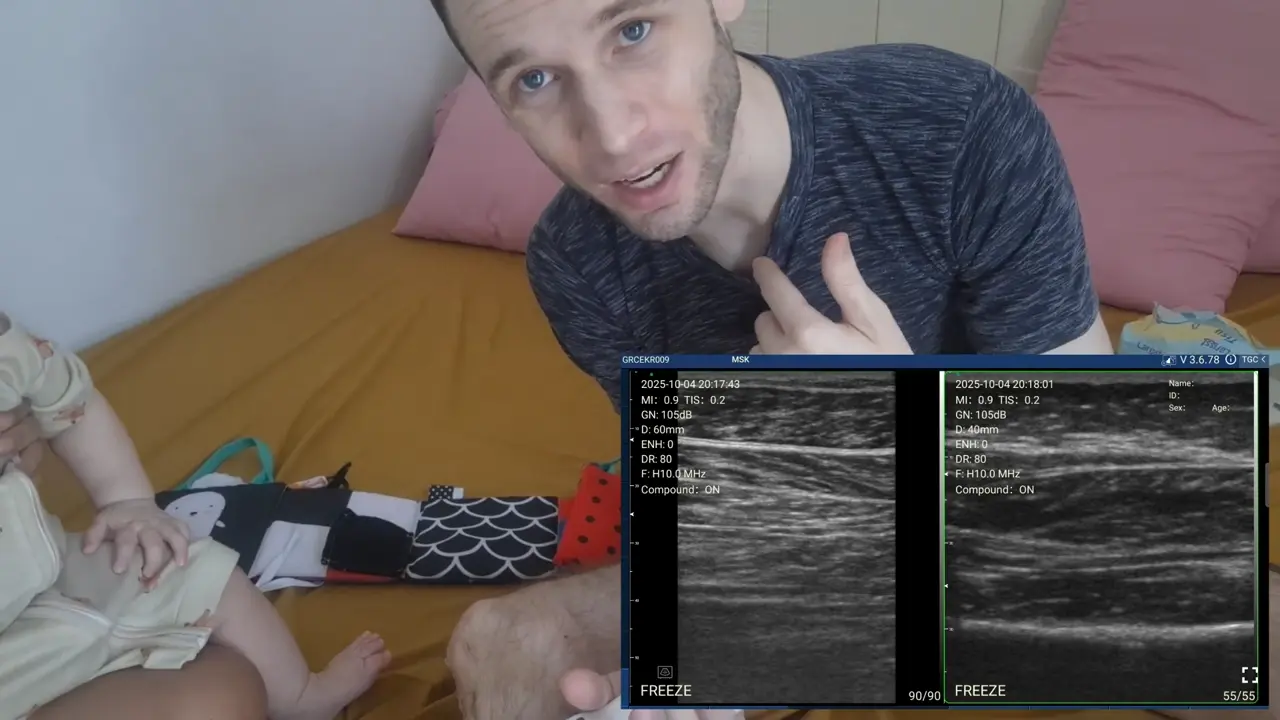 Untersuchen Sie die gesunde Seite und frieren Sie das Bild zum Vergleich ein.
Die App zeigt ein Livebild neben einem eingefrorenen Bild. Die Asymmetrie unterscheidet eine verdickte Sehne von einer dicken Sehne, und das Vergleichsbild bleibt während der Untersuchung sichtbar.
Livebild und Standbild nebeneinander- Planen Sie den Nadelweg vor dem Vorschieben.
Die Punktionshilfe zeigt den Nadelweg mit Position und Winkel auf dem Bildschirm an. Der Farbdoppler macht das zu umgehende Gefäß sichtbar, und die optimierte Nadelvisualisierung hebt den Nadelschaft in der Bildebene hervor.
Position und Winkel auf der Führungslinie angezeigt
Was die Forschung zeigt
Die Evidenz, drei Studien geprüft
- Ultraschall zeigte eine hohe diagnostische Genauigkeit bei transmuralen Rotatorenmanschettenrupturen.
Eine Metaanalyse von 2015 berichtete für Ultraschall, MRT und MR-Arthrographie bei transmuralen Rotatorenmanschettenrupturen eine Sensitivität und Spezifität von jeweils über 0,90.
Roy et al., Br J Sports Med 2015 - Unter Ultraschallkontrolle wurden mehr Gelenkinjektionen korrekt platziert.
Bei 184 Patienten mit entzündlicher Arthritis platzierte ein Arzt in Weiterbildung unter Ultraschallkontrolle 83 % der Gelenkinjektionen korrekt, gegenüber 66 % bei erfahrenen Rheumatologen, die sich an der klinischen Untersuchung orientierten.
Cunnington et al., Arthritis Rheum 2010 - Ein Handheld-Ultraschallgerät im Taschenformat erkannte pathologische Schulterbefunde.
Bei 10 Patienten, die zur Schultersonografie überwiesen wurden, stimmten die Befunde zweier unabhängiger Beurteiler anhand von Bildern eines Handheld-Ultraschallgeräts im Taschenformat in 7 bzw. 8 Fällen mit der Diagnose der Standardsonografie überein.
Lau et al., Clin J Sport Med 2020
Wählen Sie Ihr Modell
Wählen Sie das Modell, das zu Ihrem Alltag passt
AM HÄUFIGSTEN GEWÄHLT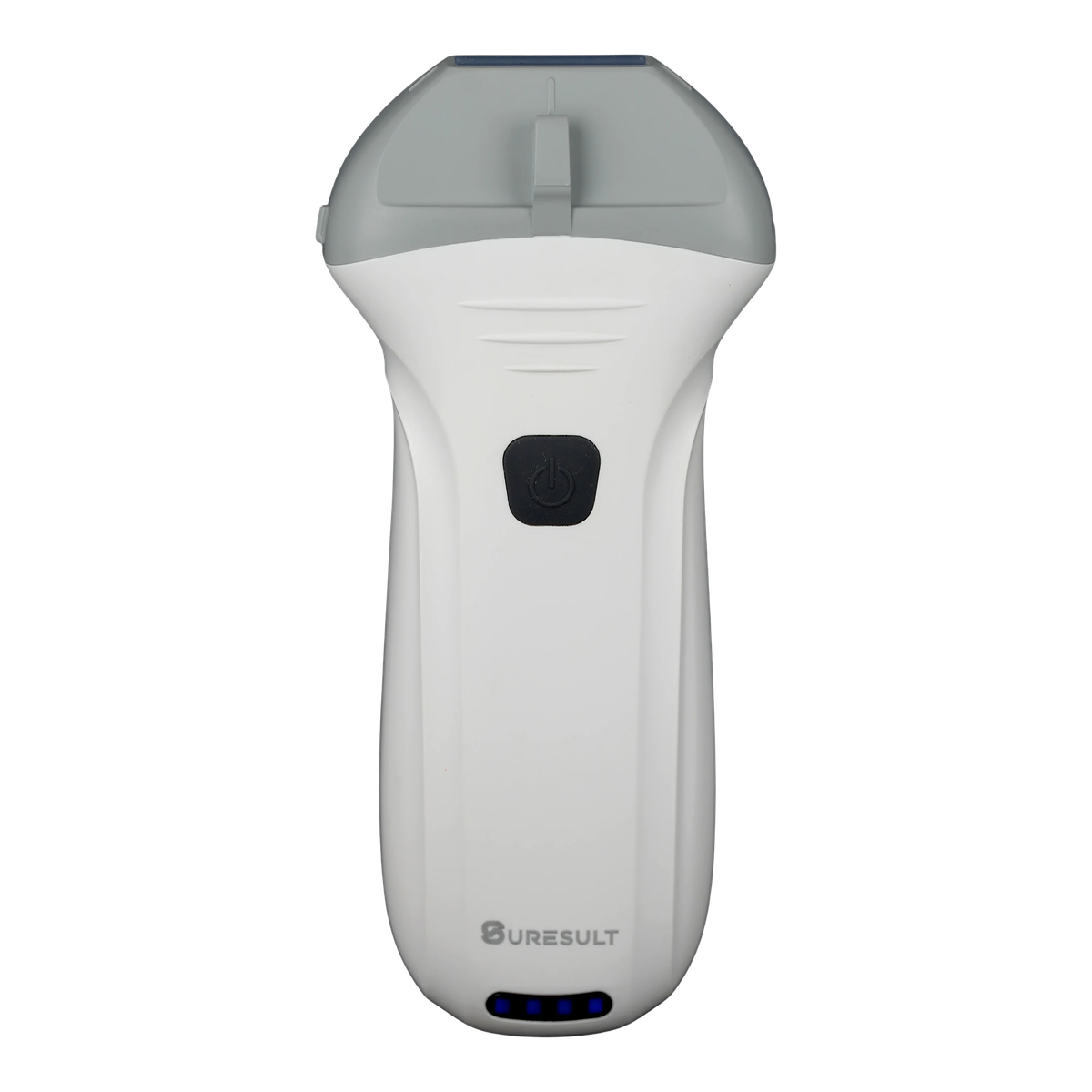 Sportmedizin und OrthopädieL14Pro
Sportmedizin und OrthopädieL14ProDas L14Pro arbeitet mit 10/14 MHz und Tiefenstufen bis 80 mm, sodass sich Achillessehne und Rotatorenmanschette mit demselben Schallkopf untersuchen lassen. Es verfügt über 256 Elemente, 64 Kanäle und eine Akkulaufzeit von 4 Stunden im Scanbetrieb.
80 mm bei 14, eine Sonde
$3,441 L14Pro · Linearsonde mit 10/14 MHz und 256 Elementen für MSKJetzt kaufenL14Pro ansehen →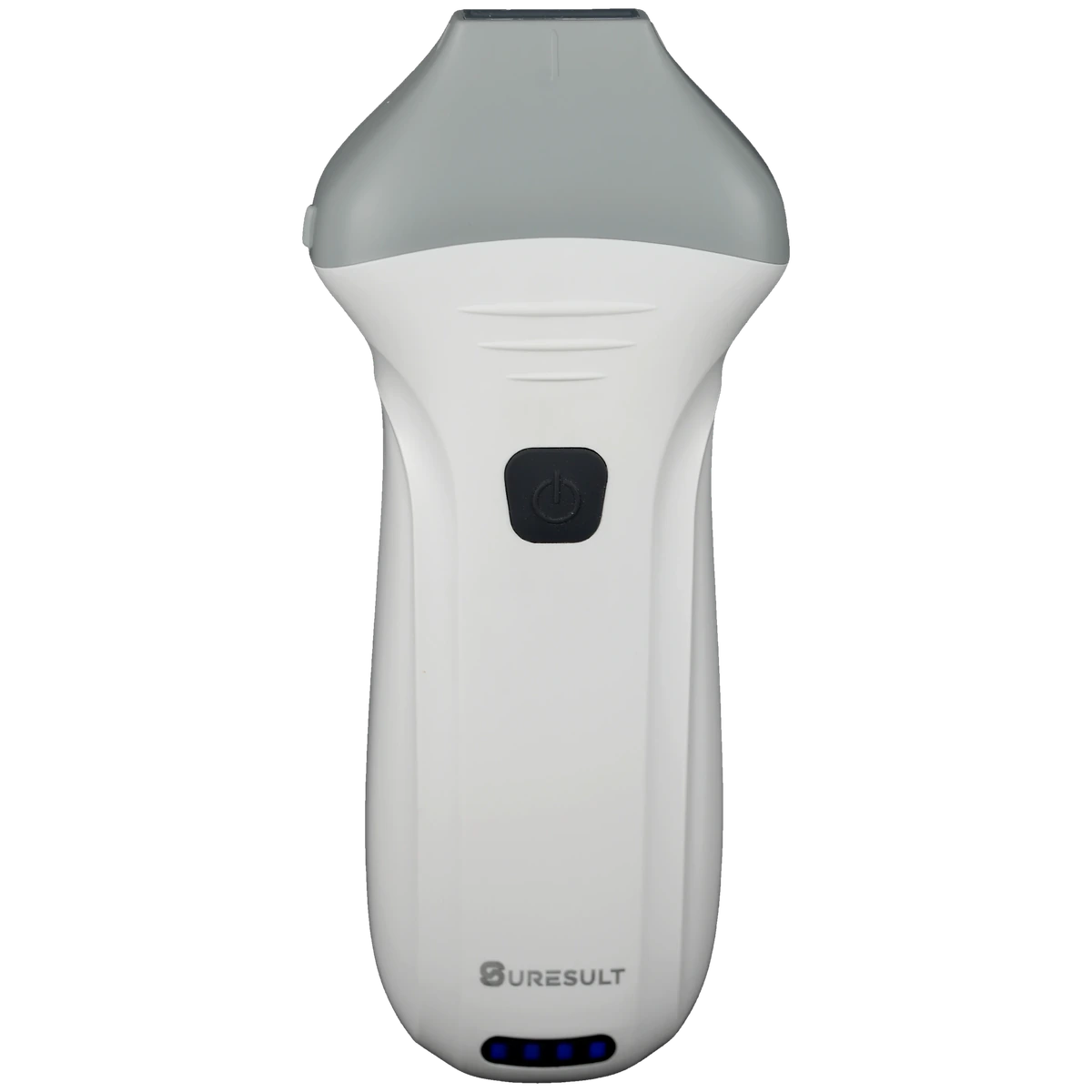 Details oberflächlicher Sehnen und NervenL20Pro
Das L20Pro arbeitet mit 16/20 MHz und Tiefenstufen von 10 mm bis 40 mm – dem Bereich für Kapseln kleiner Gelenke, Fingersehnen und oberflächliche Nerven. Die optimierte Nadelvisualisierung ist enthalten.
16/20 MHz bis 40, höchste Frequenz
$3,720 L20Pro · 16/20 MHz Hochfrequenz-Linearultraschall für ästhetische Medizin, Haut & oberflächliche muskuloskelettale StrukturenJetzt kaufenL20Pro ansehen →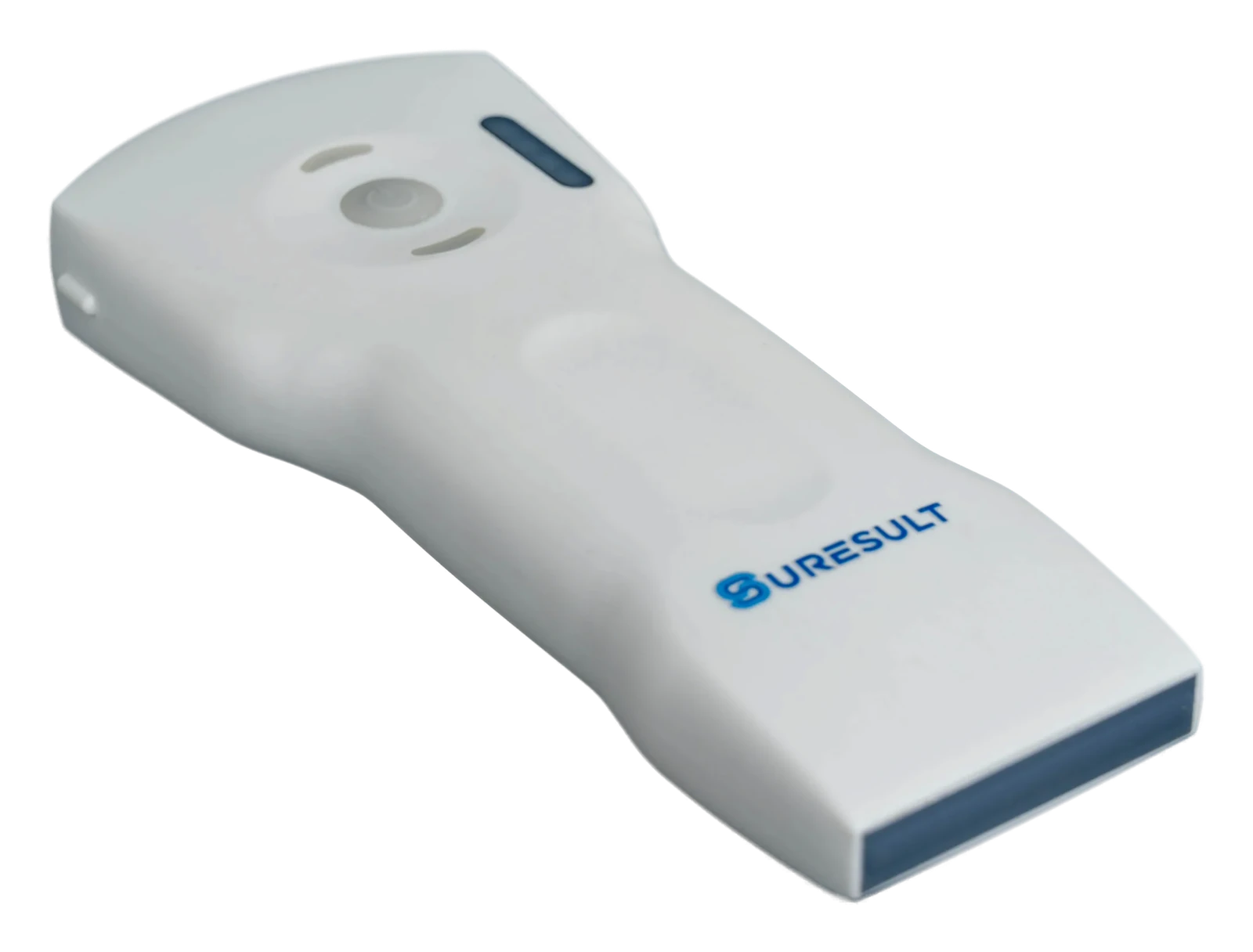 MSK als eine von mehreren UntersuchungenD3Ultra
Das D3Ultra verfügt über einen Linearschallkopf mit 7.5/10 MHz für Tiefen bis 100 mm sowie einen Konvexschallkopf für Tiefen bis 300 mm. Tief liegende Hüftstrukturen und das Abdomen lassen sich mit derselben Sonde untersuchen, und beide Kundenaufnahmen im Atlas stammen von diesem Modell.
linear plus konvex, zwei Schallköpfe
$2,976 D3Ultra · Vielseitiger Handheld-Ultraschall mit Konvex-, Linear- und Phased-Array-BildgebungJetzt kaufenD3Ultra anzeigen →Ultraschallgeräte im Vergleich
Acht Modelle von Suresult für MSK, hinsichtlich Frequenz und Eindringtiefe verglichen
Wischen Sie, um alle Spalten zu sehen →
| Modell | Preis | Frequenz | Tiefe | Am besten geeignet für |
|---|---|---|---|---|
| L14Pro | $3,441 | Linear 10/14 MHz | 20/40/60/80 mm | Erste Wahl für MSK: 256 Elemente, 64 Kanäle, 4 Stunden Akkulaufzeit |
| L20Pro | $3,720 | Linear 16/20 MHz | 10/20/30/40 mm | Details oberflächlicher Sehnen und Nerven mit 256 Elementen |
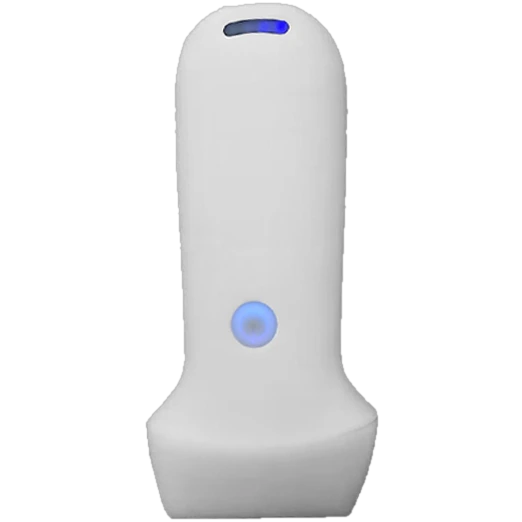 L10SH L10SH | $3,534 | Linear 7.5/10 MHz | 20/40/60/100 mm | Größere Eindringtiefe mit einem Linearschallkopf mit 40 mm Auflagefläche |
| D3Ultra | $2,976 | Linear 7.5/10 MHz plus konvex 3.2/5.0 MHz | Linear 20-100 mm, konvex 90-300 mm | MSK, Abdomen und Lunge mit einer Sonde |
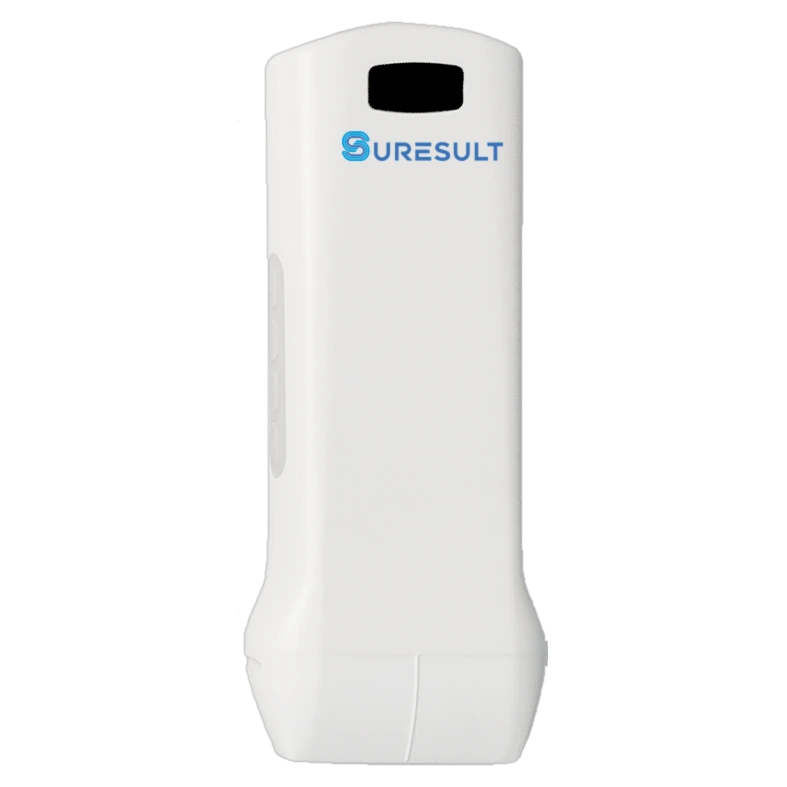 L10H L10H | $2,325 | Linear 7.5/10 MHz | 20/40/60/100 mm | Visualisierte Nadelführung und 5 Stunden Akkulaufzeit |
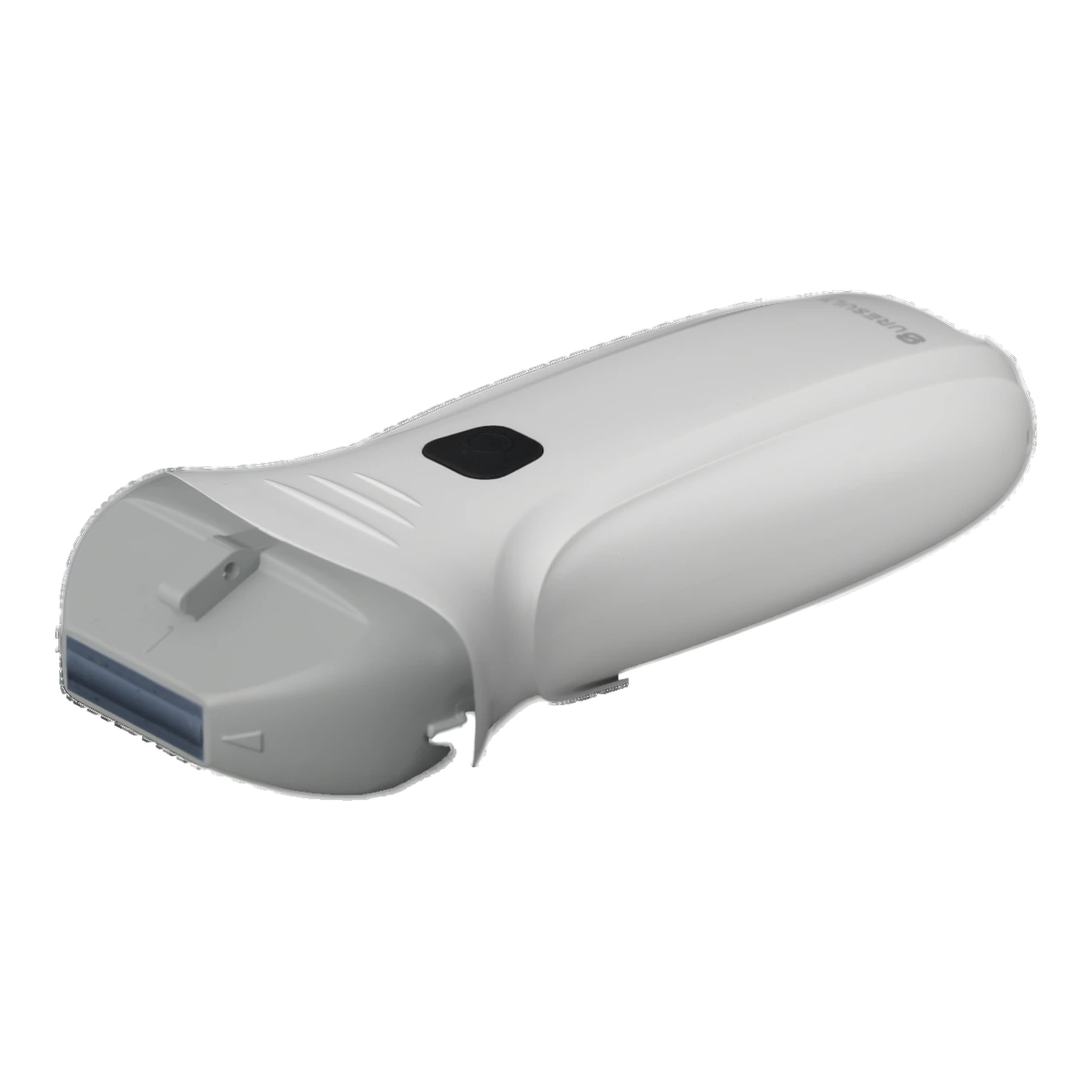 L14 L14 | $2,139 | Linear 10/14 MHz | 20-80 mm | Einstieg in die Bildgebung mit 10/14 MHz und 192 Elementen |
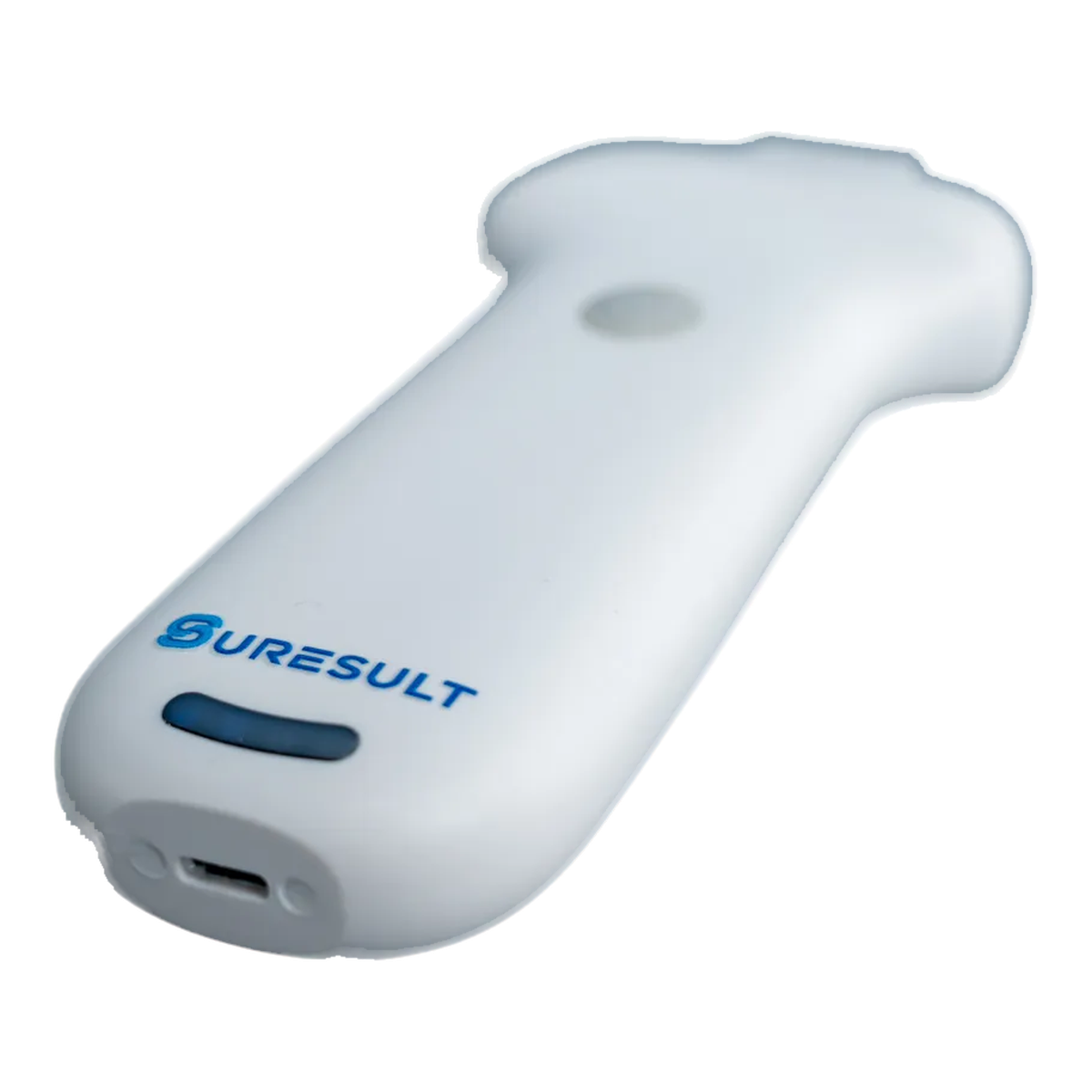 L20 L20 | $2,790 | Linear 16/20 MHz | 10/20/30/40 mm | Einstieg in 16/20 MHz mit 192 Elementen |
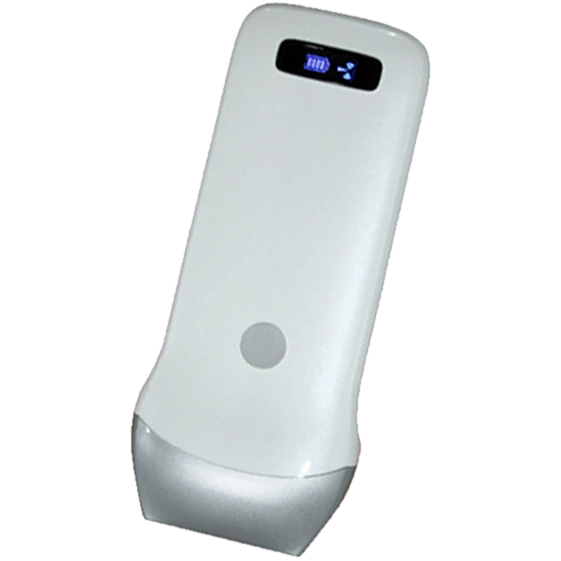 L7.5 L7.5 | $1,209 | Linear 7.5/10 MHz | 40–100 mm | Nur B-Mode und Power-Doppler, 80 Elemente, 40–100 mm Eindringtiefe |
Im Vergleich mit bekannten Marken
Suresult im Vergleich mit Clarius L15 HD3, Butterfly iQ3 und GE Vscan Air CL für MSK-Ultraschall
Wischen Sie, um alle Spalten zu sehen →
| Suresult | Clarius L15 HD3 | Butterfly iQ3 | GE Vscan Air CL | |
|---|---|---|---|---|
| MSK-Bildgebung | 10/14 MHz bis 80 mm beim L14Pro; 16/20 MHz bis 40 mm beim L20Pro; jeweils 256 Elemente | Linearschallkopf mit 5-15 MHz, maximale Tiefe 7 cm | Einzelsonde mit 1-12 MHz; Presets für MSK und MSK-Weichteile decken 1–12 cm ab | Linear-Array mit 3-12 MHz bis 8 cm, Konvex-Array mit 2-5 MHz bis 24 cm |
| Nadelgestützte Eingriffe | In-Plane- und Out-of-Plane-Punktionshilfen sowie Punktionshilfen mit Raster- und Spiegelungsfunktion bei jedem Linearmodell; optimierte Nadelvisualisierung bei L14Pro, L20Pro, L10SH, L10H, L20 und D3Ultra | Erweiterte Software ist in der jährlichen Clarius Essentials-Mitgliedschaft enthalten | Power-Doppler und gepulster Doppler setzen den Advanced-Tarif voraus; die DICOM-Integration wird separat erworben | Digital Tools werden dem Gerät separat hinzugefügt |
| Vergleich nebeneinander | Livebild und Standbild gleichzeitig auf dem Bildschirm, mit tiefenabhängiger Verstärkung in 8 Segmenten bei den Doppler-Modellen | Der Funktionsumfang hängt von der Mitgliedschaftsstufe ab | Der Funktionsumfang hängt von der Mitgliedschaftsstufe ab | Der Funktionsumfang hängt von der Lizenz ab |
| Gerätepreis | Veröffentlichte Preise der Doppler-Linearmodelle: $2,139 bis $3,720 | $3,795 veröffentlichter Preis | $3,899 veröffentlichter Preis | Veröffentlichter Preis ab $4,999 |
| Abonnement | Keine. Software, Messfunktionen, DICOM-Export und die Doppler-Modi des jeweiligen Modells sind enthalten. | Clarius Essentials $695 pro Jahr | Core $299 pro Jahr, Advanced $420 pro Jahr oder einmalig $1,500 für fünf Jahre | Digital Tools werden separat vom Gerät verkauft |
| Gesamtkosten bis zur Lieferung | Zoll und Versand inklusive, Lieferung in 1–7 Tagen | US-Listenpreis; außerhalb der USA zuzüglich Zoll und Versand | US-Listenpreis; außerhalb der USA zuzüglich Zoll und Versand | US-Listenpreis; außerhalb der USA zuzüglich Zoll und Versand |
| Plattformen | iOS, Android und Windows | iOS und Android | iOS und Android | iOS und Android |
| Regulatorische Registrierungen | FDA 510(k) · ISO 13485 · EU MDR (CE) · TGA · ANVISA · Health Canada | FDA 510(k) | FDA 510(k) | FDA 510(k) |
Wo Suresult überzeugt
- Die neun MSK-Schallfenster auf dieser Seite zeigen echte klinische Aufnahmen, von der Plantarfaszie bis zur Kniekehle.
- Abonnementfrei: Doppler-Modi, Nadelführungshilfen, Messfunktionen und DICOM-Export sind im Lieferumfang des Ultraschallgeräts enthalten.
- Zwei Frequenzgruppen decken MSK ab, 10/14 MHz für größere Eindringtiefe und 16/20 MHz für oberflächliche Details.
- Jedes Linearmodell enthält standardmäßig In-Plane- und Out-of-Plane-Punktionshilfen.
- Das L14Pro und das L20Pro verfügen jeweils über 256 Elemente auf 64 Kanälen bei einer Auflagefläche von 25 mm.
- Der Preis an der Kasse ist der Endpreis einschließlich Zoll und Versand, mit Lieferung in 1-7 Tage.
- Die Suresult-Software läuft unter Windows sowie iOS und Android, ohne Gebühren pro Arbeitsplatz.
- Die Preise für jedes MSK-Modell von Suresult sind direkt auf der Produktseite einsehbar, sodass keine Angebotsanfrage per Formular erforderlich ist.
Die Fünfjahresrechnung
Clarius bietet den L15 HD3 für $3,795 und die Clarius Essentials-Mitgliedschaft für $695 pro Jahr an. Damit summieren sich allein die Gebühren nach fünf Jahren auf $3,475. Der Advanced-Tarif von Butterfly für $420 pro Jahr kostet über denselben Zeitraum $2,100. Der L14Pro ist ohne Abonnement nutzbar.
L14Pro, einmalige ZahlungClarius L15 HD3: Ultraschallgerät + Mitgliedschaft= $3,475 allein an Gebühren bis zum fünften Jahr
Drei Modelle, eine Entscheidung
Sie fragen sich, welches Modell zu Ihren Fällen passt?
In einem Gespräch erhalten Sie eine klare Empfehlung: den passenden Suresult-Schallkopf oder ein klares “keiner von beiden.”
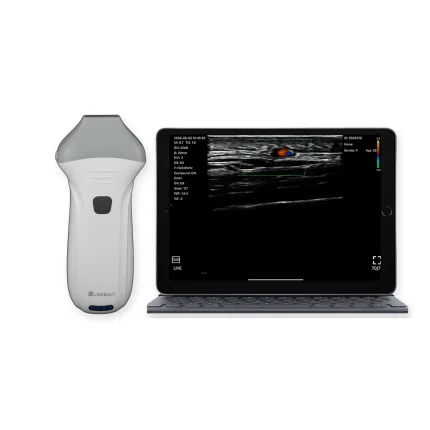
L20Pro
Hochfrequenz-Ultraschallkopf Suresult L20Pro für das Gesicht – 16/20 MHz, 256 Elemente, kabellos
Frequenz: 16/20 MHz
Bildgebungstiefe: 10/20/30/40 mm
Muskuloskelettale Medizin (MSK)
buy scanner

L24Pro
L24Pro 18/24 MHz Ultraschallsonde mit 256 Elementen für ästhetische Medizin und Filler
Frequenz: 18/24 MHz
Bildgebungstiefe: 10/15/20/25mm
Muskuloskelettale Medizin (MSK)
buy scanner

D3Ultra
D3Ultra Mehrzweck-Handheld-Ultraschall mit Konvex-, Linear- und Phased-Array-Funktion
Frequenz: Konvex- / Phased-Array-Sonde 3.2/5.0MHz Linearsonde 7.5/10MHz
Bildgebungstiefe: Linearsonde: 20–100 mm, Konvexsonde & Phased-Array-Sonde: 90–300 mm
Muskuloskelettale Medizin (MSK)
buy scanner


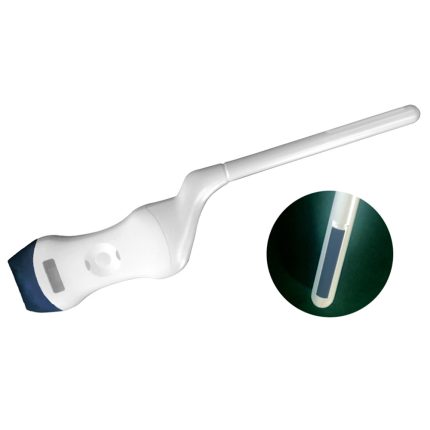


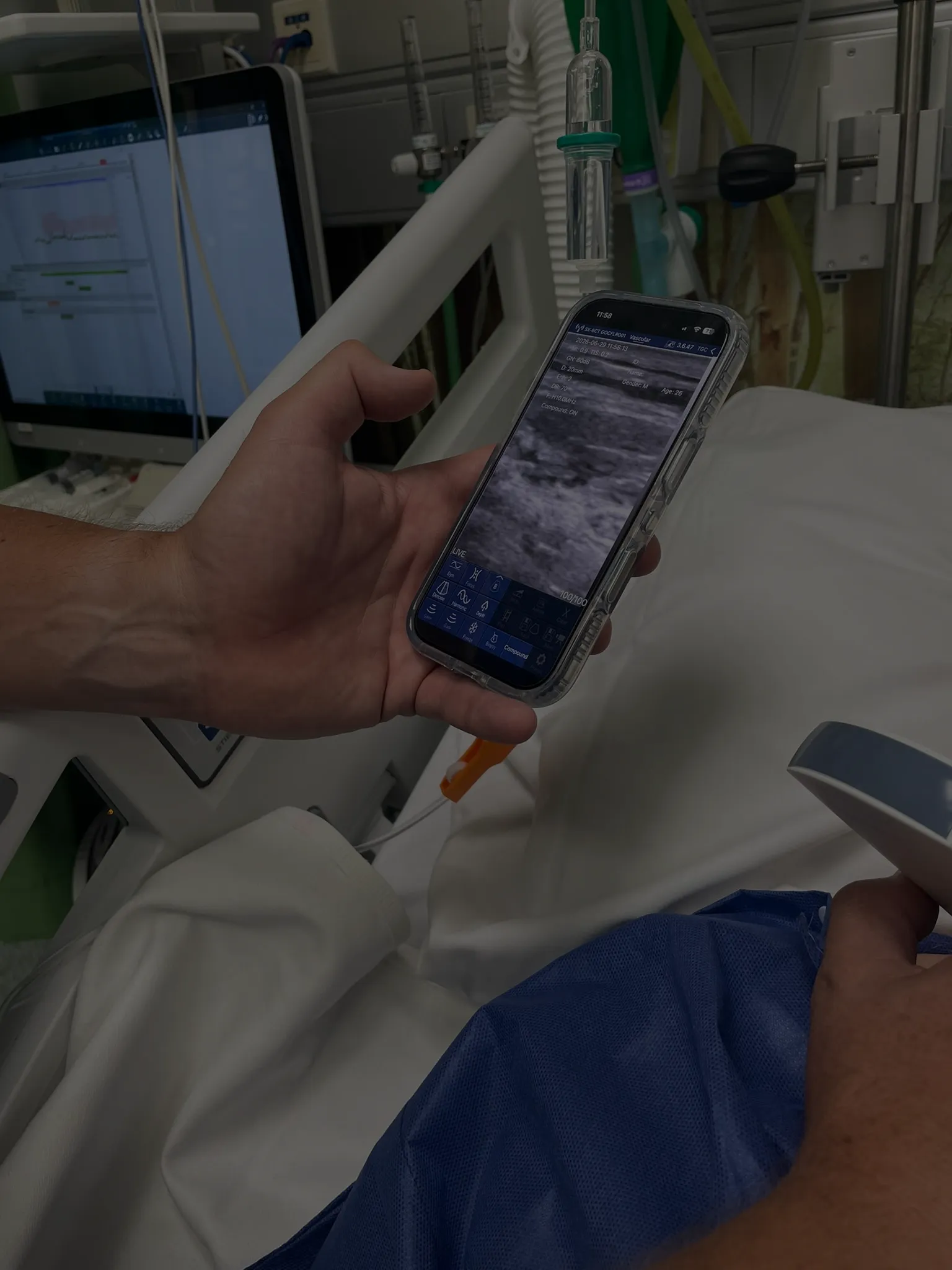
Fachkundige Beratung
Sprechen Sie mit einem Spezialisten für Ultraschallgeräte
Beschreiben Sie Suresult Ihren täglichen Arbeitsablauf und erhalten Sie eine individuelle Geräteempfehlung mit einem Komplettangebot.
- Kostenlose Beratung zur Gerätewahl — Schallköpfe, Frequenz und Tiefe auf Ihre Verfahren abgestimmt
- Komplettangebot — Versand, Zollabfertigung und anfallende Steuern inklusive
- Schnelle Lieferung — Versand innerhalb von 24 Stunden, Lieferung bis an Ihre Tür in 1–7 Tagen
- Kein Software-Abonnement erforderlich — Apps für iOS, Android und Windows inklusive
- 30 Tage Rückgaberecht und Support rund um die Uhr
Der Live-Chat öffnet sich direkt hier — Sie können sofort losschreiben.
