
Toutes les échographies de cette page ont été enregistrées avec cette gamme d’appareils Suresult, par des cliniciens qui les ont achetés et par un formateur clinique qui les utilise pour ses examens. Chaque séquence est coupée pour ne conserver que l’examen lui-même. ·8 717 cliniciens nous font confiance →
Réponse rapide
Un échographe musculosquelettique portable est un échographe à sonde linéaire haute fréquence qui visualise les tendons, les ligaments, les nerfs et les surfaces articulaires au chevet du patient. Le diagnostic et l’injection guidée ont alors lieu au cours d’une seule consultation — un seul rendez-vous suffit.
- Deux familles de fréquences couvrent l’exploration musculosquelettique : le L14Pro fonctionne à 10/14 MHz, 80 max mm, le L20Pro fonctionne à 16/20 MHz jusqu’à 40 mm.
- Des guides de ponction sont fournis sur chaque modèle linéaire Suresult, et l’amélioration de la visibilité de l’aiguille est incluse sur les L14Pro, L20Pro, L10SH, L10H, L20 et D3Ultra.
- L’application affiche une image en temps réel à côté d’une image figée, ce qui permet de comparer le côté douloureux au côté sain.
- Doppler couleur et Doppler pulsé sont inclus sur les L14, L14Pro, L20, L20Pro, L10H, L10SH et D3Ultra, afin de repérer d’abord le vaisseau situé à côté de la cible.
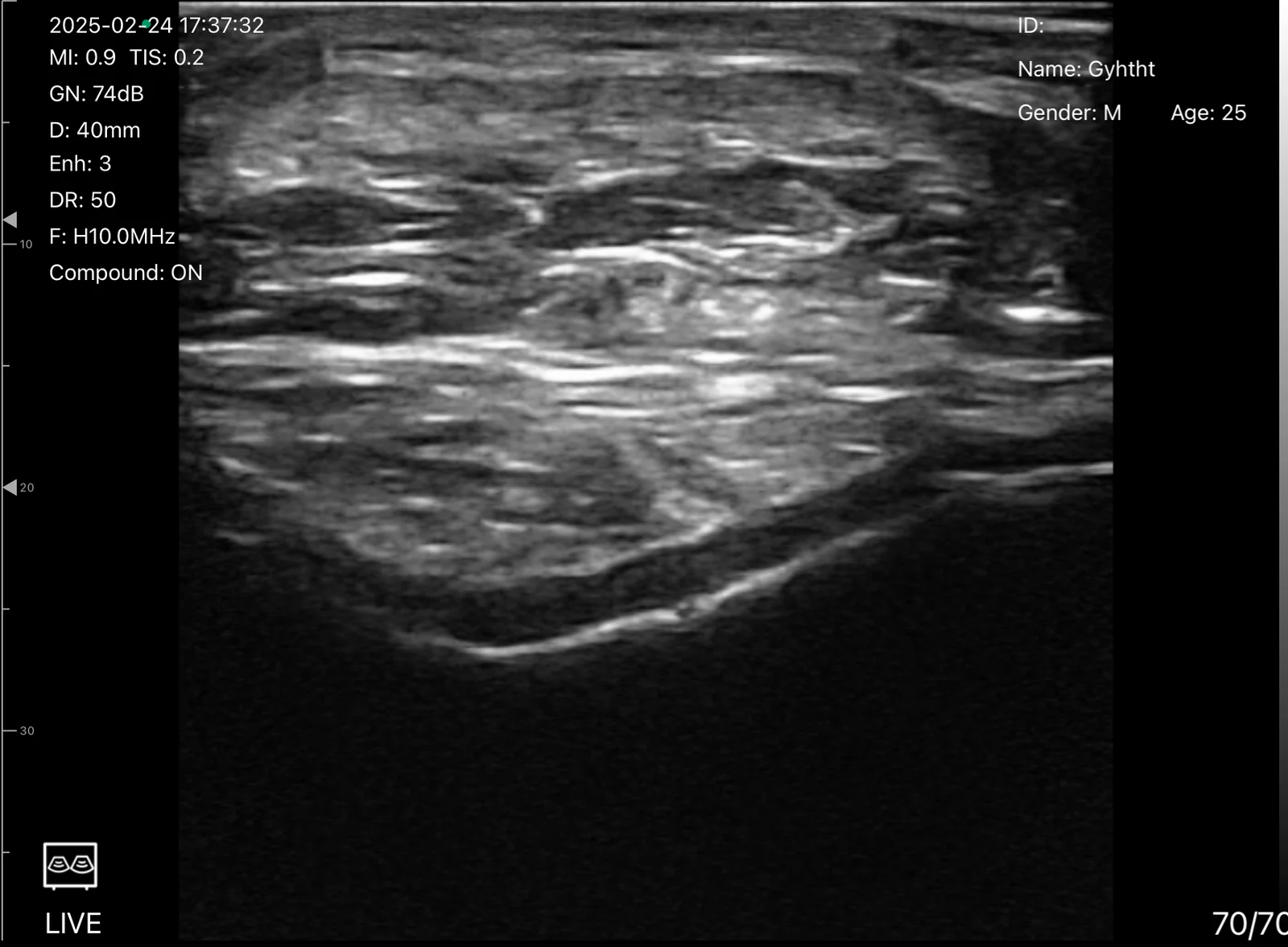
L’atlas des captures
Neuf coupes échographiques musculosquelettiques réelles, acquises avec des échographes de poche Suresult
Captures cliniques brutes · sélectionnez une image pour l’agrandir
Pied et cheville3 windows
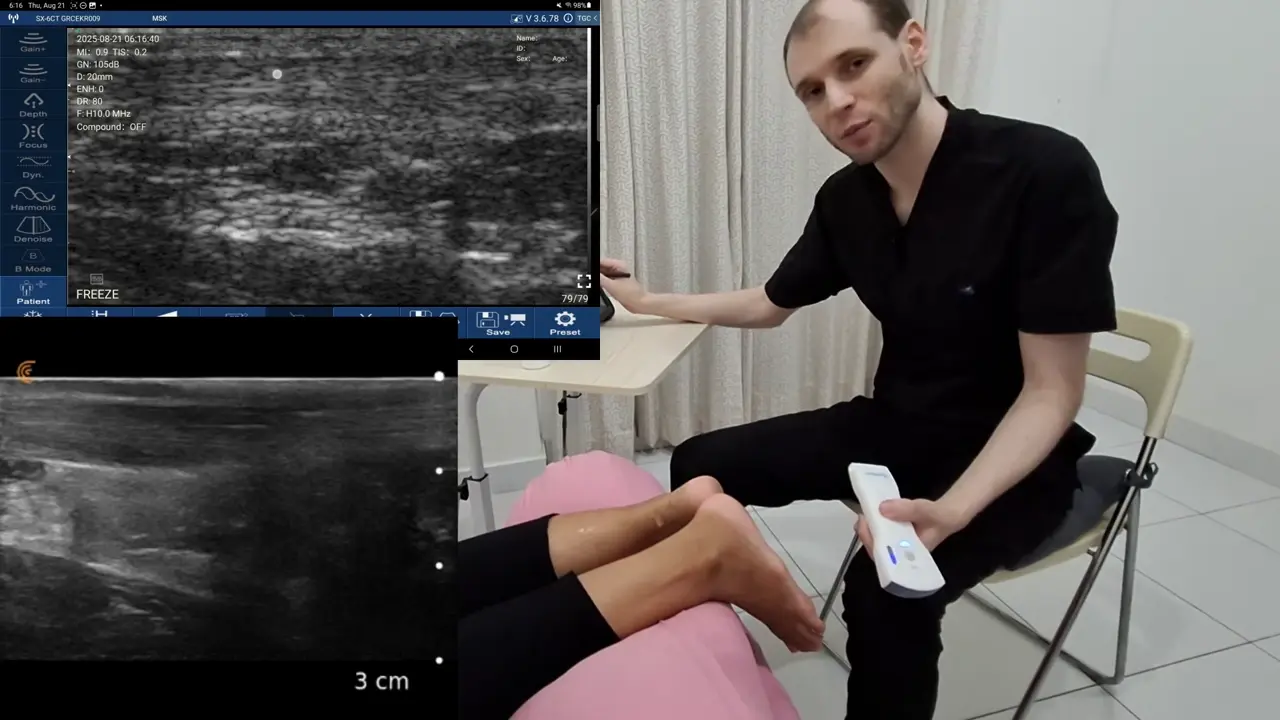
Le tendon d'Achille vu dans le plan longitudinal
La structure fibrillaire du tendon d’Achille s’étend sur toute la longueur de l’écran, avec l’insertion calcanéenne à une extrémité. Cette vue permet d’évaluer l’épaisseur et la rupture des fibres.
enregistré par le médecin évaluateur Brandon Ramakko avec un échographe de poche Suresult, préréglage MSK et indications en haut de l’écran GN : 105dB, D : 20mm, DR : 80, F : H10.0 MHz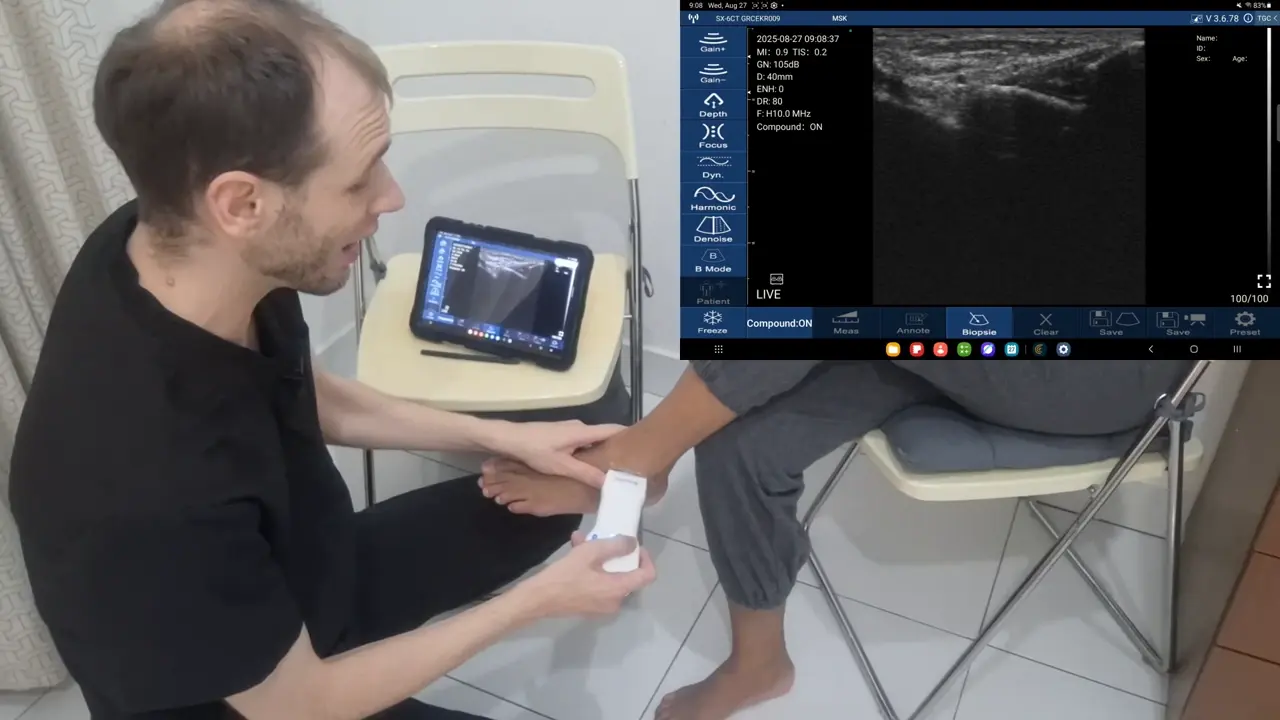
Ligament talofibulaire antérieur après une entorse latérale de la cheville
Le ligament talo-fibulaire antérieur est visualisé entre la fibula et le talus ; c’est le ligament lésé lors d’une entorse en inversion. Lorsqu’il est déchiré, il perd son aspect fibrillaire tendu.
enregistré par le médecin évaluateur Brandon Ramakko avec un échographe de poche Suresult, publié comme examen pédagogique POCUS du ligament talo-fibulaire antérieur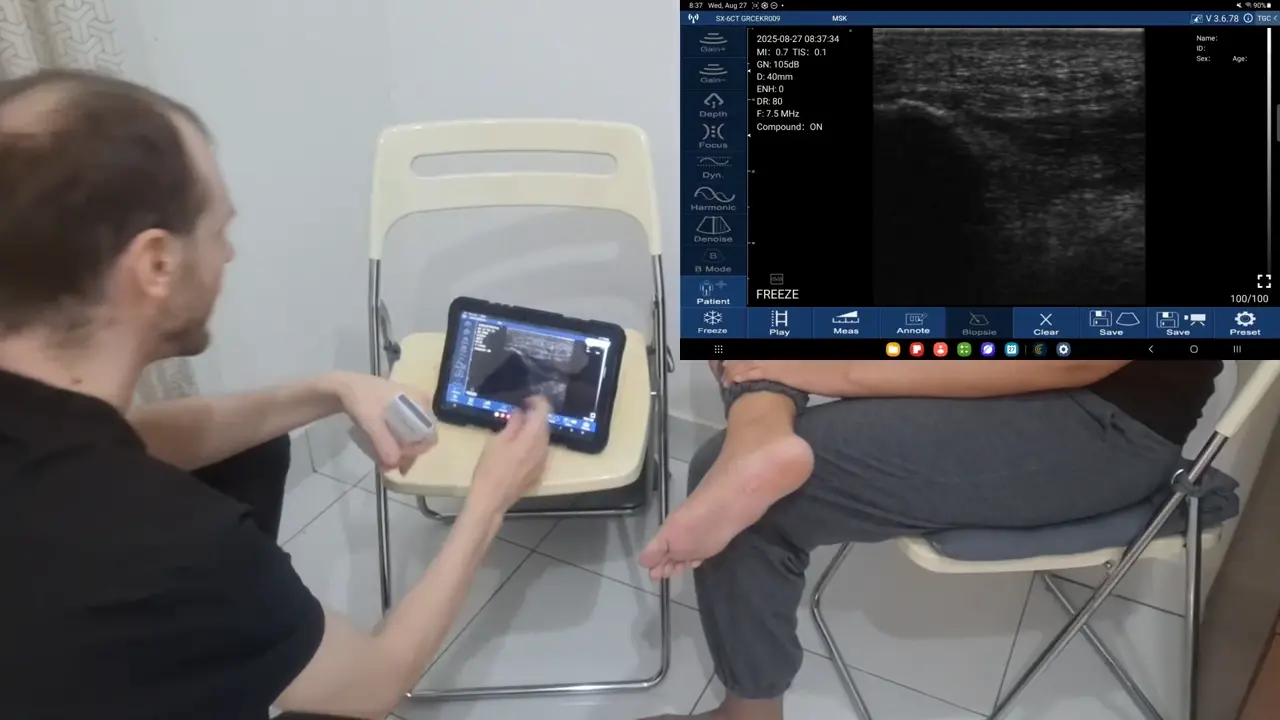
Fascia plantaire à son insertion calcanéenne
L’aponévrose plantaire est mesurée à son origine sur le calcanéus, le site qui s’épaissit en cas de fasciopathie plantaire dégénérative. Un curseur de mesure dans l’application permet d’en chiffrer l’épaisseur.
enregistré par le médecin évaluateur Brandon Ramakko avec un échographe de poche Suresult, publié comme évaluation de la fasciite plantaire et de la fasciopathie plantaire dégénérativeCoude2 windows
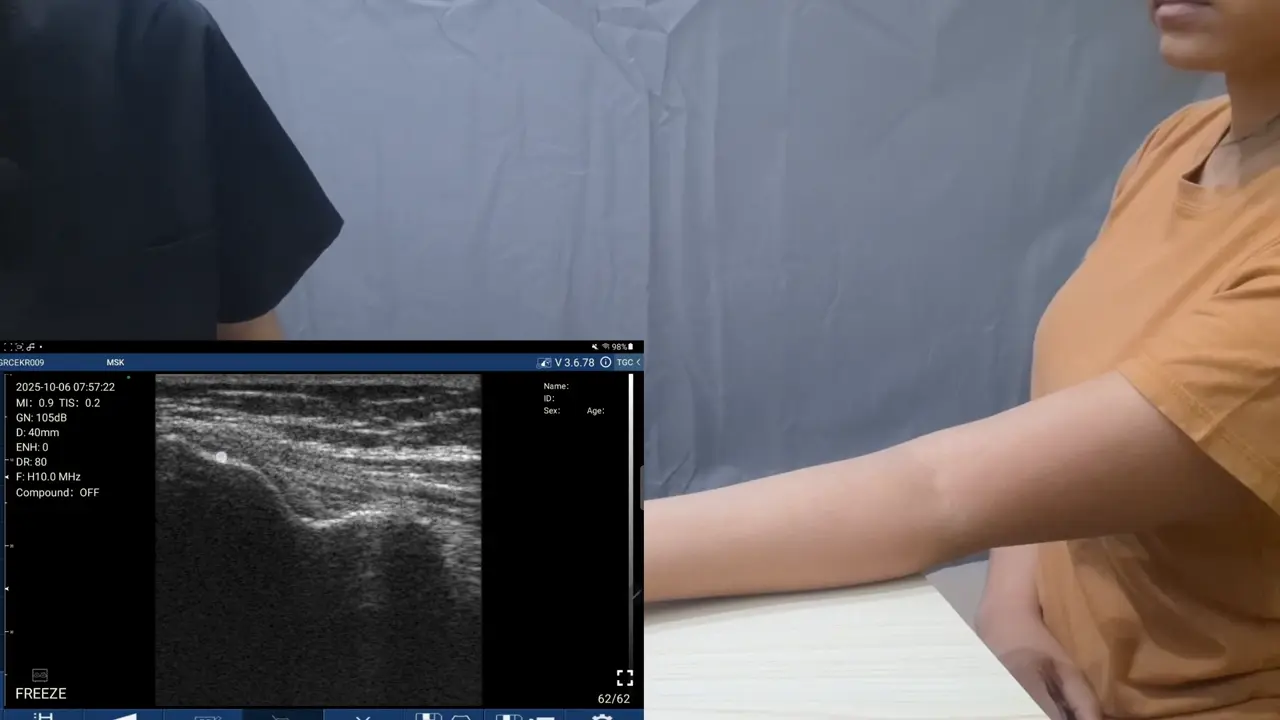
Face médiale du coude dans le « coude du golfeur »
L’origine commune des fléchisseurs sur l’épicondyle médial est la cible de l’examen en cas d’épicondylite médiale. L’échographie distingue un épaississement tendineux d’une déchirure partielle à l’interface osseuse.
enregistré par le médecin évaluateur Brandon Ramakko avec un échographe de poche Suresult, indications en haut de l’écran : profondeur de 40 mm, 10.0 MHz, gain de 105 dB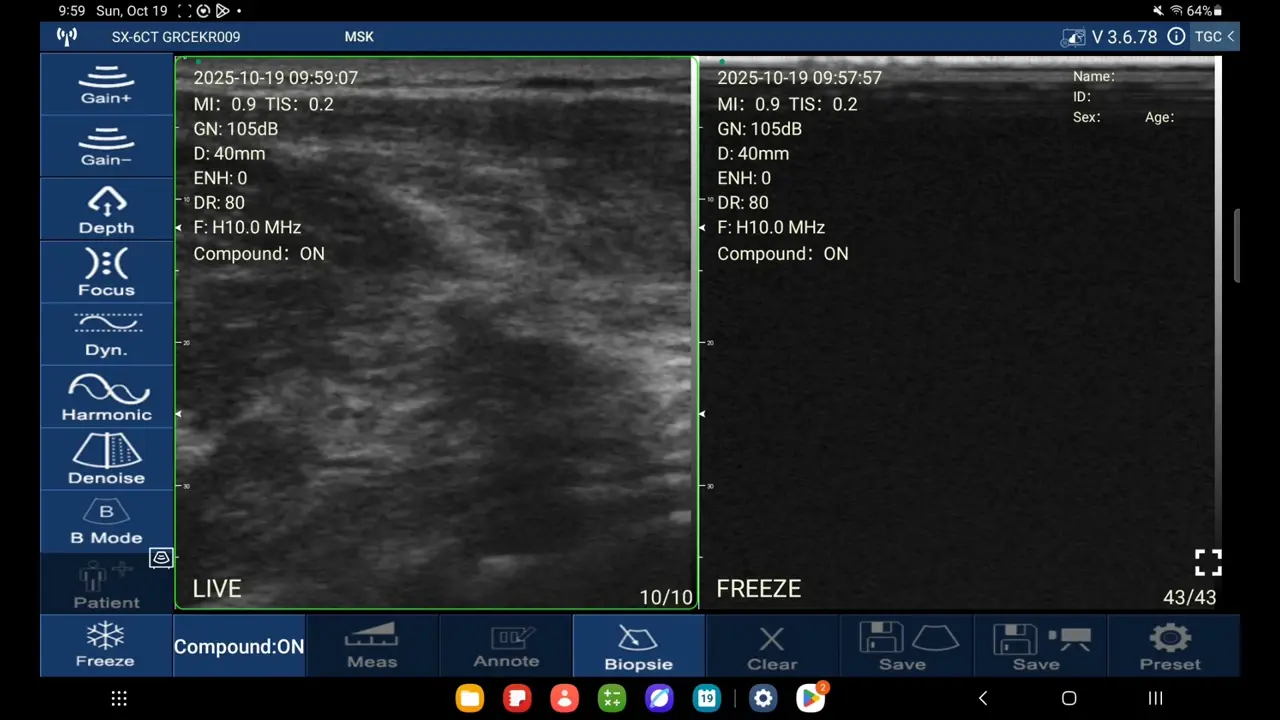
Ligament collatéral ulnaire du coude : image en temps réel à côté d'une image figée
Le ligament collatéral ulnaire est le ligament sollicité chez les sportifs pratiquant le lancer, et l’application affiche l’image en temps réel à côté d’une image figée pour une comparaison directe. Une contrainte dynamique en valgus peut être appliquée pendant l’examen.
enregistré par le médecin évaluateur Brandon Ramakko avec un échographe de poche Suresult, préréglage MSK, profondeur de 40 mm, 10.0 MHz, plage dynamique de 80Poignet et main2 windows
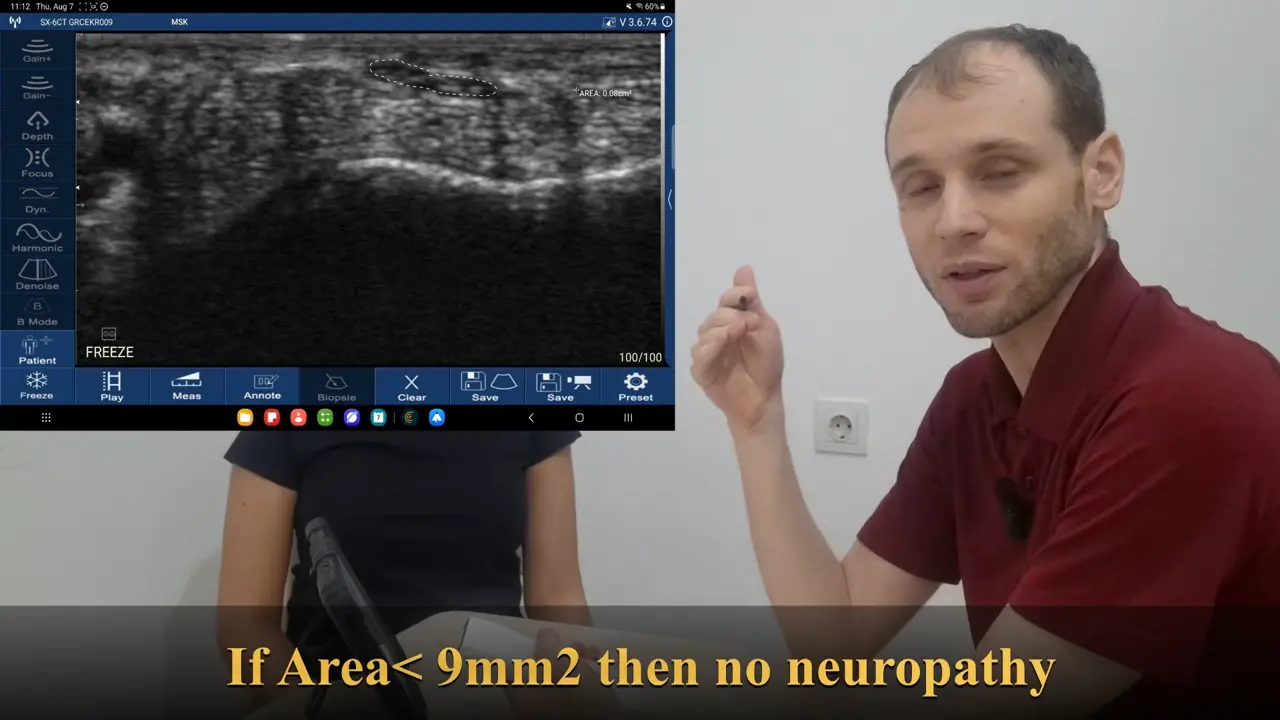
Le nerf médian au niveau du canal carpien
Le nerf médian apparaît comme un ovale en nid d’abeilles au-dessus des tendons fléchisseurs, entre le scaphoïde et le pisiforme. L’aire de section transversale à l’entrée du canal est la mesure déterminante.
enregistré par le médecin évaluateur Brandon Ramakko avec un échographe de poche Suresult, publié comme évaluation du syndrome du canal carpien avec une légende anatomique à l’écran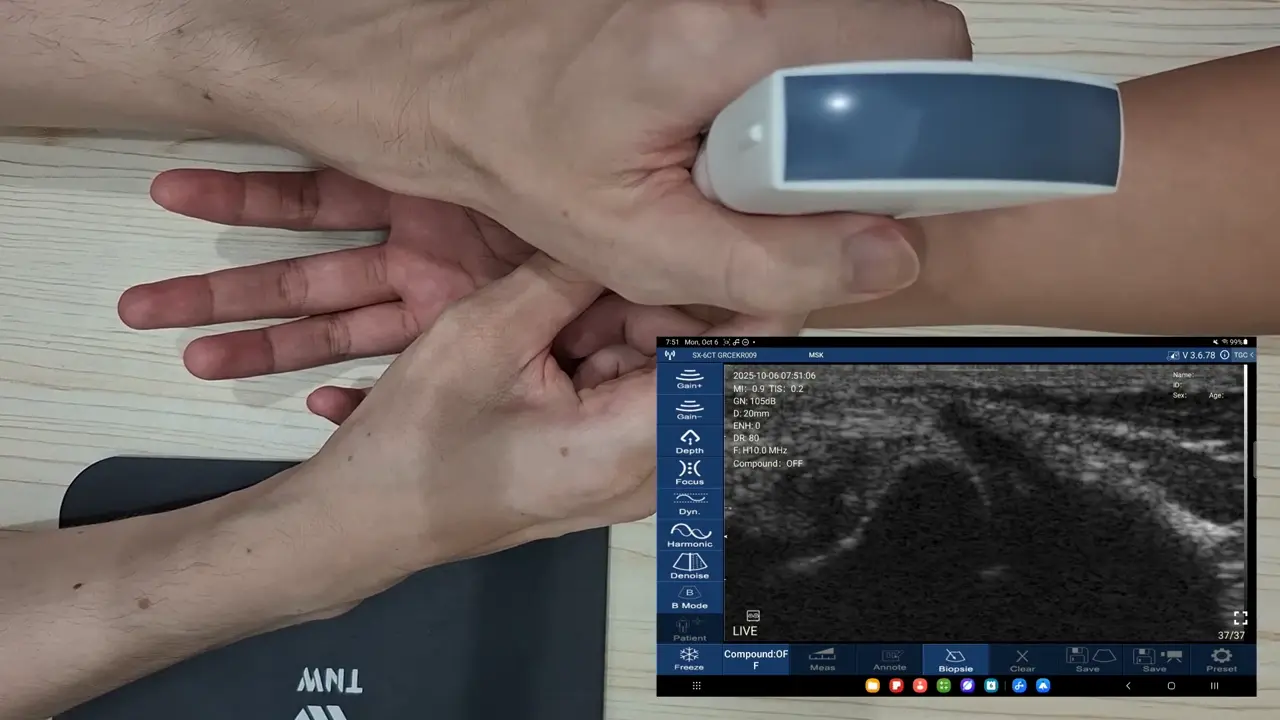
Scaphoïde du côté radial du poignet
La corticale du scaphoïde est suivie à la recherche d’un décroché, d’une interruption ou d’un hématome sus-jacent après une chute sur la main tendue. L’échographie est utilisée ici lorsque la première radiographie est interprétée comme normale.
enregistré par le médecin évaluateur Brandon Ramakko avec un échographe de poche Suresult, publié comme examen échographique d’une fracture du scaphoïdeGenou et planification des injections2 windows
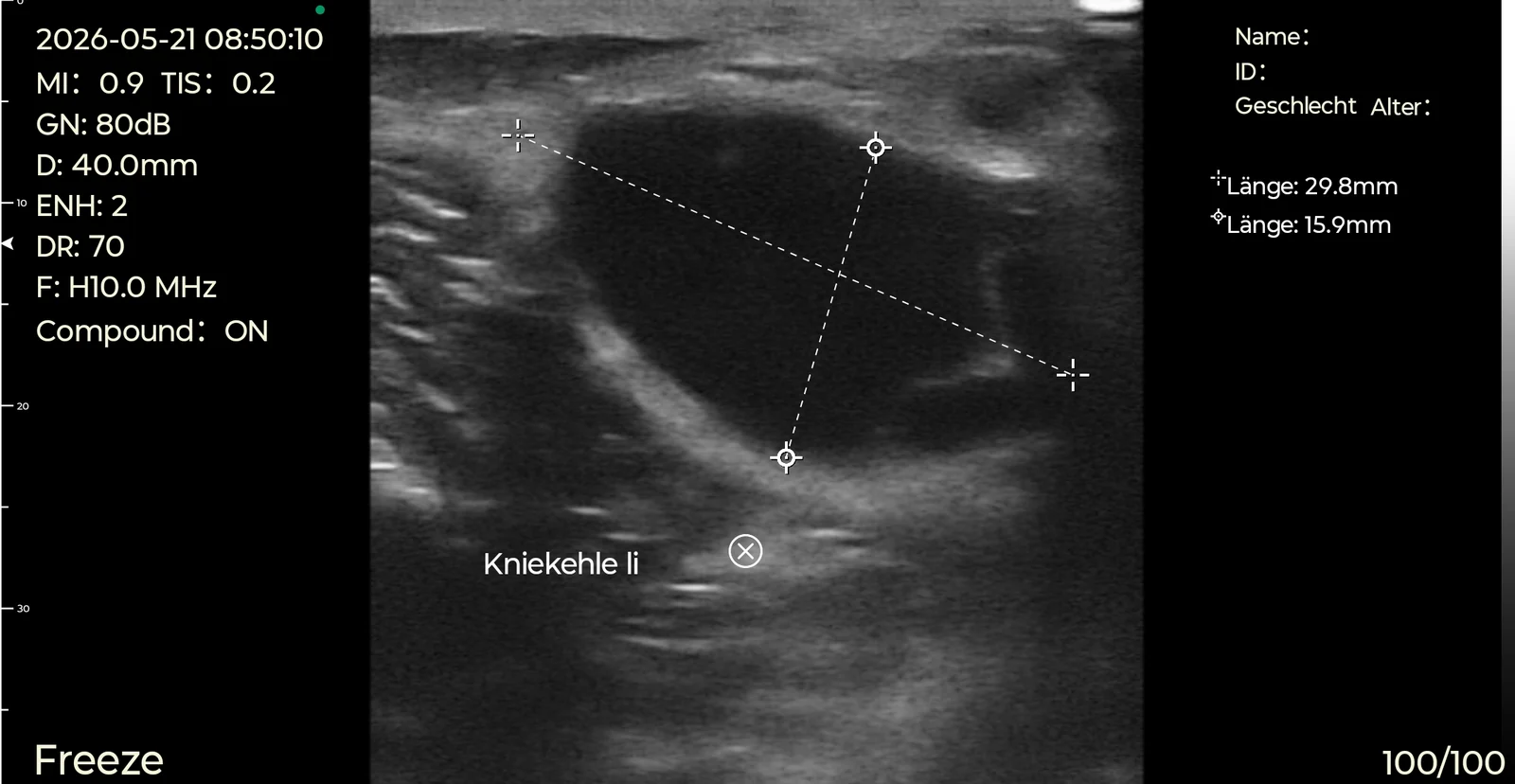
Structure kystique poplitée, mesurée à l'aide d'un D3Ultra
Un acheteur allemand a annoté cette image Kniekehle li, soit la fosse poplitée gauche, et mesuré la structure anéchogène à 29,8 mm sur 15,9 mm. Les indications en haut de l’écran affichent 10.0 MHz à une profondeur de 40 mm.
capture réalisée par un acheteur avec un D3Ultra, gain de 80 dB, plage dynamique de 70, imagerie composée activée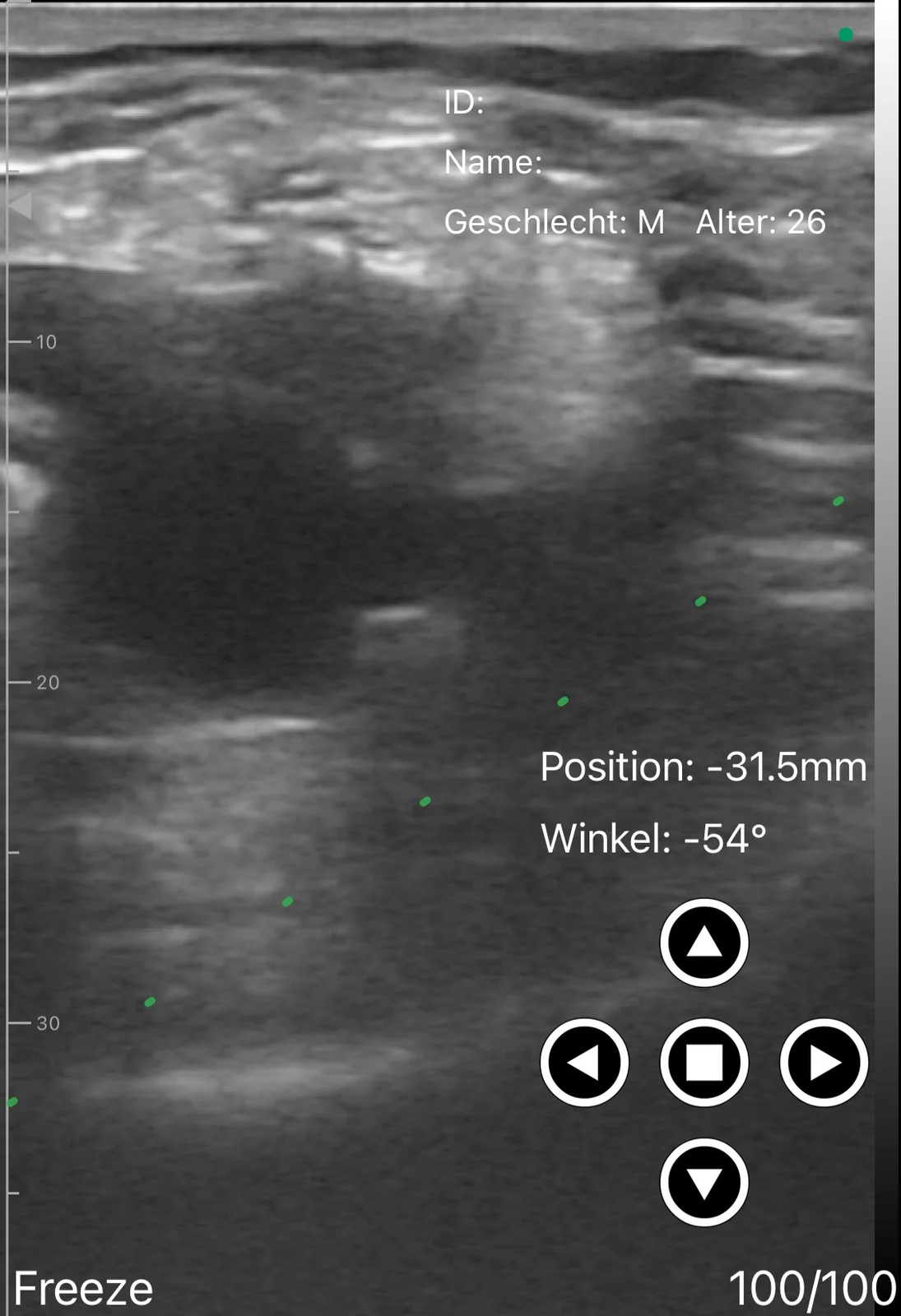
Guide de ponction au niveau de la face postérieure du genou
La ligne de guidage en pointillés traverse les plans tissulaires, avec les indications Position -31,5 mm et Winkel -54 degrés affichées à côté. L’acheteur a utilisé cette vue pour un bloc IPACK derrière le genou.
capture réalisée par un acheteur avec un D3Ultra, guide d’aiguille à l’écran avec affichage de la position et de l’angleSélectionnez une carte pour changer de capture
Les bases de la technique
Le déroulement de l’examen, de la sonde au compte rendu
- Commencez par une tête linéaire haute fréquence.
La plupart des cibles musculosquelettiques se situent à moins de 40 mm de la peau. Une sonde linéaire à 10 MHz ou plus permet de distinguer les fibres tendineuses et les fascicules nerveux qu’une tête convexe rend flous.
Linéaire, 10/14 MHz ou 16/20 MHz - Sélectionnez le préréglage MSK et une profondeur de 40 mm.
Le préréglage MSK s’ouvre avec l’imagerie composée activée. Réduisez la profondeur vers 20 mm lorsque le tendon ou le nerf occupe le champ proche, et augmentez le gain pour une cible profonde de la hanche.
D : 40 mm, F : H10.0 MHz en haut de l’écran de l’application 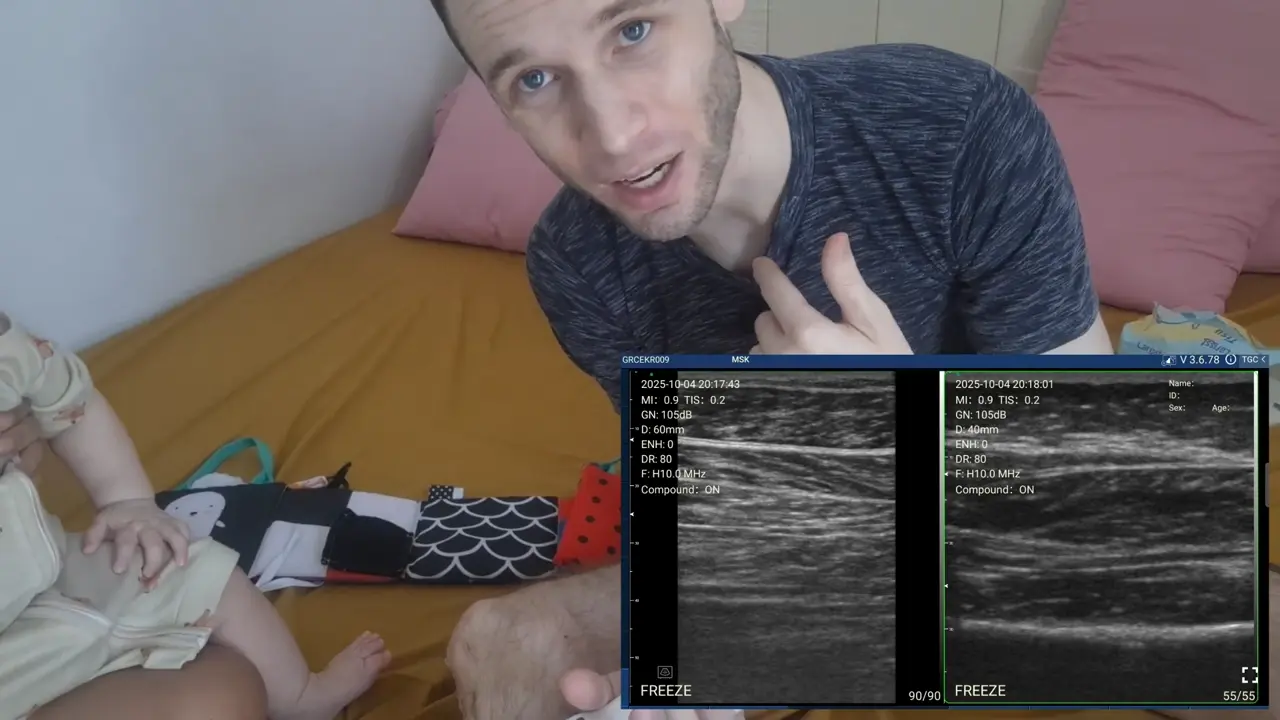 Examinez le côté sain et figez l’image de comparaison.
L’application affiche une image en temps réel à côté d’une image figée. L’asymétrie permet de distinguer un tendon épaissi d’un tendon épais, et la comparaison reste à l’écran pendant l’examen.
Images EN TEMPS RÉEL et FIGÉE côte à côte- Planifiez la trajectoire de l’aiguille avant de la déplacer.
Le guide de ponction trace la trajectoire à l’écran en indiquant sa position et son angle. Le Doppler couleur repère le vaisseau à éviter, et le rehaussement de l’aiguille accentue la luminosité de sa tige dans le plan.
Position et angle affichés sur la ligne de guidage
Ce que dit la recherche
Les données scientifiques, trois études vérifiées
- L’échographie s’est montrée précise pour le diagnostic des ruptures transfixiantes de la coiffe des rotateurs.
Une méta-analyse de 2015 a rapporté une sensibilité et une spécificité supérieures à 0,90 pour l’échographie, l’IRM et l’arthro-IRM dans le diagnostic des ruptures transfixiantes de la coiffe des rotateurs.
Roy et al., Br J Sports Med 2015 - Le guidage échographique a permis de réaliser davantage d’injections articulaires au bon emplacement.
Chez 184 patients atteints d’arthrite inflammatoire, un médecin en formation utilisant le guidage échographique a réalisé 83 % des injections articulaires au bon emplacement, contre 66 % pour des rhumatologues expérimentés guidés par l’examen clinique.
Cunnington et al., Arthritis Rheum 2010 - Un échographe de poche a identifié des pathologies de l’épaule.
Chez 10 patients adressés pour une échographie de l’épaule, deux évaluateurs indépendants ayant interprété les images d’un échographe de poche ont retrouvé le diagnostic de l’échographie standard dans respectivement 7 et 8 cas.
Lau et al., Clin J Sport Med 2020
Choisissez votre modèle
Choisissez le modèle qui s’adapte à votre quotidien
Le plus choisi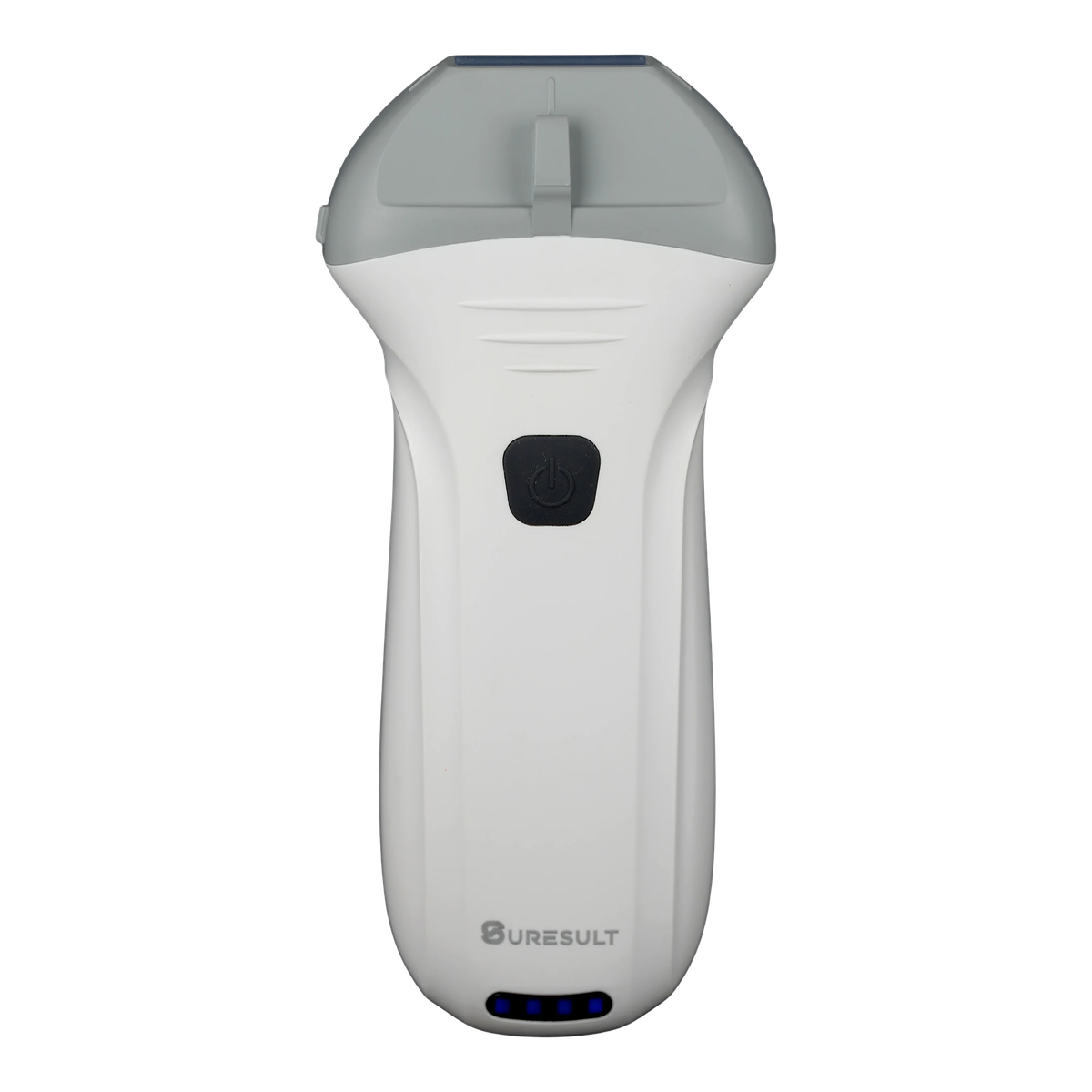 Médecine du sport et orthopédieL14Pro
Médecine du sport et orthopédieL14ProLe L14Pro fonctionne à 10/14 MHz avec des paliers de profondeur jusqu’à 80 mm, permettant d’examiner le tendon d’Achille et la coiffe des rotateurs avec la même tête. Il dispose de 256 éléments, de 64 canaux et d’une batterie offrant 4 heures d’examen.
80 mm à 14, une seule sonde
$3,441 L14Pro · Sonde échographique linéaire 10/14 MHz à 256 éléments pour l’échographie musculosquelettiqueAcheter maintenantVoir L14Pro →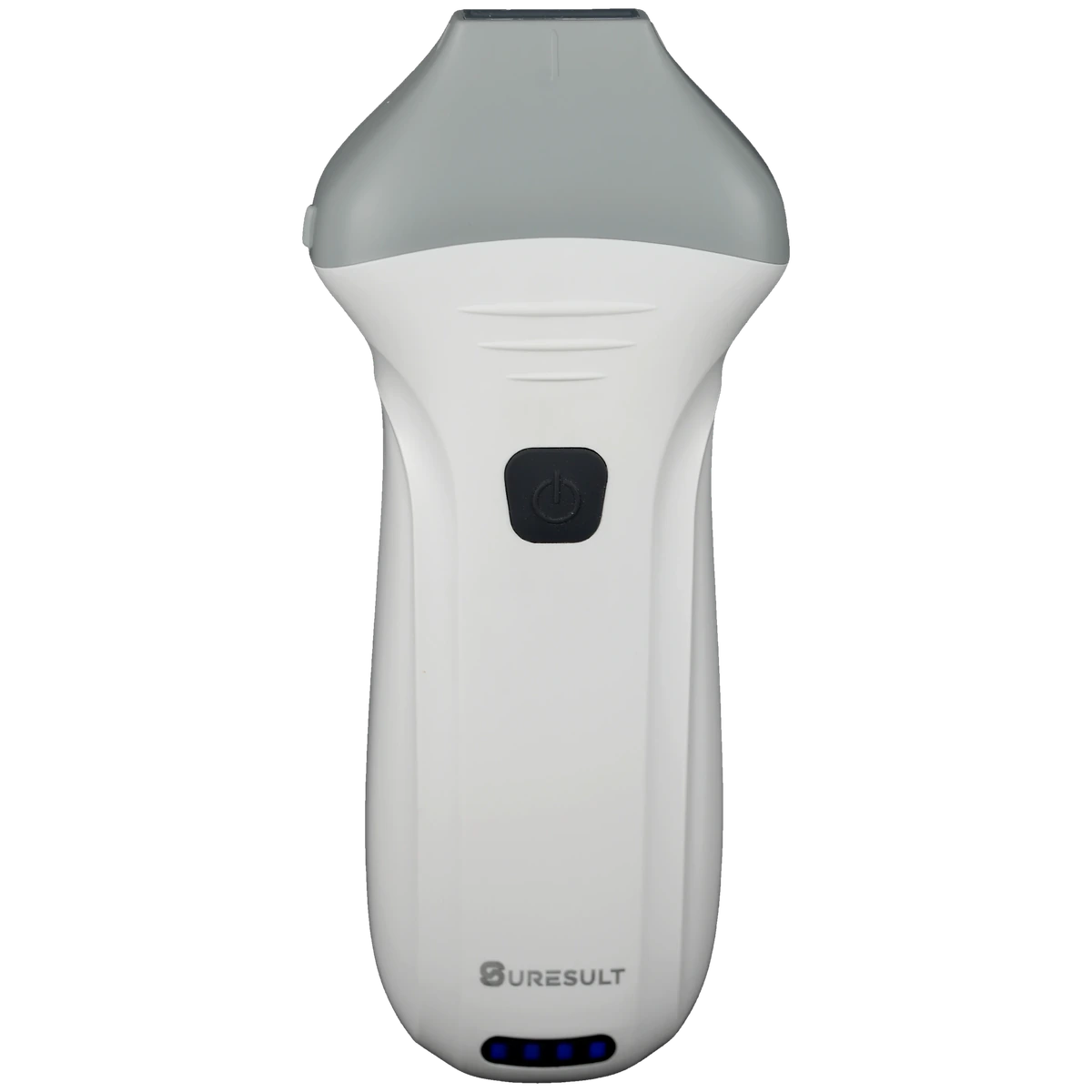 Détail des tendons et des nerfs superficielsL20Pro
Le L20Pro fonctionne à 16/20 MHz avec des paliers de profondeur de 10 mm à 40 mm, une plage adaptée aux capsules des petites articulations, aux tendons des doigts et aux nerfs superficiels. Le rehaussement de l’aiguille est inclus.
16/20 MHz jusqu’à 40, fréquence la plus élevée
$3,720 L20Pro · Échographe linéaire haute fréquence 16/20 MHz pour la médecine esthétique, la peau & les structures musculosquelettiques superficiellesAcheter maintenantVoir le L20Pro →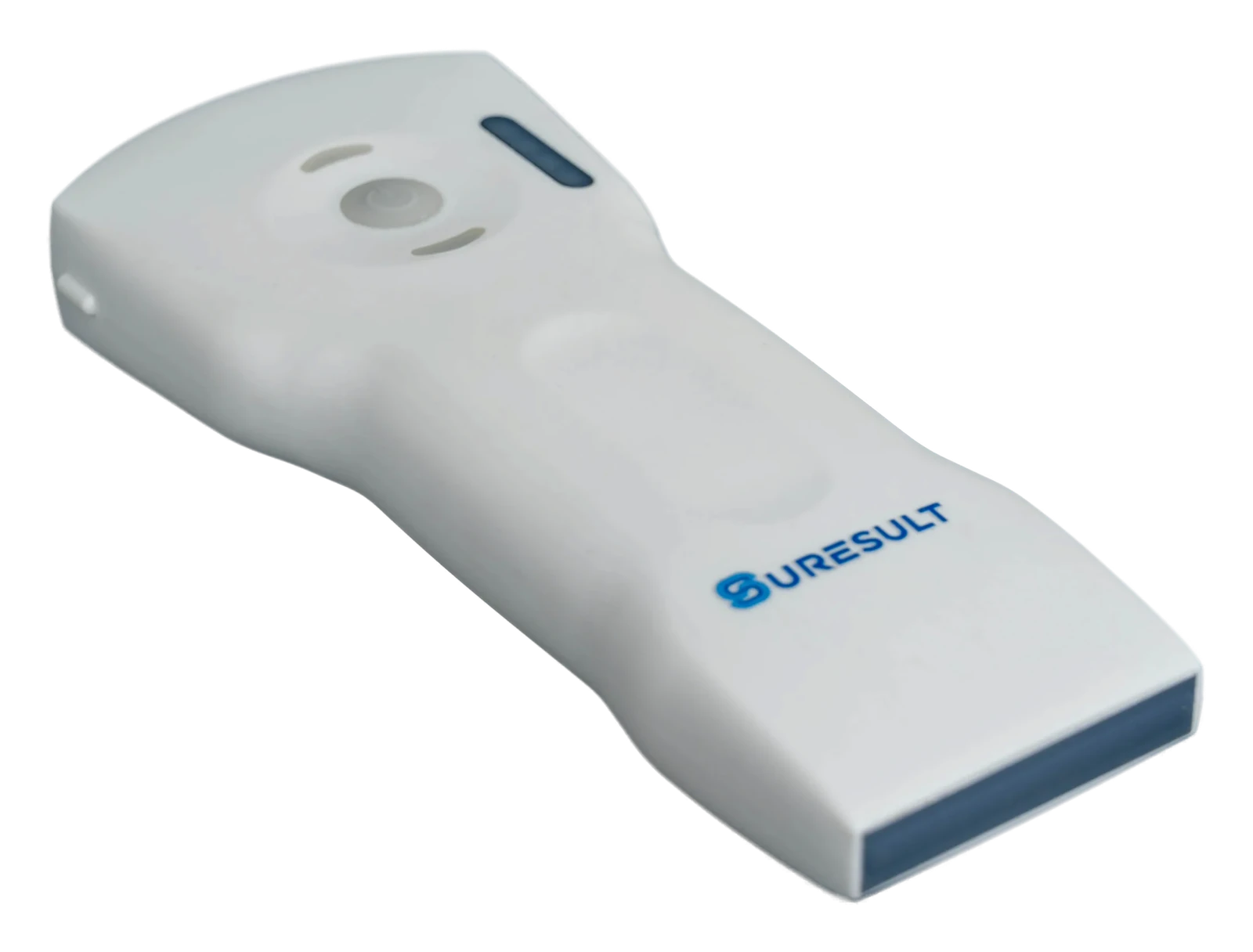 L’examen MSK parmi d’autres examensD3Ultra
Le D3Ultra comporte une tête linéaire de 7.5/10 MHz atteignant 100 mm de profondeur et une tête convexe atteignant 300 mm. La même sonde permet d’examiner la hanche en profondeur ou l’abdomen, et les deux captures fournies par des clients dans l’atlas proviennent de ce modèle.
linéaire et convexe, deux têtes
$2,976 D3Ultra · Échographe de poche polyvalent convexe, linéaire et sectoriel à réseau phaséAcheter maintenantVoir D3Ultra →Comparatif des échographes
Huit modèles Suresult pour l’imagerie musculosquelettique, comparés selon leur fréquence et leur profondeur d’exploration
Balayez pour voir toutes les colonnes →
| Modèle | Prix | Fréquence | Profondeur | Idéal pour |
|---|---|---|---|---|
| L14Pro | $3,441 | Linéaire 10/14 MHz | 20/40/60/80 mm | Premier choix en MSK : 256 éléments, 64 canaux, 4 heures d’autonomie |
| L20Pro | $3,720 | Linéaire 16/20 MHz | 10/20/30/40 mm | Détail des tendons et des nerfs superficiels avec 256 éléments |
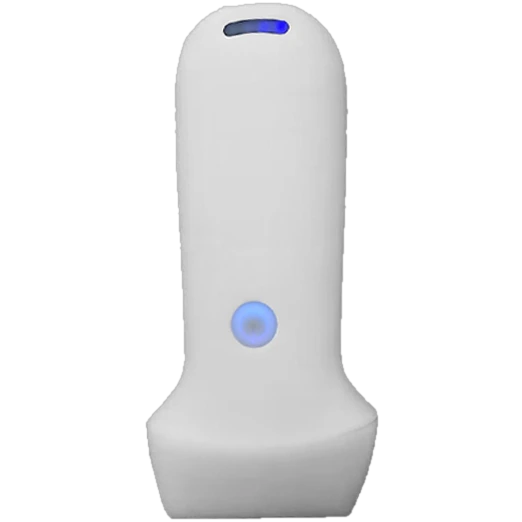 L10SH L10SH | $3,534 | Linéaire 7.5/10 MHz | 20/40/60/100 mm | Exploration linéaire plus profonde avec une empreinte de 40 mm |
| D3Ultra | $2,976 | Linéaire 7.5/10 MHz et convexe 3.2/5.0 MHz | Linéaire 20-100 mm, convexe 90-300 mm | Examens MSK, abdominaux et pulmonaires avec une seule sonde |
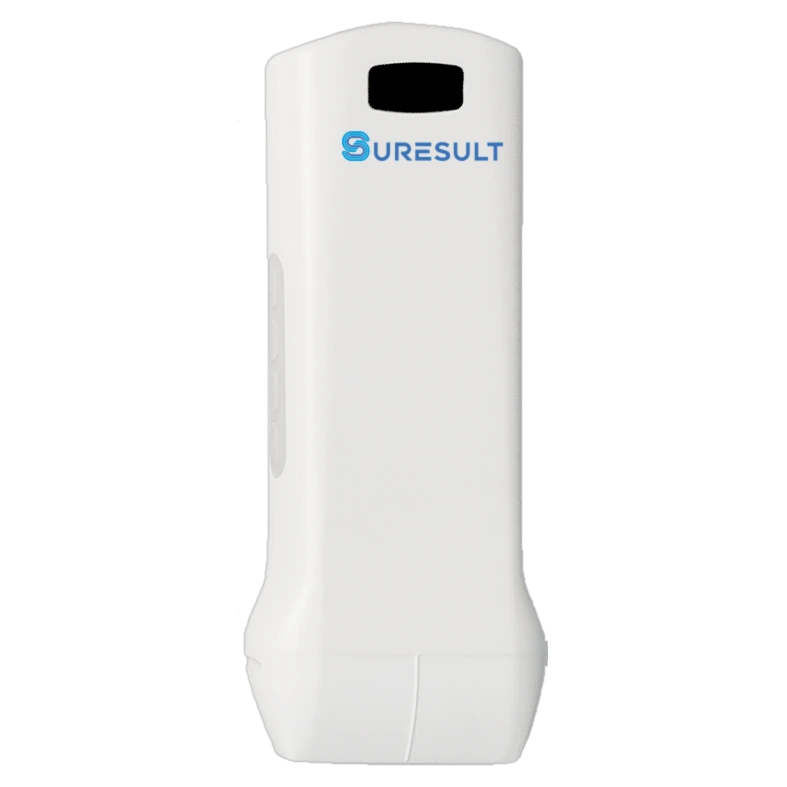 L10H L10H | $2,325 | Linéaire 7.5/10 MHz | 20/40/60/100 mm | Guidage visuel de l’aiguille et batterie offrant 5 heures d’autonomie |
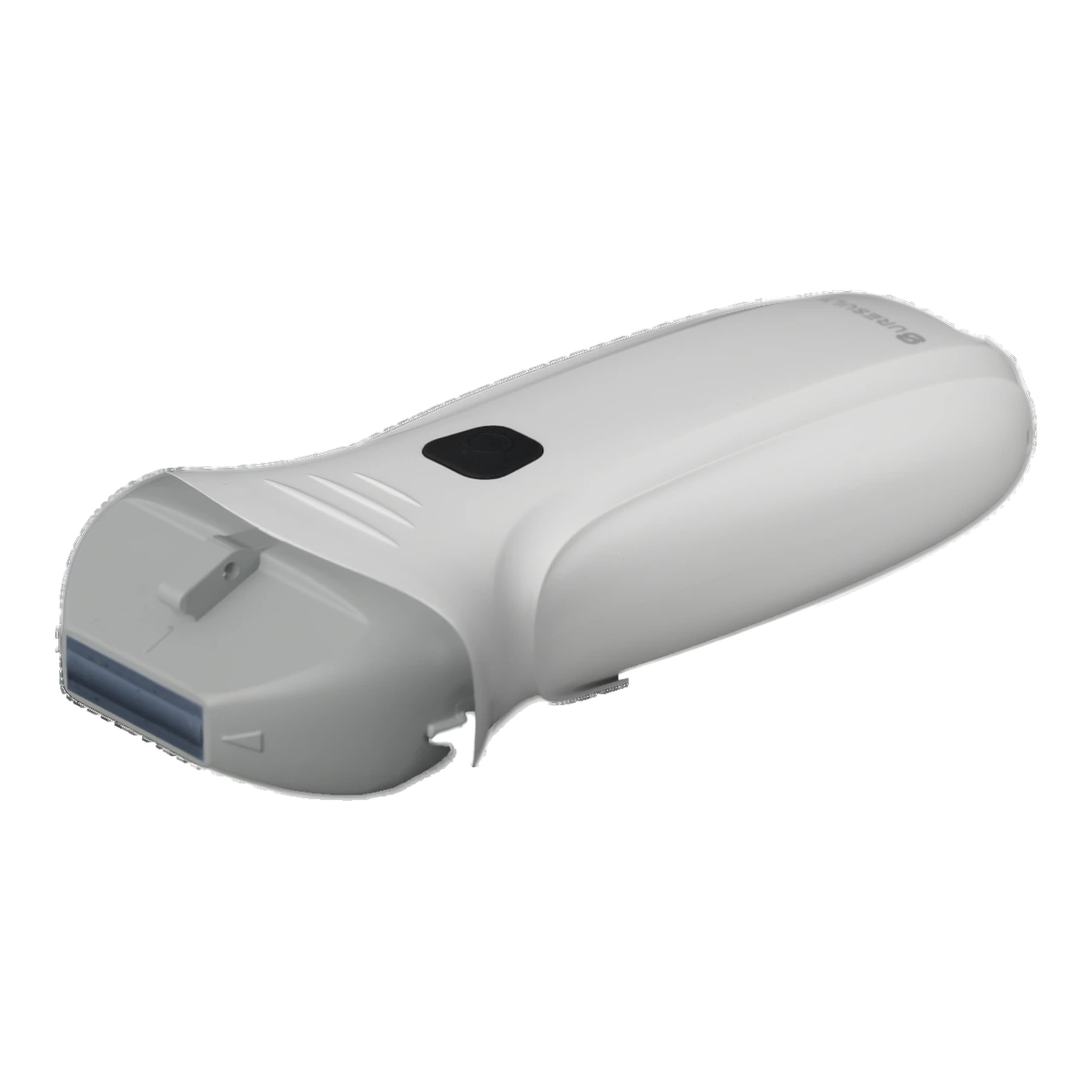 L14 L14 | $2,139 | Linéaire 10/14 MHz | 20 à 80 mm | Accès au 10/14 MHz avec 192 éléments |
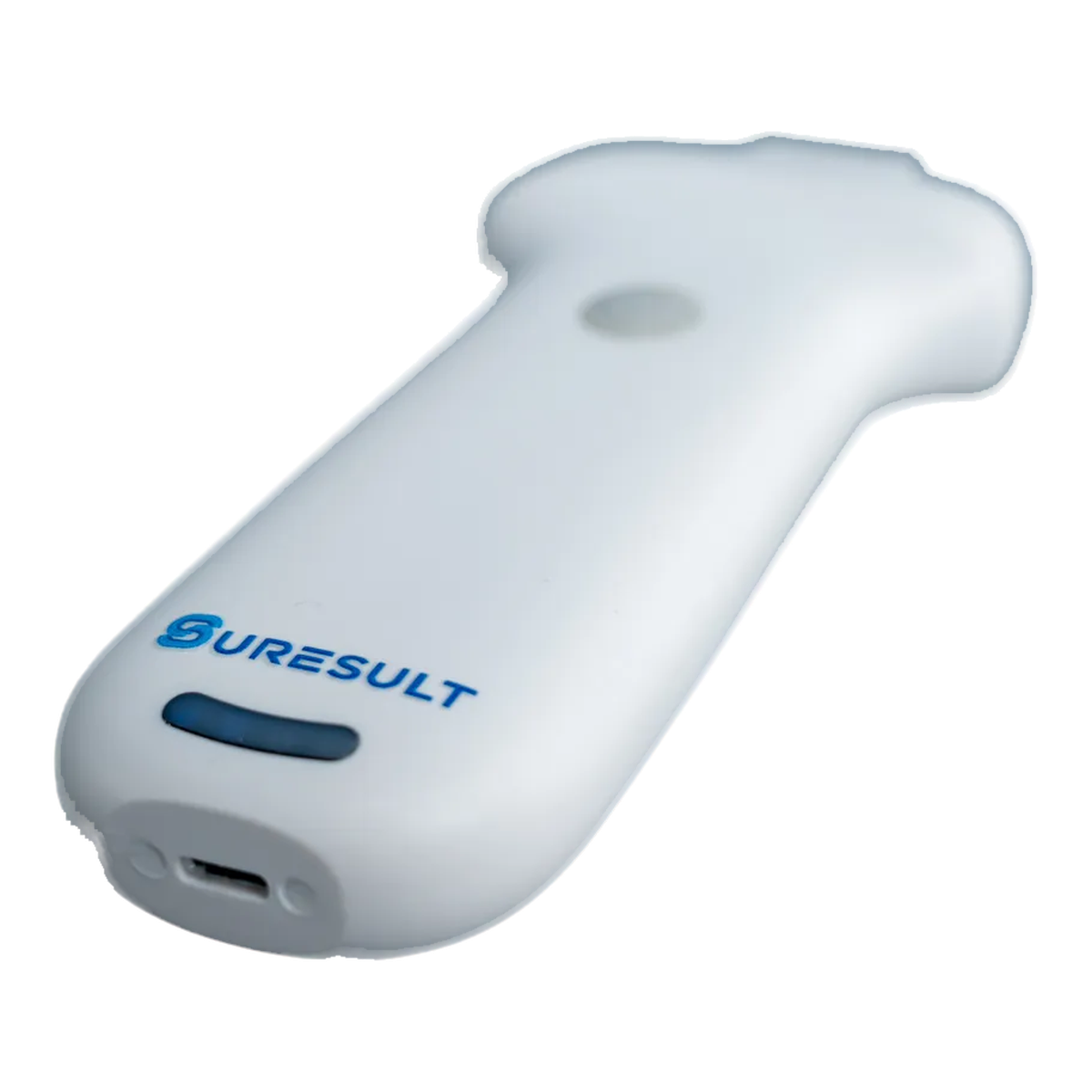 L20 L20 | $2,790 | Linéaire 16/20 MHz | 10/20/30/40 mm | Accès au 16/20 MHz avec 192 éléments |
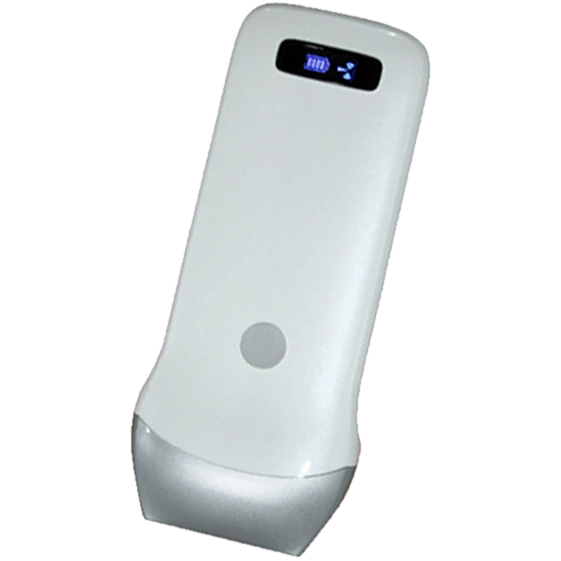 L7.5 L7.5 | $1,209 | Linéaire 7.5/10 MHz | 40-100 mm | Mode B et Doppler puissance uniquement, 80 éléments, profondeur de 40 à 100 mm |
Face aux marques reconnues
Suresult face à Clarius L15 HD3, Butterfly iQ3 et GE Vscan Air CL pour Échographie musculosquelettique
Balayez pour voir toutes les colonnes →
| Suresult | Clarius L15 HD3 | Butterfly iQ3 | GE Vscan Air CL | |
|---|---|---|---|---|
| Imagerie musculosquelettique | 10/14 MHz jusqu’à 80 mm sur le L14Pro ; 16/20 MHz jusqu’à 40 mm sur le L20Pro ; 256 éléments sur les deux modèles | Sonde linéaire 5-15 MHz, profondeur maximale de 7 cm | Sonde unique de 1-12 MHz ; préréglages MSK et tissus mous MSK couvrant 1 à 12 cm | Sonde linéaire 3-12 MHz jusqu’à 8 cm, sonde convexe 2-5 MHz jusqu’à 24 cm |
| Gestes à l’aiguille | Guides de ponction dans le plan, hors du plan, avec grille et inversion sur chaque modèle linéaire ; rehaussement de l’aiguille sur les L14Pro, L20Pro, L10SH, L10H, L20 et D3Ultra | Les fonctions logicielles avancées sont comprises dans l’abonnement annuel Clarius Essentials | Le Doppler puissance et le Doppler pulsé nécessitent la formule Advanced ; l’intégration DICOM s’achète séparément | Les outils numériques s’ajoutent séparément à l’appareil |
| Comparaison côte à côte | Image en direct et image figée affichées simultanément à l’écran, avec compensation du gain en profondeur sur 8 segments sur les modèles Doppler | Les fonctionnalités varient selon la formule d’abonnement | Les fonctionnalités varient selon la formule d’abonnement | Les fonctionnalités varient selon la licence |
| Prix de l’appareil | De $2,139 à $3,720 pour les modèles linéaires Doppler, prix publiés | $3,795 affichés | $3,899 affichés | Prix affiché à partir de $4,999 |
| Abonnement | Aucun. Le logiciel, les mesures, l’export DICOM et les modes Doppler de chaque modèle sont inclus. | Clarius Essentials à $695 par an | Core à $299 par an, Advanced à $420 par an, ou $1,500 en un seul paiement pour cinq ans | Digital Tools vendus séparément de l’appareil |
| Coût total livré | Droits de douane et livraison inclus, livraison sous 1 à 7 jours | Prix catalogue aux États-Unis ; droits de douane et livraison en supplément hors des États-Unis | Prix catalogue aux États-Unis ; droits de douane et livraison en supplément hors des États-Unis | Prix catalogue aux États-Unis ; droits de douane et livraison en supplément hors des États-Unis |
| Plateformes | iOS, Android et Windows | iOS et Android | iOS et Android | iOS et Android |
| Enregistrements réglementaires | FDA 510(k) · ISO 13485 · EU MDR (CE) · TGA · ANVISA · Health Canada | FDA 510(k) | FDA 510(k) | FDA 510(k) |
Les atouts de Suresult
- Les neuf vues MSK de cette page sont de véritables images cliniques, de l’aponévrose plantaire à la fosse poplitée.
- Sans abonnement : les modes Doppler, les guides de ponction, les mesures et l’export DICOM sont fournis avec l’échographe.
- Deux familles de fréquences couvrent les examens MSK, 10/14 MHz pour la profondeur et 16/20 MHz pour le détail superficiel.
- Chaque modèle linéaire intègre de série des guides de ponction dans le plan et hors du plan.
- Le L14Pro et le L20Pro disposent chacun de 256 éléments sur 64 canaux avec une empreinte de 25 mm.
- Le prix affiché au paiement est le prix total à destination, droits de douane et livraison inclus, avec une livraison sous 1-7 jours.
- Le logiciel Suresult fonctionne sous Windows ainsi que sous iOS et Android, sans frais par poste.
- Les prix Suresult de chaque modèle MSK sont directement accessibles sur la page produit, sans formulaire de demande de devis.
Le calcul sur cinq ans
Clarius affiche le L15 HD3 à $3,795 et l’abonnement Clarius Essentials à $695 par an, soit $3,475 de frais d’abonnement à eux seuls sur cinq ans. L’offre Advanced de Butterfly à $420 par an représente $2,100 sur la même période. Le L14Pro fonctionne sans abonnement.
L14Pro, paiement uniqueClarius L15 HD3 : échographe + abonnement= $3,475 de frais à eux seuls au bout de cinq ans
Trois modèles, un seul choix
Vous hésitez sur le modèle qui convient à vos cas cliniques?
Un échange suffit pour obtenir une recommandation claire : la sonde Suresult adaptée, ou une réponse franche “aucune des deux.”
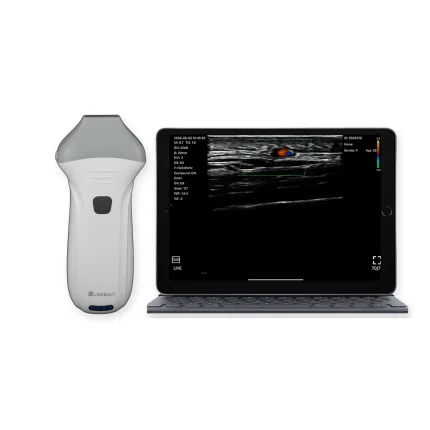
L20Pro
Sonde échographique haute fréquence Suresult L20Pro pour le visage – 16/20 MHz, 256 éléments, sans fil
Fréquence : 16/20 MHz
Profondeur d’exploration : 10/20/30/40 mm
Médecine musculosquelettique (MSK)
buy scanner

L24Pro
L24Pro 18/24 MHz : sonde d’échographie esthétique à 256 éléments pour les injections de produits de comblement
Fréquence : 18/24 MHz
Profondeur d’exploration : 10/15/20/25mm
Médecine musculosquelettique (MSK)
buy scanner

D3Ultra
D3Ultra, échographe de poche polyvalent convexe, linéaire et à réseau phasé
Fréquence : Sonde convexe / à réseau phasé 3.2/5.0MHz Sonde linéaire 7.5/10MHz
Profondeur d’exploration : Linéaire : 20–100 mm, convexe & sectorielle : 90–300 mm
Médecine musculosquelettique (MSK)
buy scanner




Conseils d’experts
Échangez avec un spécialiste des échographes
Décrivez votre pratique quotidienne à Suresult et recevez une recommandation personnalisée d’échographe accompagnée d’un devis tout compris.
- Conseils gratuits pour choisir votre échographe — sondes, fréquence et profondeur adaptées à vos interventions
- Devis tout compris — livraison, dédouanement et taxes applicables inclus
- Livraison rapide — expédition sous 24 heures, livraison à domicile en 1–7 jours
- Logiciel utilisable sans abonnement obligatoire — applications iOS, Android et Windows incluses
- Retours sous 30 j et assistance 24 h/24, 7 j/7
Le chat en direct s’ouvre ici même — sans formulaire ni attente.
