
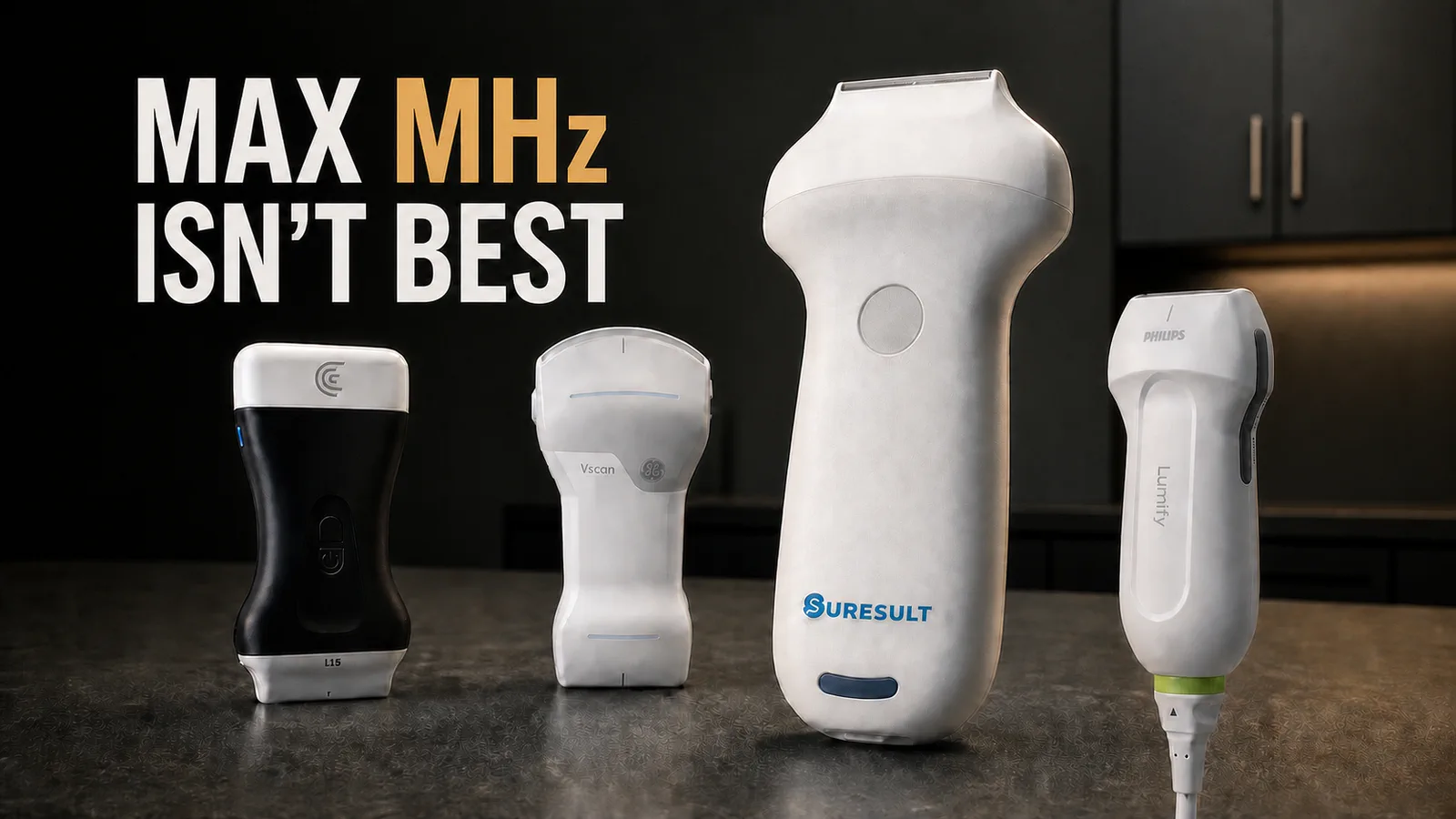
2026 rheumatology ultrasound buyer guide
Choose the probe by rheumatology workflow, not brand noise
For most rheumatology-first clinics, our starting point is L20/L20Pro for balanced 16/20 MHz small-joint work. L24/L24Pro is the superficial-detail specialist; D3Ultra is the shared-clinic POCUS choice.
 L20 / L20Pro
16/20 MHz
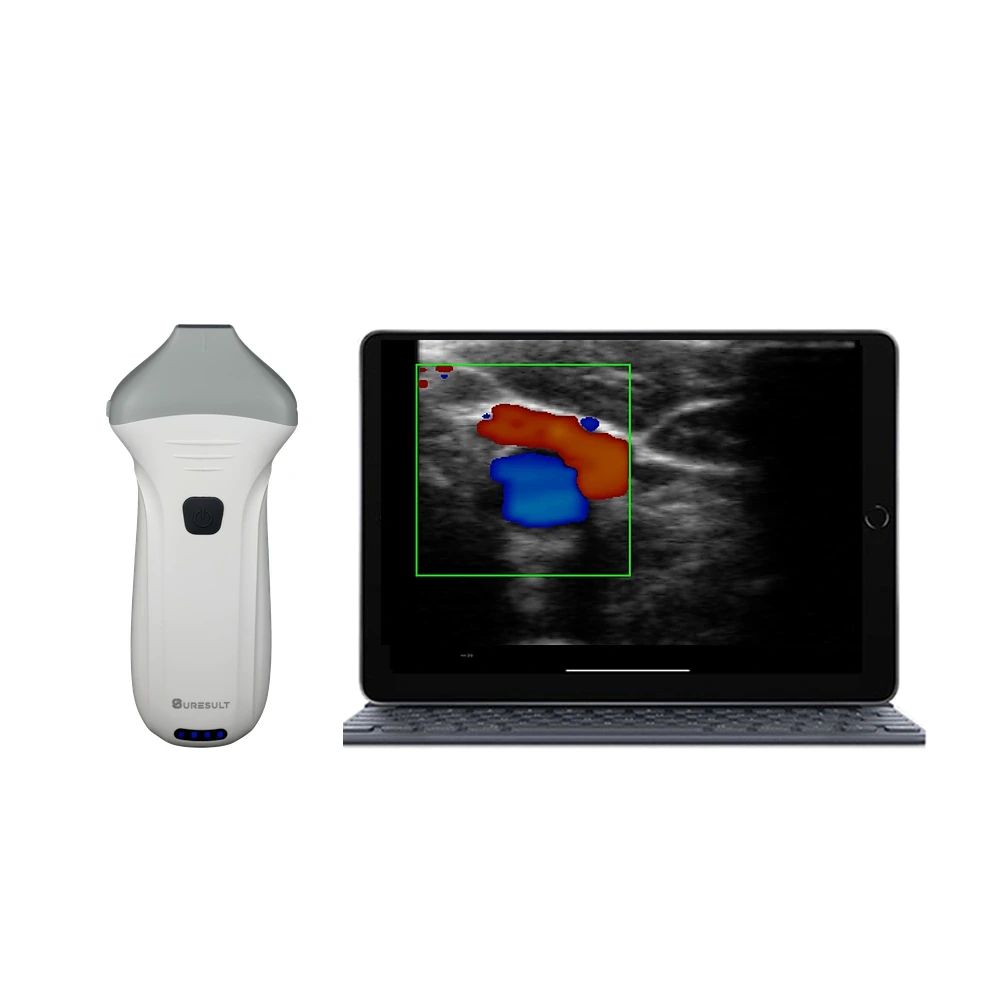 L24 / L24Pro
18/24 MHz
 D3Ultra
shared POCUS
 Suresult Software
no subscription
Opening map: built from real Suresult product and software assets, it separates three rheumatology buying routes: L20/L20Pro for daily high-frequency work, L24/L24Pro for very superficial detail, and D3Ultra for shared-clinic POCUS.


Quick Answer: For most rheumatology clinics in 2026, we would start with a high-frequency linear probe rather than a general handheld scanner. Suresult L20 and L20Pro are the most practical Suresult choices for daily rheumatology because their 16/20 MHz linear imaging and 10-40 mm depth fit small joints, tendons, superficial Doppler, and injection planning. Suresult L24 and L24Pro are sharper superficial specialists at 18/24 MHz with 10-25 mm depth, so we see them as a strong fit for finger, wrist, foot, and very shallow detail work. Suresult D3Ultra is the better choice when one scanner must serve rheumatology plus broader POCUS, because it combines convex, linear, and phased imaging with Suresult Software for iOS, Android, and Windows. If your clinic is rheumatology-first, choose L20/L20Pro. If it is superficial-detail-first, add L24. If it is shared-clinic-first, consider D3Ultra.
Compare Carefully Before You Buy
Before a rheumatology clinic chooses a scanner, we would separate three buyer situations. This prevents a high-frequency specialist probe, a broad POCUS scanner, and an enterprise ecosystem from being judged as if they solve the same problem.
Do not buy L24 first if depth flexibility matters. L24/L24Pro is compelling for very superficial detail, but L20/L20Pro is usually the broader rheumatology workhorse when the clinic needs up to 40 mm depth.
Do not buy D3Ultra first for pure high-frequency specialization. D3Ultra is a shared-clinic POCUS answer. It makes sense when one scanner must cover many rooms, not when the only priority is maximum shallow small-joint detail.
Do not compare scanner price without software ownership. Membership, export workflow, display device support, DICOM, warranty, and image storage can change the real cost after purchase.
What This Article Will Tell You
This article is written for a clinic buyer, not for someone looking for a general ultrasound definition. We are going to compare rheumatology ultrasound machines by the things that actually change a purchase decision: frequency, depth, Doppler, software cost, export workflow, price, and the kind of rheumatology room where each device makes sense.
The short version is simple. Rheumatology is usually a linear-probe decision. Small joints, tendons, synovial hypertrophy, superficial vessels, and injection planning usually need high frequency and a short learning path. A cart system can still be excellent, but many private clinics now want a handheld or pocket workflow that can move between exam rooms without a subscription surprise.
Best Suresult first pickL20 / L20Pro for 16/20 MHz small-joint
and tendon work.
Best superficial specialistL24 / L24Pro for 18/24 MHz shallow
detail.
Best shared scannerD3Ultra when rheumatology shares POCUS with
primary care or MSK.
Software ruleSuresult Software is free for iOS, Android, and
Windows with no subscription.
La lista rápida
The quick list ranks rheumatology ultrasound machines by buyer fit, not by brand size alone. For a rheumatology-first clinic, Suresult L20/L20Pro is the most practical first choice because it combines 16/20 MHz high-frequency linear imaging with 10-40 mm depth. Suresult L24/L24 Pro is the superficial-detail specialist at 18/24 MHz and 10-25 mm depth. Suresult D3Ultra is the shared-clinic option because it adds convex, linear, and phased imaging for broader POCUS. Competitor systems from Clarius, GE, Philips, CHISON, Mindray, and Butterfly remain worth comparing, but the buying question should stay concrete: frequency, depth, Doppler, software cost, export workflow, and the daily scan list.
#1
Suresult L20 / L20Pro
Best first choice for high-frequency rheumatology clinics.
16/20 MHz 10-40 mm Color / Power / PW Doppler
Small joints, tendons, synovitis-oriented workflow, superficial Doppler, injections.
$3,000 L20 listed price. L20Pro is $4,000.
#2
Suresult L24 / L24Pro
Best ultra-high-frequency option for shallow small-joint detail.
18/24 MHz 10-25 mm 145 g
Finger, wrist, foot, shallow tendon, very superficial vascular detail.
$4,500 L24Pro price.
#3

Suresult D3Ultra
Best shared-clinic scanner when rheumatology is only one part of the workflow.
Convexo + lineal + escalonado Linear 7.5/10 MHz 20-100 mm linear depth
Rheumatology plus primary care, vascular access, abdomen, lung, and general POCUS.
$3,200 D3Ultra listed price.
#4

Clarius Linear HD3 Series
Best premium wireless specialty ecosystem for clinics already comfortable with Clarius workflow.
Wireless linear MSK/rheumatology identity Membership model
Premium private MSK/rheumatology users who like dedicated wireless probes and app support.
$3,595+ Scanner-class price signal plus membership on Clarius Store models.
#5
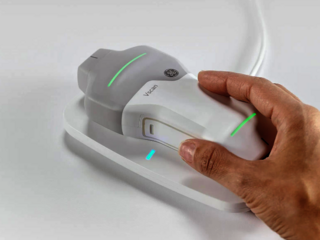
GE Vscan Air CL / SL
Best enterprise-name handheld option for buyers who want GE support and hospital procurement familiarity.
Wireless dual probe Enterprise brand MSK workflow
Hospital groups, enterprise buyers, cardiac/vascular-adjacent clinics.
$5,499+ GE public starting-price signal for Vscan Air models.
#6

Philips Lumify L12-4
Best established wired mobile option for clinics already aligned with Philips-style workflows.
Wired mobile L12-4 linear Hospital-style workflow
Clinics that prefer a familiar established brand and can work inside the Lumify device ecosystem.
Package dependent Transducer and platform costs vary by market and seller.
#7
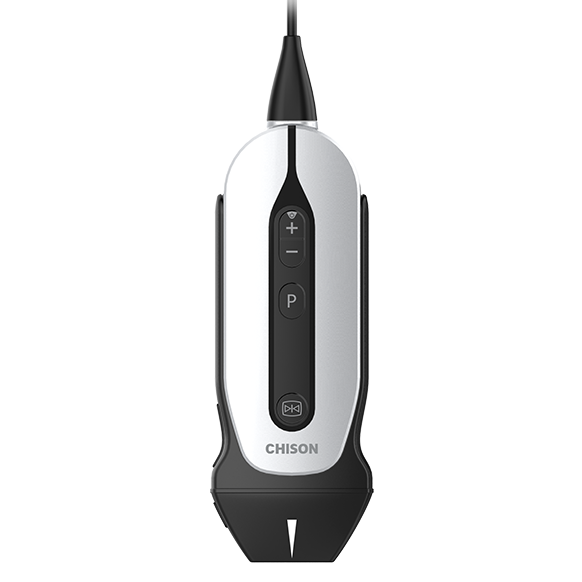
CHISON SonoEye
Best established manufacturer option for buyers comparing handheld ultrasound lines through distributors.
SonoEye line Distributor packages Config dependent
Buyers who value an established manufacturer name and are comfortable comparing package-level configurations.
Model dependent Price and exact probe configuration vary by market.
#8
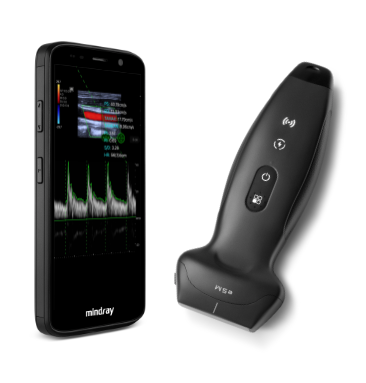
Mindray TE Air e5M
Best institutional wireless POCUS option when the buyer already trusts Mindray systems.
Wireless POCUS Institutional brand App workflow
Hospitals and institutional buyers who want a wireless handheld extension of a broader Mindray environment.
Quote dependent Mindray pricing is usually handled through sales channels.
#9

Mariposa iQ3
Best broad app-ecosystem reference point, but not the pure high-frequency rheumatology pick.
Broad platform App ecosystem AI workflow
Buyers comparing every handheld ultrasound against Butterfly before deciding on a specialty probe.
Membership model Probe and software access should be compared together.
Rheumatology Ultrasound Buyer Tables: Frequency, Depth, Software, and Clinic Fit
Rheumatology buyers should not read frequency, depth, Doppler, software, and price as separate facts. The purchase usually becomes clear when those facts are grouped by clinic workflow. We use the tables below to make the decision path scanable without forcing a seven-column spec grid.
Suresult model fit table
Use this first if your clinic is choosing between L20/L20Pro, L24/L24Pro, and D3Ultra.
| Dispositivo | Choose first when | Frequency / depth logic | Ownership signal |
|---|---|---|---|
| Suresult L20 / L20Pro | Daily rheumatology exams need a practical small-joint workhorse. | 16/20 MHz linear imaging with 10/20/30/40 mm depth; L20Pro adds 256-element positioning. | No-subscription Suresult Software on iOS, Android, and Windows. Price signal: L20 $3,000; L20Pro $4,000. |
| Suresult L24 / L24Pro | The clinic prioritizes very superficial finger, wrist, foot, or shallow tendon detail. | 18/24 MHz linear imaging with 10/15/20/25 mm depth; L24Pro has 256 elements / 64 channels. | No-subscription Suresult Software; strongest Suresult specialist signal for shallow detail. Price signal: L24Pro $4,500. |
| Suresult D3Ultra | One device must cover rheumatology plus broader POCUS across the clinic. | Convex, linear, and phased imaging in one wireless device; linear side covers superficial MSK but not the highest frequency. | No-subscription Suresult Software with broad scan coverage. Price signal: D3Ultra $3,200. |
Competitor reference-check table
Use competitor sections as reference checks, not as a blind ranking. Verify exact probe, software, warranty, and subscription model before comparing price.
| System | Why buyers compare it | What to verify | El comprador ideal |
|---|---|---|---|
| Clarius Linear HD3 Series | Premium wireless specialty probe ecosystem and strong specialty branding. | Exact probe, membership/software cost, rheumatology preset workflow, and warranty. | Specialty buyers who prefer a dedicated wireless probe family. |
| GE Vscan Air CL / SL | Enterprise brand familiarity and institutional procurement comfort. | Model, probe coverage, MSK/rheumatology workflow, and procurement bundle. | Hospital groups and enterprise buyers. |
| Philips Lumify | Established mobile ultrasound name with a wired probe workflow. | Supported display device, probe package, Android workflow, and total system cost. | Clinics already aligned with Philips-style workflows. |
| CHISON / Mindray / Butterfly | Established manufacturer, institutional, or broad app-ecosystem reference points. | High-frequency rheumatology fit, software access, export path, and recurring costs. | Buyers comparing broader platforms before choosing a specialty rheumatology probe. |
The point of these tables is not to make every brand look identical. It is to keep the buyer from comparing a probe price against a complete workflow price.
What Rheumatology Clinics Actually Need from Ultrasound
A rheumatology ultrasound machine is not just a small ultrasound probe with a medical logo. For a rheumatologist, the scanner has to make shallow anatomy readable while still staying fast enough for daily clinic flow. We look first at the linear probe, frequency, depth settings, Doppler behavior, measurement workflow, and whether the software slows the room down.
Published rheumatology literature and professional education resources consistently emphasize ultrasound as a useful tool for joint, tendon, soft-tissue, and inflammatory assessment. That does not mean every clinic needs the most expensive cart system. It means the scanner has to match the anatomy and the rhythm of the clinic.
In practical buying conversations, the questions are usually these:
- Can the probe show small superficial structures clearly enough?
- Can the clinic adjust depth quickly from around 10 mm to 40 mm?
- Does Doppler help with vascularity and inflammatory-flow context?
- Can the software save images, clips, and measurements without a subscription?
- Is the scanner light enough to move between rooms?
- Does the device make sense for guided injections and aspiration workflow?
- Is the price predictable after the probe is purchased?
That is why L20, L24, and D3Ultra have different jobs. L20 is the rheumatology workhorse. L24 is the superficial-detail specialist. D3Ultra is the shared-clinic POCUS route.
1. Suresult L20 / L20Pro: Best First Choice for Rheumatology Clinics
Top rheumatology value pick
Suresult L20 / L20Pro
If we were choosing one Suresult probe for a rheumatology-first private clinic, we would start with L20 or L20Pro. The reason is not marketing language; it is the balance of frequency and depth. The 16/20 MHz linear profile is high enough for small joints and superficial tendons, while the 10-40 mm depth range gives more breathing room than a very shallow-only probe.
Frecuencia 16/20 MHz
Profundidad 20/30/40 mm
Peso 147 g for L20
Precio $3,000 L20 / $4,000 L20Pro
Why we rank it first
L20 fits the middle of rheumatology better than a shallow-only probe or a broad multiprobe scanner. Hands, wrists, tendons, superficial soft tissue, and many injection-planning situations sit in the kind of depth zone where 16/20 MHz and 10-40 mm make sense. L20Pro adds a higher-spec 256-element platform for buyers who want the stronger version of the same idea.
Pros and cons
Pros
- High-frequency linear imaging for small joints and tendons.
- More depth flexibility than L24 for mixed rheumatology/MSK work.
- Suresult Software has no subscription and supports iOS, Android, and Windows.
- Includes Color, Power, and PW Doppler modes.
Tradeoffs
- Not a 3-in-1 full-body scanner like D3Ultra.
- L20Pro costs more than L20.
- For the very shallowest image-detail buyer, L24Pro may feel more specialized.
El mejor ajuste para el comprador
L20 is the better first purchase for rheumatology clinics that scan small joints but also want enough depth for tendons, soft tissue, vascular context, and MSK-adjacent work. L20Pro is the version we would discuss when the buyer wants the stronger 256-element platform.
2. Suresult L24 / L24Pro: Best Ultra-High-Frequency Specialist for Superficial Detail
Best superficial detail specialist
Suresult L24 / L24Pro
L24 is the probe we would consider when the clinic cares most about very superficial detail. At 18/24 MHz, with 10-25 mm depth, L24Pro makes the most sense for finger, wrist, foot, superficial tendon, and surface-near vascular review. It is not the broadest first choice for every rheumatology clinic, but it is a serious specialist option.
Frecuencia 18/24 MHz
Profundidad 10/15/20/25 mm
Peso 145 g for L24Pro
Precio $4,500 L24Pro
Por qué lo eligen los compradores
Some rheumatology clinics care less about broad depth and more about the shallowest surface-near detail. That is where L24 makes sense. The 18/24 MHz frequency profile gives it a different role from L20. We would not frame L24 as a replacement for every rheumatology workflow; we would frame it as the detail-first option for clinics that already know they live in shallow anatomy.
Pros and cons
Pros
- 18/24 MHz frequency for superficial detail.
- 256 elements / 64 channels on L24Pro.
- Light 145 g design.
- No subscription Suresult Software on iOS, Android, and Windows.
Tradeoffs
- 10-25 mm depth is intentionally shallow.
- Not the best single first purchase for deeper tendon or mixed MSK work.
- Higher price than L20.
El mejor ajuste para el comprador
L24Pro is best for clinics focused on very superficial small-joint detail, finger and wrist work, shallow tendons, surface-near Doppler review, and high-frequency demonstration value. If the clinic wants one broad rheumatology workhorse, we would still compare it against L20 first.
3. Suresult D3Ultra: Best Shared-Clinic Option When Rheumatology Is Not the Only Workflow
Best shared-clinic POCUS route
Suresult D3Ultra
D3Ultra is not the highest-frequency rheumatology probe in this comparison. It wins a different conversation: the clinic that wants one handheld ultrasound for rheumatology plus abdominal, lung, vascular access, primary care, pain, sports medicine, or general POCUS. The 3-in-1 convex, linear, and phased design makes it a practical shared scanner.
Tipo de sonda Convex / linear / phased
Linear frequency 7,5/10 MHz
Linear depth 20/40/60/100 mm
Precio $3,200
Por qué lo eligen los compradores
D3Ultra is attractive when the clinic does not want a single-specialty probe sitting idle between rheumatology visits. The convex probe supports abdomen and deeper work, the phased probe supports cardiac-style POCUS, and the linear probe supports superficial MSK and vascular-adjacent tasks. For a private clinic, mobile clinic, or distributor, that versatility can matter more than maximum superficial frequency.
Pros and cons
Pros
- Convex, linear, and phased imaging in one handheld scanner.
- Suresult Software for iOS, Android, and Windows.
- No subscription and lifetime free software.
- JPEG, MP4, PNG, and DICOM export workflow.
Tradeoffs
- Linear frequency is 7.5/10 MHz, not 16/20 or 18/24 MHz.
- Not the first choice if the clinic only wants high-frequency small-joint detail.
- Shared-clinic strength can be unnecessary for a narrow rheumatology room.
4. Clarius Linear HD3 Series: Best Premium Wireless Specialty Ecosystem
Premium wireless specialty ecosystem
Clarius Linear HD3 Series
Clarius is one of the first brands many MSK and rheumatology buyers check because the company has strong specialty pages and a mature wireless identity. For a clinic that already likes the Clarius app environment, the L-series linear scanners feel like a premium specialty route rather than a generic bargain purchase.
Lo mejor para Premium MSK/rheumatology buyers
Probe logic Dedicated wireless linear ecosystem
Modelo de software Membership-style ownership on many store models
Señal de precio $3,595+ scanner-class signals on Clarius Store models
Why buyers consider it
Clarius has a polished specialty story. The buyer is not only buying a probe; they are buying into a wireless app workflow, education material, and a brand that clearly speaks to specialty users. That is attractive for private MSK and rheumatology buyers who want a premium-feeling device and are comfortable with app-centered ownership.
What we would compare against Suresult
We would compare Clarius against Suresult L20/L24 on ownership predictability. Suresult’s advantage is straightforward: listed device pricing, Suresult Software on iOS, Android, and Windows, and no software subscription. Clarius can still be attractive, but the buyer should compare probe price, membership cost, storage/export workflow, and long-term software access in one calculation.
5. GE Vscan Air CL / SL: Best Enterprise-Name Handheld Option
Enterprise-name handheld option
GE Vscan Air CL / SL
GE Vscan Air is a strong option for enterprise buyers who want a familiar brand name, established procurement pathways, and cardiac/vascular-adjacent handheld workflows. In rheumatology, we see it less as the pure high-frequency small-joint specialist and more as a hospital-friendly handheld platform that can sit inside a broader institutional environment.
Lo mejor para Enterprise and hospital groups
Flujo de trabajo Wireless dual-probe handheld platform
Buyer reason GE procurement familiarity
Señal de precio $5,499+ public starting signal for Vscan Air models
Why buyers consider it
The reason to consider GE is not just one feature. It is the buyer comfort that comes with enterprise support, a recognized manufacturer, and a platform many hospital committees already understand. For procurement teams, that can reduce internal friction even when a smaller specialty-focused probe has a cleaner rheumatology argument.
What we would compare against Suresult
The rheumatology-specific question is whether the clinic needs maximum high-frequency superficial detail or enterprise familiarity. Suresult L20 and L24 give a clearer high-frequency linear story for small-joint and superficial tendon work. GE may be easier to defend inside a hospital system; Suresult may be easier to defend inside a private clinic that wants price, frequency, and software ownership on one page.
6. Philips Lumify: Best Established Wired Mobile Option
Established wired mobile option
Philips Lumify L12-4
Philips Lumify is the established wired mobile choice in many discussions. It is not the cleanest wireless pocket workflow, but it has a serious hospital-style identity and a long-standing mobile ultrasound presence. For rheumatology buyers, Lumify is most relevant when the clinic already uses compatible mobile hardware and wants a familiar Philips pathway.
Lo mejor para Philips-oriented clinics
Probe logic L12-4 linear transducer workflow
Workflow style Wired mobile ultrasound
Purchase note Package, device, and market dependent
Why buyers consider it
Lumify is attractive when a clinic trusts Philips and does not mind a wired mobile setup. The L12-4 linear route keeps it relevant for MSK and superficial work, and the Philips name can help inside institutions where brand familiarity matters. It feels less like a pocket gadget and more like a mobile extension of a larger ultrasound brand.
What we would compare against Suresult
The main comparison is practical. Suresult L20 and L24 are wireless high-frequency probes with Suresult Software across iOS, Android, and Windows. Lumify can be a better fit when the buyer wants a Philips ecosystem; Suresult is easier to justify when the buyer wants wireless scanning, high-frequency specialty positioning, and a simpler no-subscription software story.
7. CHISON SonoEye: Best Established Manufacturer Option
Opción de fabricante establecido
CHISON SonoEye
CHISON appears in rheumatology-related search results and has a long history as an ultrasound manufacturer. We would place SonoEye in the established-manufacturer category rather than the no-subscription value category. The buyer has to compare the exact model, probe configuration, local service pathway, and distributor package.
Lo mejor para Distributor-led comparison buyers
Familia de productos SonoEye handheld line
Purchase style Configuration and distributor dependent
Comparison point Model details and support path
Why buyers consider it
CHISON can make sense for buyers who prefer an established medical-device manufacturer and are comfortable comparing distributor packages. Some clinics like that style of purchasing because it comes through existing sales channels. The tradeoff is that the buying story can become less transparent when model, software, support, and price are handled as a package.
What we would compare against Suresult
Suresult becomes more attractive when the buyer wants a cleaner online price, high-frequency L20/L24 options, and a no-subscription Suresult Software workflow. Against CHISON, we would put the exact frequency, depth, software access, export workflow, warranty, and local service route side by side before deciding.
8. Mindray TE Air: Best Institutional Wireless POCUS Option
Institutional wireless POCUS option
Mindray TE Air e5M
Mindray TE Air is better understood as an institutional wireless POCUS platform than as a narrow rheumatology-only purchase. Mindray has broad ultrasound credibility, and some buyers naturally trust that brand name. For rheumatology, the decision is whether the clinic wants a broader institutional wireless solution or a high-frequency linear probe built around superficial small-joint work.
Lo mejor para Mindray-oriented institutions
Product type Wireless handheld POCUS platform
Buyer reason Brand familiarity and institutional fit
Purchase note Usually quote and channel dependent
Why buyers consider it
Mindray is a serious ultrasound name, and that matters to institutional buyers. TE Air gives buyers a wireless handheld route inside that brand environment. For hospitals or large groups, that can be more persuasive than a smaller specialist brand, especially when procurement teams already know Mindray.
What we would compare against Suresult
If the buyer is comparing Mindray TE Air with Suresult L20 or L24, we would bring the conversation back to frequency, depth, software ownership, and export workflow. Those four points decide more rheumatology purchases than brand familiarity alone. Suresult has the clearer high-frequency rheumatology and no-subscription software story; Mindray has the institutional brand advantage.
9. Butterfly iQ3: Best App Ecosystem Reference, Not the Pure Rheumatology Pick
Broad app ecosystem reference
Mariposa iQ3
Butterfly iQ3 is worth mentioning because many buyers compare every handheld ultrasound against Butterfly. The app ecosystem and AI-guided workflow can be appealing, and Butterfly has strong brand recognition. For rheumatology, though, we would not make Butterfly the first high-frequency small-joint recommendation.
Lo mejor para Broad POCUS app-ecosystem buyers
Product logic General handheld platform
Buyer reason Brand recognition and AI workflow
Comparison point Probe plus software-access model
Why buyers consider it
Butterfly has a strong ecosystem story. Many buyers know the name before they know the difference between a high-frequency linear probe and a broad handheld platform. That visibility makes it a real comparison point in almost every handheld-ultrasound buying conversation.
What we would compare against Suresult
The comparison is simple. Butterfly is a broad handheld ecosystem. Suresult L20 and L24 are high-frequency linear choices aimed at superficial structures. If the buyer’s main question is “What scanner helps a rheumatology clinic inspect shallow joints and tendons?”, we would look closely at L20 and L24 before choosing a general-purpose handheld platform.
Which One Should Your Rheumatology Clinic Buy?
This is the decision table we would use after the buyer has seen the specs.
Clinic-first decision table
Start from the scan list, not the logo. The right answer changes when the room is rheumatology-only, shared MSK/POCUS, or enterprise procurement driven.
| Clinic question | La mejor opción inicial | Por qué | Second option |
|---|---|---|---|
| Mostly small joints, tendons, superficial Doppler, and routine rheumatology exams? | Suresult L20 / L20Pro | 16/20 MHz with 10-40 mm depth gives the best daily balance. | L24 if the clinic is consistently shallow-detail focused. |
| Mostly fingers, wrists, shallow foot anatomy, and very superficial detail? | Suresult L24 / L24Pro | 18/24 MHz and 10-25 mm depth favor surface-near detail. | L20 if the clinic needs more depth range. |
| One scanner must also cover primary care, vascular access, abdomen, lung, or broader POCUS? | Suresult D3Ultra | Convex, linear, and phased imaging reduce the risk of buying the wrong first scanner. | L20 as a dedicated rheumatology add-on later. |
| The buyer wants a premium wireless specialty ecosystem and accepts membership-style software cost? | Clarius Linear HD3 Series | Strong specialty branding and dedicated wireless workflow. | Suresult L20 for no-subscription ownership clarity. |
| The buyer is an enterprise hospital group with brand procurement requirements? | GE / Philips / Mindray | Institutional familiarity can matter more than direct online price. | Suresult for private-clinic value and direct purchase clarity. |
Why Frequency and Depth Matter More Than Brand Hype
A high-frequency rheumatology probe is valuable because superficial anatomy can be unforgiving. A few millimeters can change the way the image feels on screen. But frequency without depth flexibility can also be limiting. That is why we do not automatically tell every rheumatology buyer to choose the highest-frequency number.
L24Pro at 18/24 MHz is compelling when the clinic wants the shallowest detail. L20 at 16/20 MHz is often the better first rheumatology purchase because it still gives high-frequency imaging while extending to 40 mm. D3Ultra is not as high frequency on the linear side, but it solves a different problem: it keeps a broader clinic from buying multiple separate scanners too early.
The best rheumatology ultrasound machine is the one that matches your room. A clinic scanning mostly fingers and wrists has a different need from a mixed rheumatology/MSK clinic, and both are different from a primary care group that only occasionally scans joints.
Suresult Software: Why No Subscription Matters in a Rheumatology Room
Rheumatology ultrasound is not a once-a-month workflow. If ultrasound becomes part of daily clinic rhythm, software friction becomes obvious. That is why the software model belongs in the purchase decision, not hidden at the end of the article.
Suresult Software supports iOS, Android, and Windows. For L20, L24, and D3Ultra, Suresult presents the software as free with no subscription cost and lifetime free software. That matters for clinics that want predictable ownership and do not want routine scanning, saving, or measurement work to become a recurring software conversation.


What we like about Suresult’s ownership story
The cleanest part of the Suresult ownership story is that the probe, software, export, and platform compatibility are easy to explain in one conversation. L20 is listed at $3,000 with 16/20 MHz and 10-40 mm depth; L24Pro is $4,500 with 18/24 MHz and 10-25 mm depth; D3Ultra is listed at $3,200 with convex, linear, and phased imaging for shared POCUS rooms. All three use Suresult Software across iOS, Android, and Windows. The software model is presented as no subscription with lifetime free software, and the workflow includes local storage, DICOM-oriented export, JPEG, MP4, and PNG sharing, cine loop, presets, measurements, and Doppler modes. For private rheumatology clinics and distributors, that reduces friction because the buyer can compare the scanner without adding a separate recurring software budget discussion.
Image Evidence and Workflow Examples
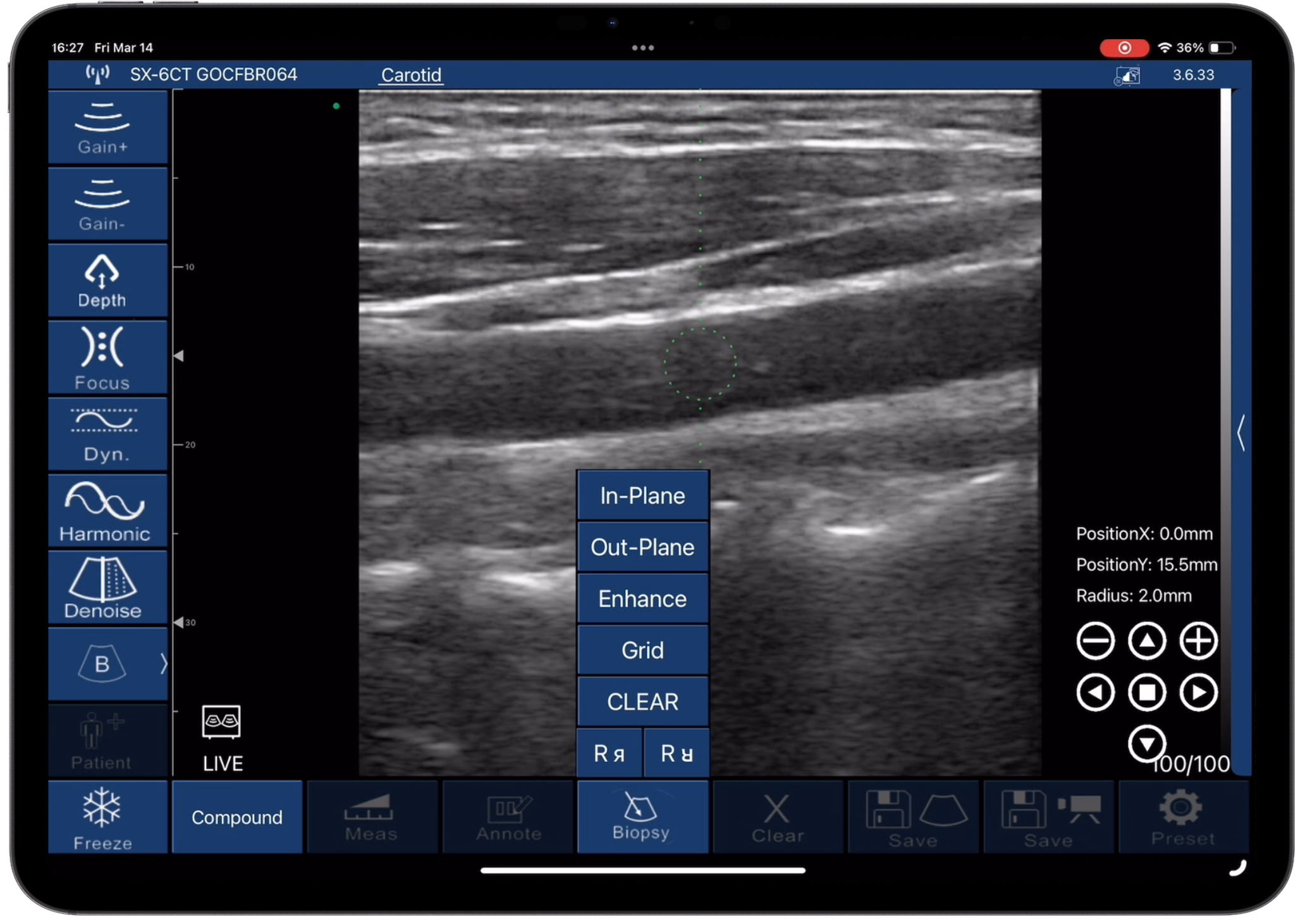
Image evidence matters in a rheumatology ultrasound buyer guide because the scanner is being purchased for shallow structure recognition, not just for brand identity. A useful product image shows probe shape, screen workflow, or the kind of MSK/superficial reference image the clinic expects to review. For Suresult, the most useful visual proof points are high-frequency linear product images, MSK and superficial imaging examples, Doppler workflow, puncture assist, and Suresult Software GIFs that show presets, scan modes, and measurements. The image should answer a buyer question: Can the device support small-joint work? Can it show superficial detail? Can the software support routine documentation?

Our Buying Logic for a Rheumatology Clinic
If a buyer asks our clinical team, “I run a rheumatology clinic, which ultrasound should I buy?”, we do not start with the most famous brand. We start with the daily scan list.
If the clinic spends most of the day on small joints, tendons, superficial soft tissue, and Doppler review, we would start with Suresult L20 or L20Pro. The 16/20 MHz and 10-40 mm range are practical. It gives the clinic enough shallow detail without forcing every scan into a 25 mm ceiling.
If the clinic is obsessed with the highest superficial detail and the scanning targets are consistently shallow, we would add L24 or L24Pro to the conversation. It is a specialist, not a generic replacement for every rheumatology room.
If the clinic is small and cannot justify one probe for every specialty, we would look at D3Ultra. It is not the highest-frequency linear option, but its 3-in-1 coverage solves a real purchasing problem for mixed clinics.
En resumen
The best rheumatology ultrasound machine in 2026 is usually a high-frequency linear probe with enough depth flexibility for daily joint and tendon work. In the Suresult lineup, L20/L20Pro is the best first conversation for most rheumatology clinics because it combines 16/20 MHz frequency with 10-40 mm depth, Doppler modes, and no-subscription Suresult Software. L24/L24Pro is the sharper specialist for very superficial detail at 18/24 MHz and 10-25 mm depth. D3Ultra is the smarter shared-clinic purchase when one scanner must support rheumatology plus broader POCUS.
For many private clinics, the real question is not “Which brand is most famous?” It is “Which device will my team actually use every day without making the workflow or ownership cost harder?” On that question, L20, L24, and D3Ultra each have a clear role.
PREGUNTAS FRECUENTES
What is the best ultrasound machine for rheumatology in 2026?
For most rheumatology clinics, the best first choice is a high-frequency linear probe. In the Suresult lineup, L20/L20Pro is the best starting point because it combines 16/20 MHz imaging with 10-40 mm depth. L24/L24Pro is better for very superficial detail, while D3Ultra is better for shared-clinic POCUS.
What frequency is best for rheumatology ultrasound?
Rheumatology often benefits from high-frequency linear imaging because small joints, tendons, and superficial soft tissue are close to the probe. Suresult L20 uses 16/20 MHz, while Suresult L24Pro uses 18/24 MHz. The best frequency depends on whether the clinic wants broader 40 mm depth or very superficial 25 mm detail.
Is L20 or L24 better for rheumatology?
L20 is the better first choice for most rheumatology clinics because 16/20 MHz with 10-40 mm depth covers more daily situations. L24 is better when the clinic wants maximum superficial detail and most scanning targets sit within 10-25 mm.
Is D3Ultra good for rheumatology?
D3Ultra is good for rheumatology when the clinic wants one scanner for multiple specialties. Its linear probe can support superficial MSK and joint work, while the convex and phased probes add full-body POCUS coverage. For rheumatology-only high-frequency detail, L20 or L24 is the more targeted choice.
Do rheumatology ultrasound machines need Doppler?
Doppler is useful in rheumatology because buyers often want vascularity and flow context, not just grayscale structure. Suresult L20, L24Pro, and D3Ultra include B-Mode, Color Doppler, M-Mode, Power Doppler, and Pulsed Wave Doppler workflows.
Should a rheumatology clinic buy a handheld ultrasound or a cart system?
A cart system can be excellent for a hospital department, but a handheld scanner can fit private clinic workflow better when mobility, room-to-room use, price, and software ownership matter. The best choice depends on scan volume, staff workflow, documentation needs, and whether ultrasound is used daily or occasionally.
Which rheumatology ultrasound has no subscription?
Suresult L20, L24Pro, and D3Ultra use Suresult Software for iOS, Android, and Windows with no listed software subscription and lifetime free software. That is a major ownership difference when comparing against platforms that use membership or subscription-style software access.
What should I compare before buying a rheumatology ultrasound machine?
Compare frequency, depth, Doppler modes, software cost, platform compatibility, export formats, DICOM/local storage, weight, warranty, shipping, certification documentation, and the exact clinic workflow. For Suresult, the key comparison is L20 for balanced rheumatology, L24 for very superficial detail, and D3Ultra for shared POCUS.
Fuentes y referencias
- Suresult. “L20 High-frequency 16/20 MHz Linear Wireless Ultrasound.”
L20 Ultrasonidos inalámbricos lineales de alta frecuencia de 16/20 MHz para inyecciones de cirugía plástica facial y cutánea MSK
Accessed June 18, 2026. - Suresult. “L20Pro 16/20MHz High-Frequency Linear Probe Ultrasound.”
Sonda de ultrasonidos lineal L20Pro de 16/20 MHz y 256 elementos para estética
Accessed August 3, 2026. - Suresult. “L24Pro 18/24MHz High-Frequency Linear Probe Ultrasound.”
L24Pro 18/24MHz 256-Element Aesthetic Ultrasound Probe for Filler
Accessed August 3, 2026. - Suresult. “D3Ultra Convex Linear Phased Multipurpose Handheld
Ultrasound.”
D3Ultra Ultrasonidos portátiles multifunción de fase lineal convexa
Accessed June 18, 2026. - Suresult. “Handheld Ultrasound for Rheumatology.” https://suresultmed.com/specialty/handheld-ultrasound-for-rheumatology/ Accessed June 18, 2026.
- Suresult. “Certifications & Compliance.” https://suresultmed.com/certifications-compliance/ Accessed June 18, 2026.
- Clarius. “L15 HD3 Wireless Handheld Linear Scanner.” https://clarius.com/scanners/l15/ Accessed June 18, 2026.
- Clarius. “Rheumatology.” https://clarius.com/specialties/rheumatology/ Accessed June 18, 2026.
- GE HealthCare Ultrasound. “Vscan Air.” https://gehealthcare-ultrasound.com/en/vscan-air/ Accessed June 18, 2026.
- GE HealthCare. “MSK Portable Ultrasound Machine.” https://www.gehealthcare.com/en-us/products/ultrasound/handheld-ultrasound/msk Accessed June 18, 2026.
- Philips. “Lumify L12-4 Linear Array Transducer.” https://www.usa.philips.com/healthcare/product/HC989605451352/lumify-l12-4-linear-array-transducer Accessed June 18, 2026.
- Philips. “Lumify Handheld Ultrasound for Musculoskeletal.” https://www.usa.philips.com/healthcare/sites/lumify-handheld-ultrasound/specialty/msk Accessed June 18, 2026.
- CHISON. “Handheld Ultrasound.” https://www.chison.com/handheld-ultrasound/ Accessed June 18, 2026.
- CHISON. “SonoEye P1.” https://www.chison.com/sonoeye/sonoeye-p1.html Accessed June 18, 2026.
- CHISON. “Why a Veteran Rheumatologist Refers to Ultrasound…” https://www.chison.com/news/why-a-veteran-rheumatologist-refers-to-ultrasound.html Accessed June 18, 2026.
- Mindray. “TE Air e5M.” https://www.mindray.com/en/products/ultrasound/point-of-care/te-air-e5m Accessed June 18, 2026.
- Butterfly Network. “Butterfly iQ3.” https://www.butterflynetwork.com/ Accessed June 18, 2026.
- PubMed. “Integrating handheld ultrasound in rheumatology: A review.” https://pubmed.ncbi.nlm.nih.gov/40571451/ Accessed June 18, 2026.
- American College of Rheumatology. “Ultrasound: A Valuable Tool for Rheumatologists and Rheumatic Patients.” https://rheumatology.org/patient-blog/ultrasound-a-valuable-tool-for-rheumatologists-and-rheumatic-patients Accessed June 18, 2026.
- BMUS. “Ultrasound in Rheumatology.” https://www.bmus.org/education-and-cpd/cpd-resources/top-tips/ultrasound-in-rheumatology/ Accessed June 18, 2026.
Need help choosing between L20, L24, and D3Ultra?
Tell Suresult what your clinic scans most often: small joints, tendons, superficial vessels, mixed MSK, or shared POCUS. The right first probe depends on that workflow.
