
El atlas de doce bloqueos contiene grabaciones clínicas sin editar de esta familia de equipos; la ilustración del flujo en color es una captura de la biblioteca de referencia de Suresult ·8.717 profesionales clínicos confían en nosotros →
Respuesta rápida
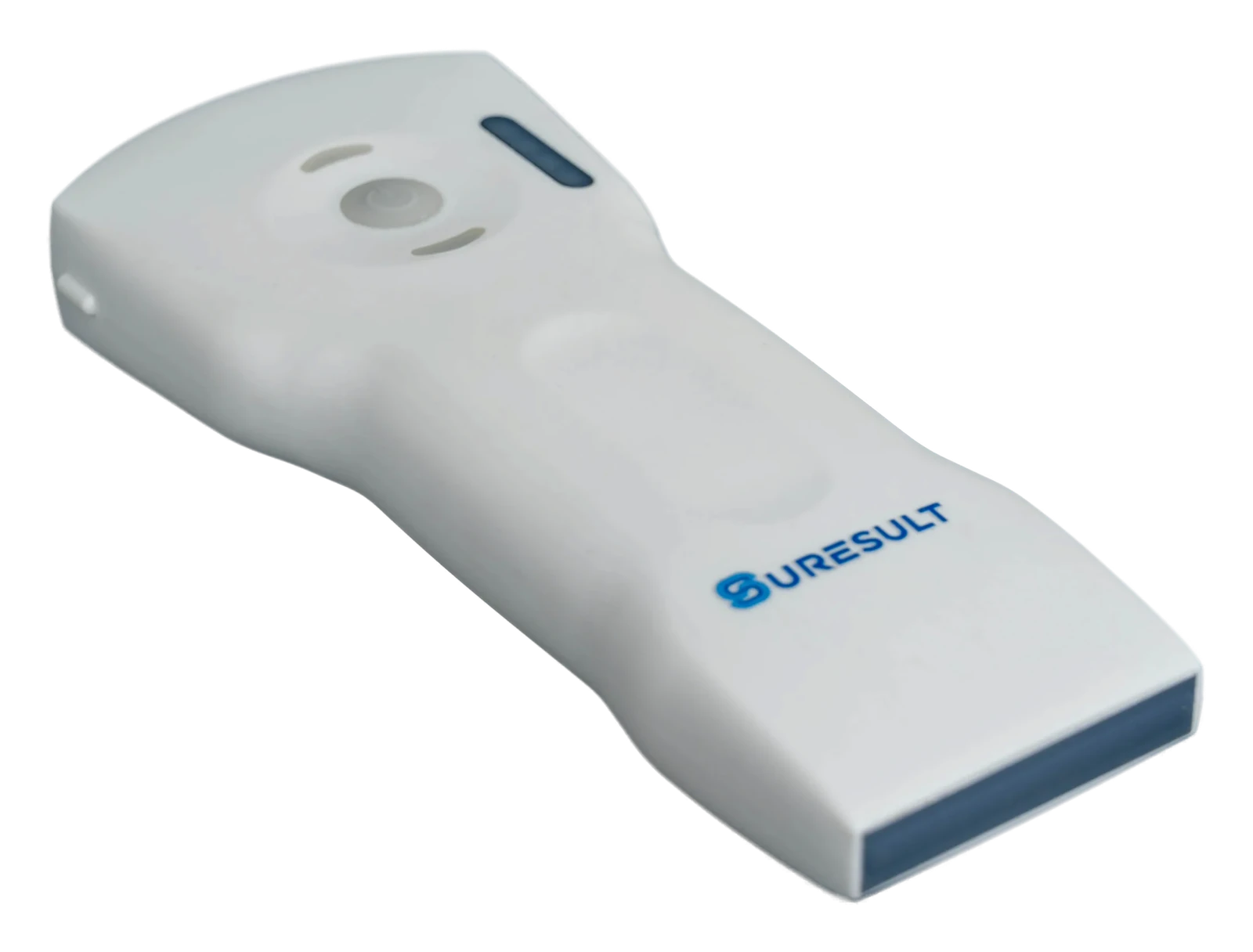
Un ecógrafo para bloqueos nerviosos es el sistema de imagen que permite visualizar el nervio objetivo y guiar la aguja hasta él en tiempo real. También confirma que el anestésico local se ha distribuido alrededor del nervio. Los ecógrafos de mano inalámbricos de doble cabezal, como el Suresult D3Ultra, abarcan ahora los bloqueos de plexos superficiales y las ventanas profundas, como la del ciático por vía anterior, procedimientos que antes requerían un equipo con carro.
- Dos cabezales: lineal para plexos superficiales, convexo para ventanas profundas del ciático
- Guías de aguja en pantalla: en plano y fuera de plano, con indicadores de posición y ángulo
- Calidad de imagen para la docencia: cada bloqueo guardado como secuencias de cine y en formato DICOM
El atlas de bloqueos
Doce bloqueos nerviosos, visualizados con un solo ecógrafo de mano
“Es un excelente ecógrafo de mano para realizar anestesia regional… Realizo anestesia regional en cirugía ambulatoria, cirugía mayor hospitalaria, en la unidad de cuidados intensivos y en medicina de urgencias prehospitalaria.”
— David Heimpel, quien obtuvo con su D3Ultra las imágenes de los doce bloqueos que se muestran a continuaciónCapturas clínicas sin editar · valores de la guía de aguja en cada fotograma · seleccione cualquier imagen para ampliarla
Imágenes obtenidas por un anestesiólogo alemán con su propio equipo. Las etiquetas en pantalla están en alemán: Winkel = ángulo de la aguja, Posición = punto de entrada de la aguja respecto a la sonda, en mm.
Hombro & brazo1 bloqueo
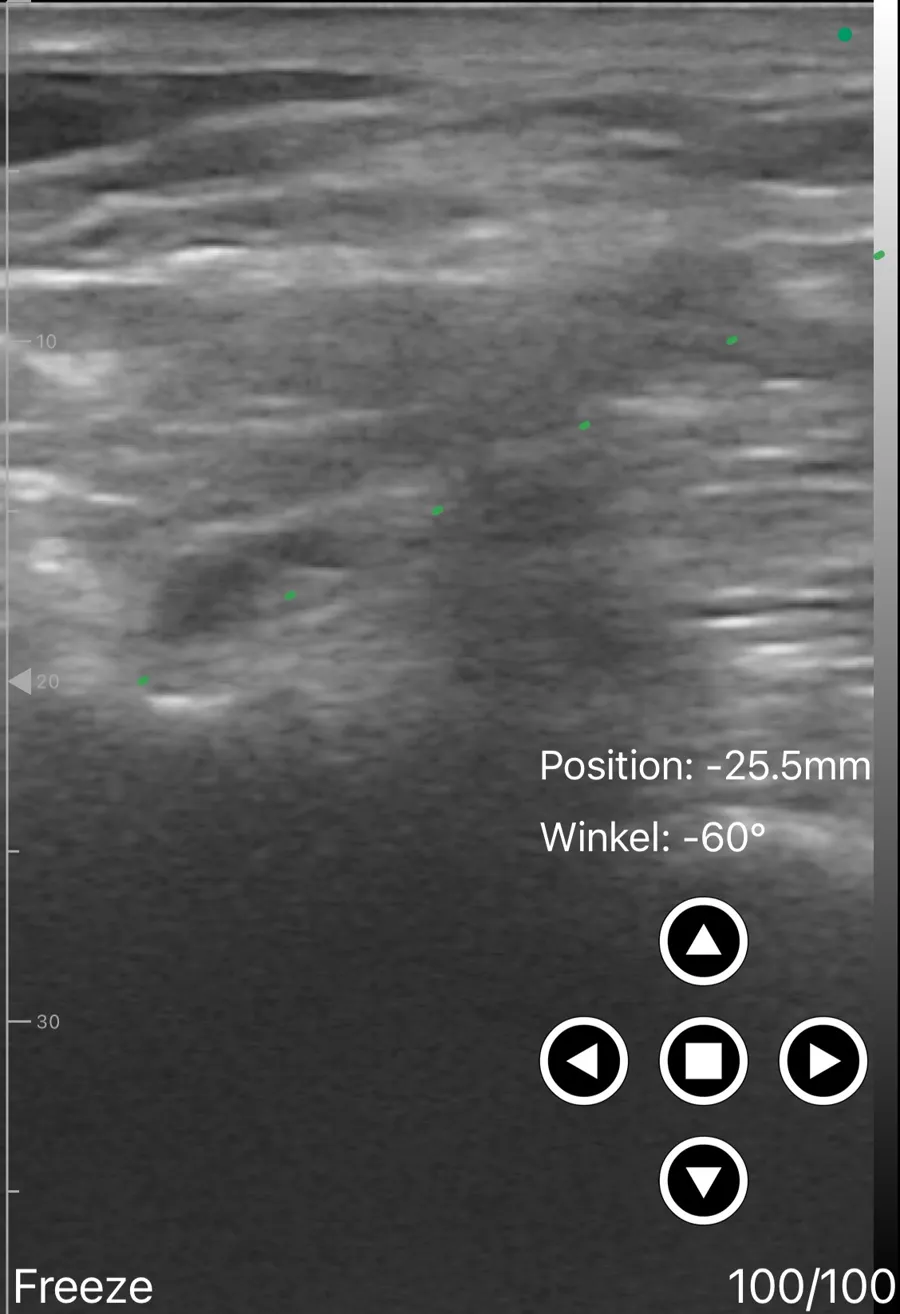
Bloqueo interescalénico del plexo braquial
Las raíces entre los escalenos: cirugía de hombro y brazo. Superficiales, a 1–3 cm, visualizadas con el cabezal lineal de alta frecuencia.
Tórax & tronco4 bloqueos
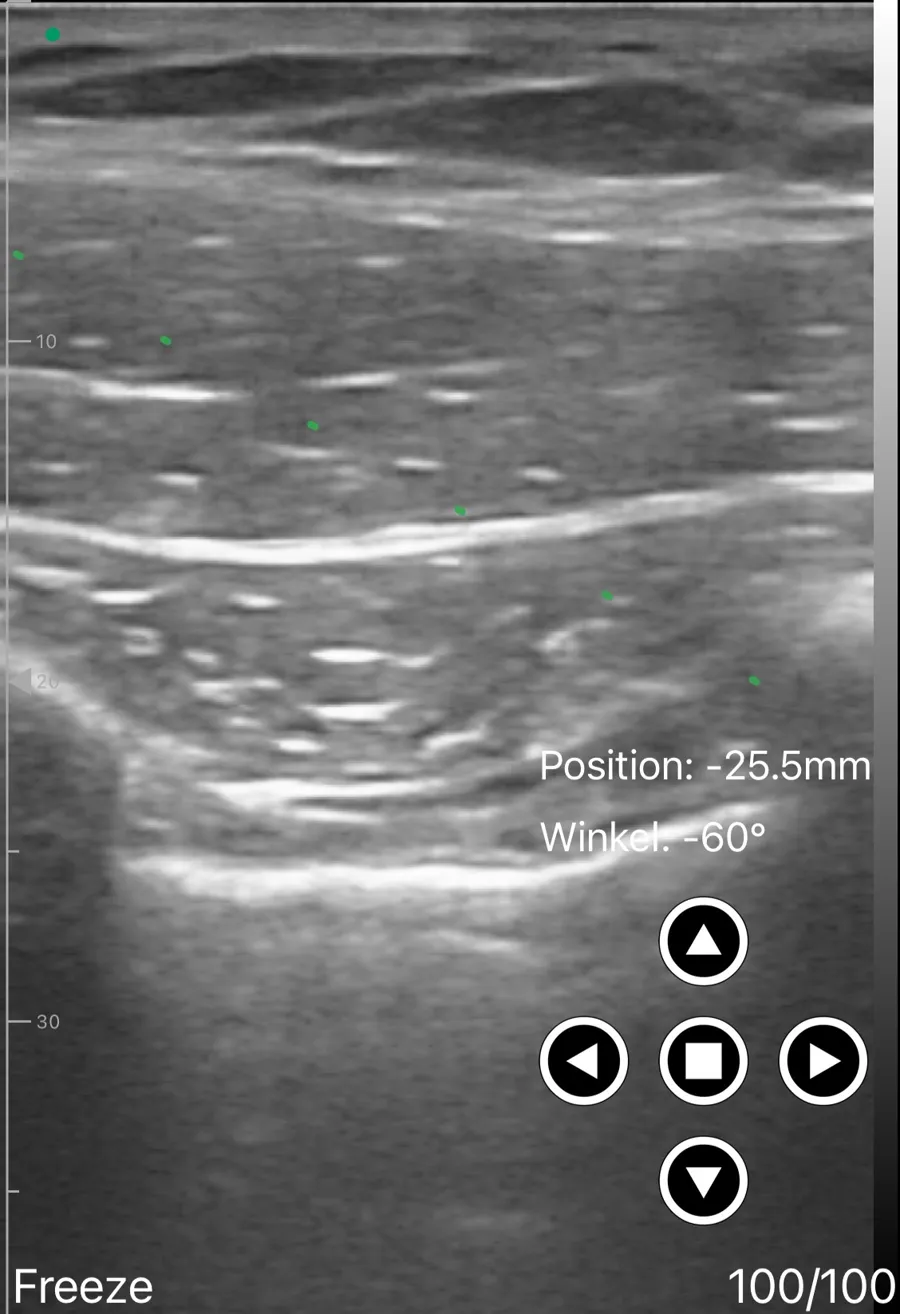
Bloqueo PECS
Nervios pectorales para cirugía mamaria y de la pared torácica anterior. Planos fasciales entre el pectoral mayor, el menor y el serrato, visualizados con el cabezal lineal.
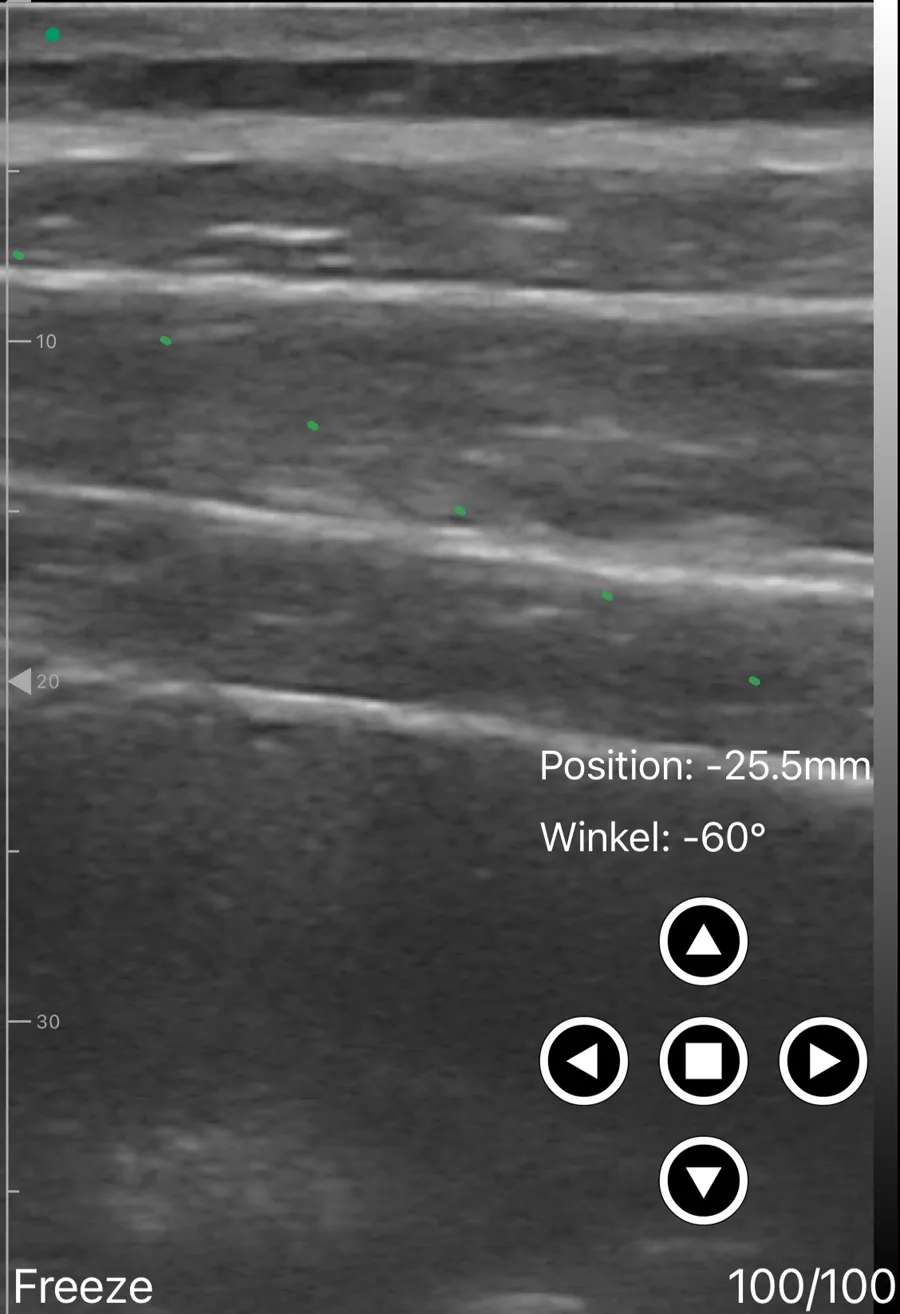
Bloqueo TAP
Analgesia de la pared abdominal. El plano entre el oblicuo interno y el transverso del abdomen, visualizado con el cabezal lineal en la región lateral del abdomen.
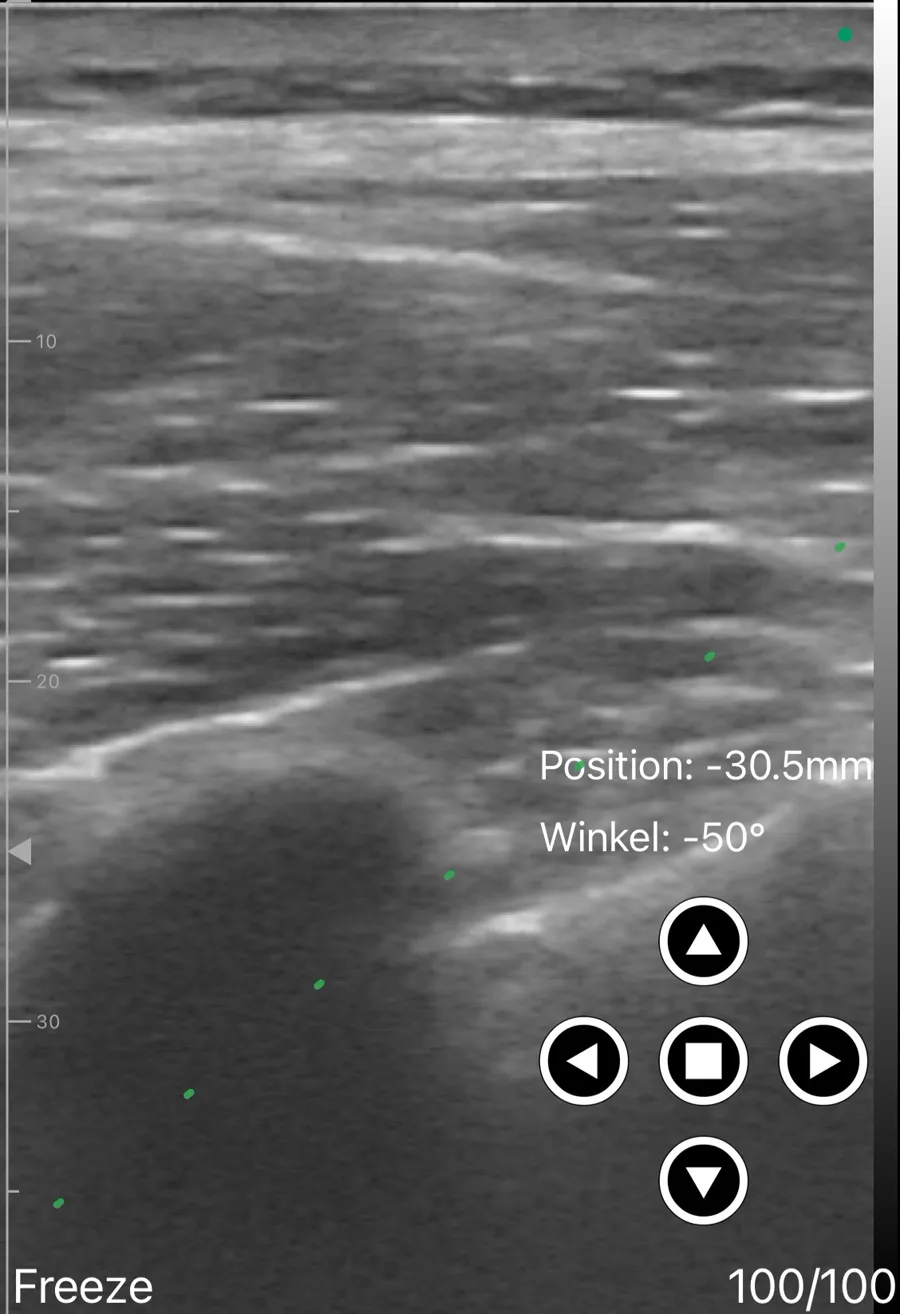
Bloqueo paravertebral
Analgesia torácica segmentaria junto a la columna. El espacio se encuentra en profundidad respecto a la apófisis transversa y lateral al cuerpo vertebral, al alcance del cabezal lineal en la mayoría de los adultos.
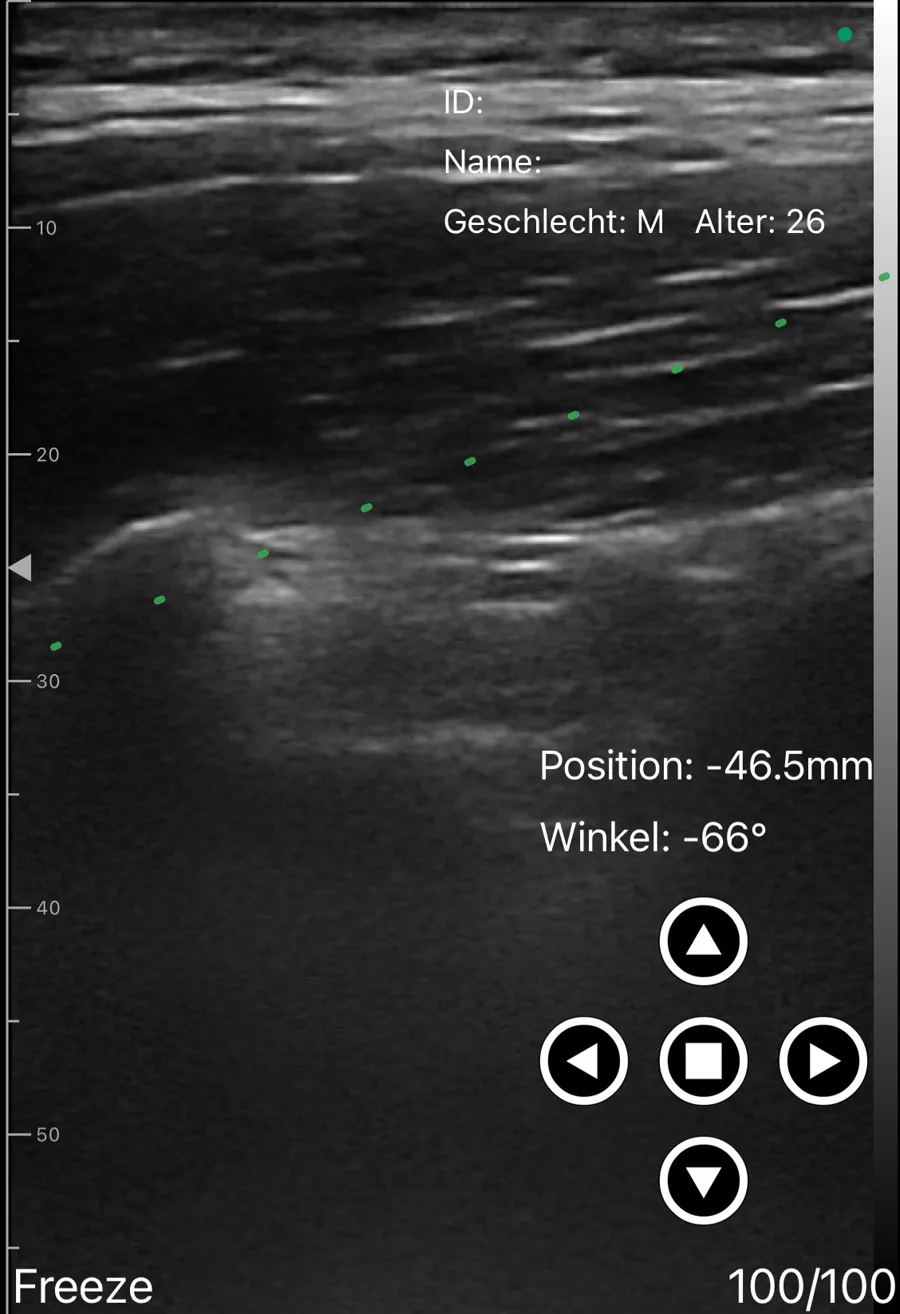
Bloqueo del plano del músculo erector de la columna
El plano fascial ESP: un nivel, amplia difusión torácica. Profundo al músculo erector de la columna, a la altura de la apófisis transversa. Cabezal lineal o convexo según la complexión.
Cadera & pelvis3 bloqueos
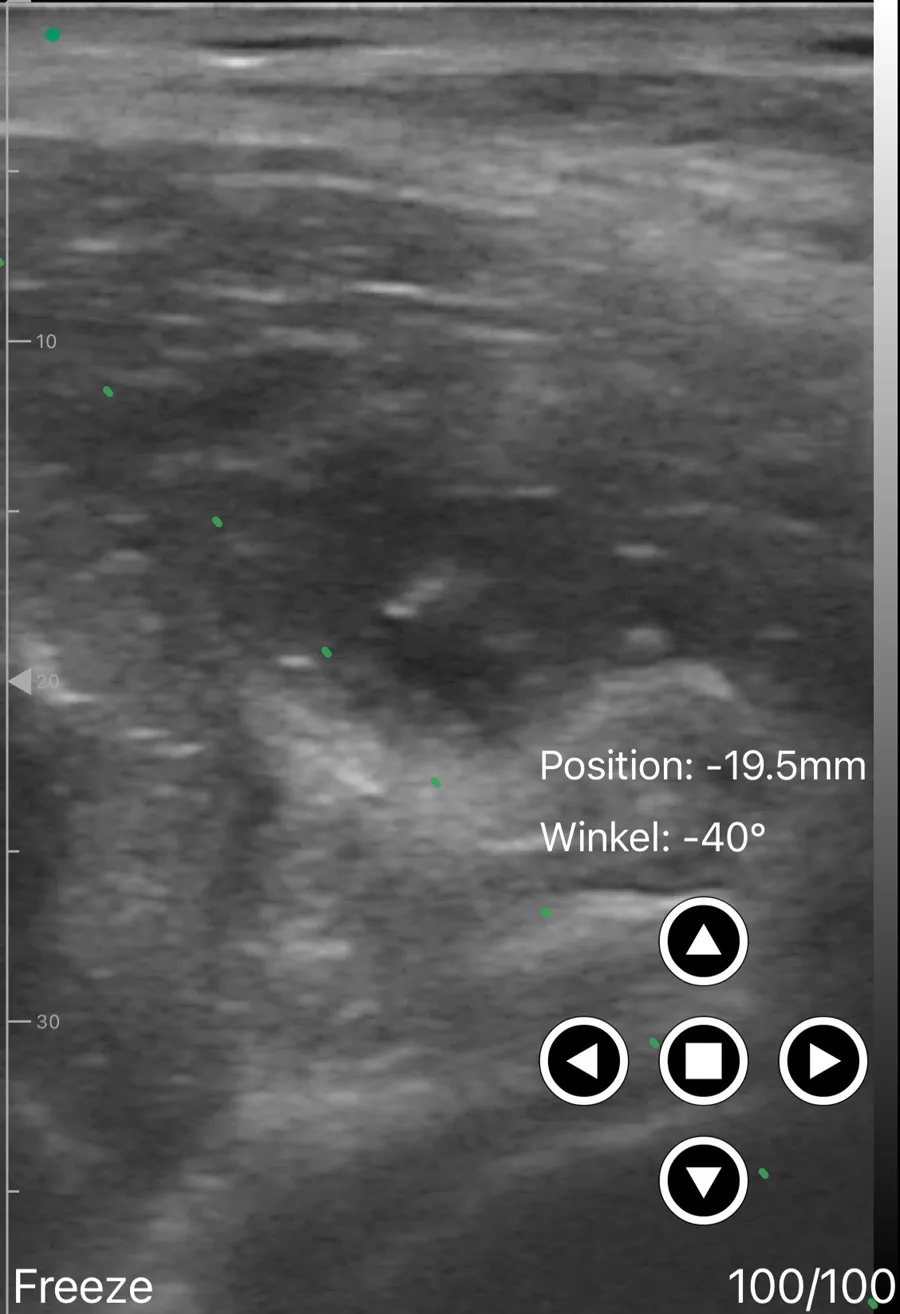
Bloqueo PENG
Grupo de nervios pericapsulares para fracturas y cirugía de cadera. Entre la espina ilíaca anteroinferior y la eminencia iliopúbica, una ventana más profunda que favorece el uso del cabezal convexo en pacientes de mayor corpulencia.
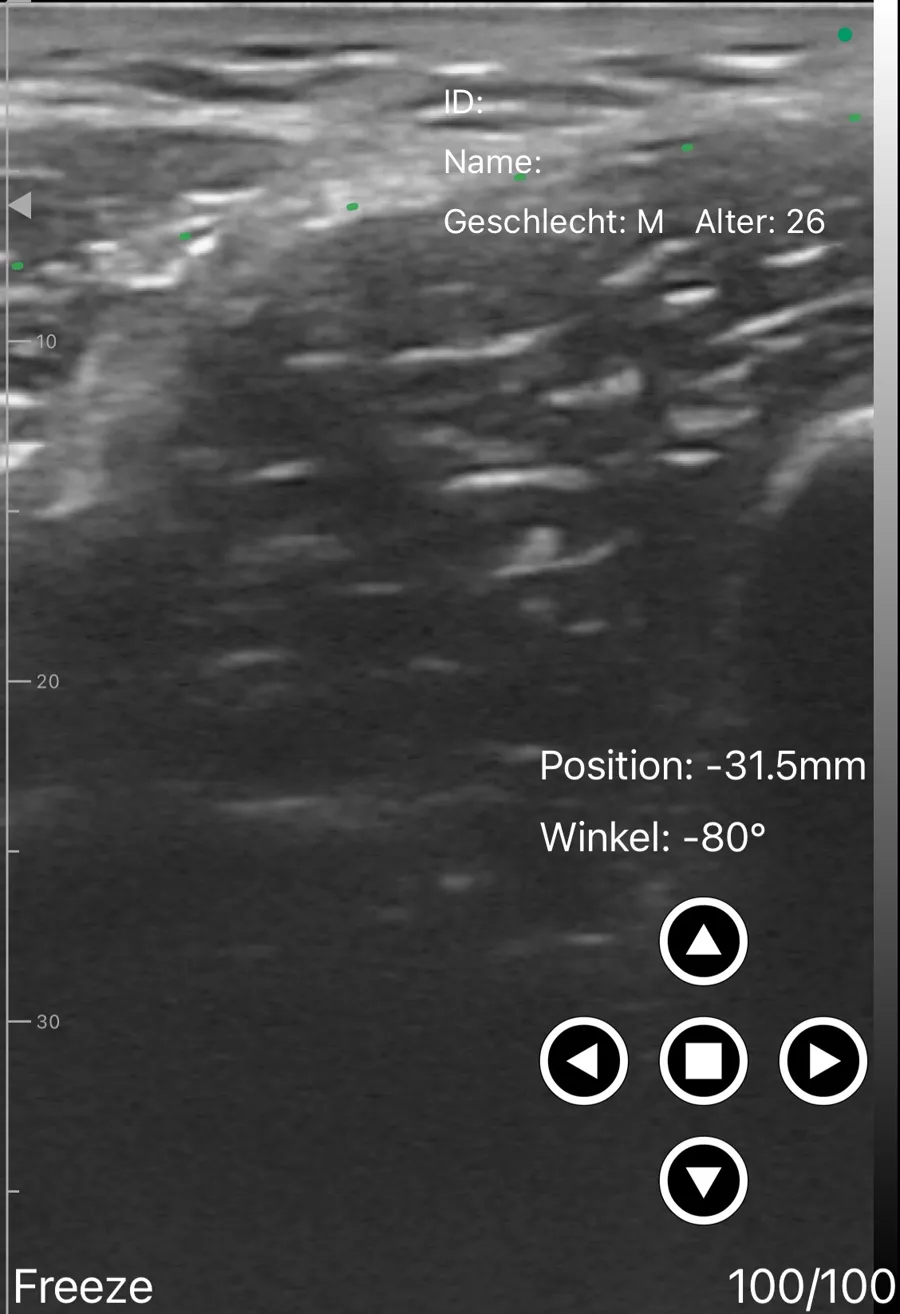
Bloqueo suprainguinal de la fascia ilíaca
Abordaje alto de la fascia ilíaca para fracturas y cirugía de cadera. Por encima del ligamento inguinal, bajo la fascia ilíaca en la fosa ilíaca; cabezal lineal para la mayoría de las complexiones.
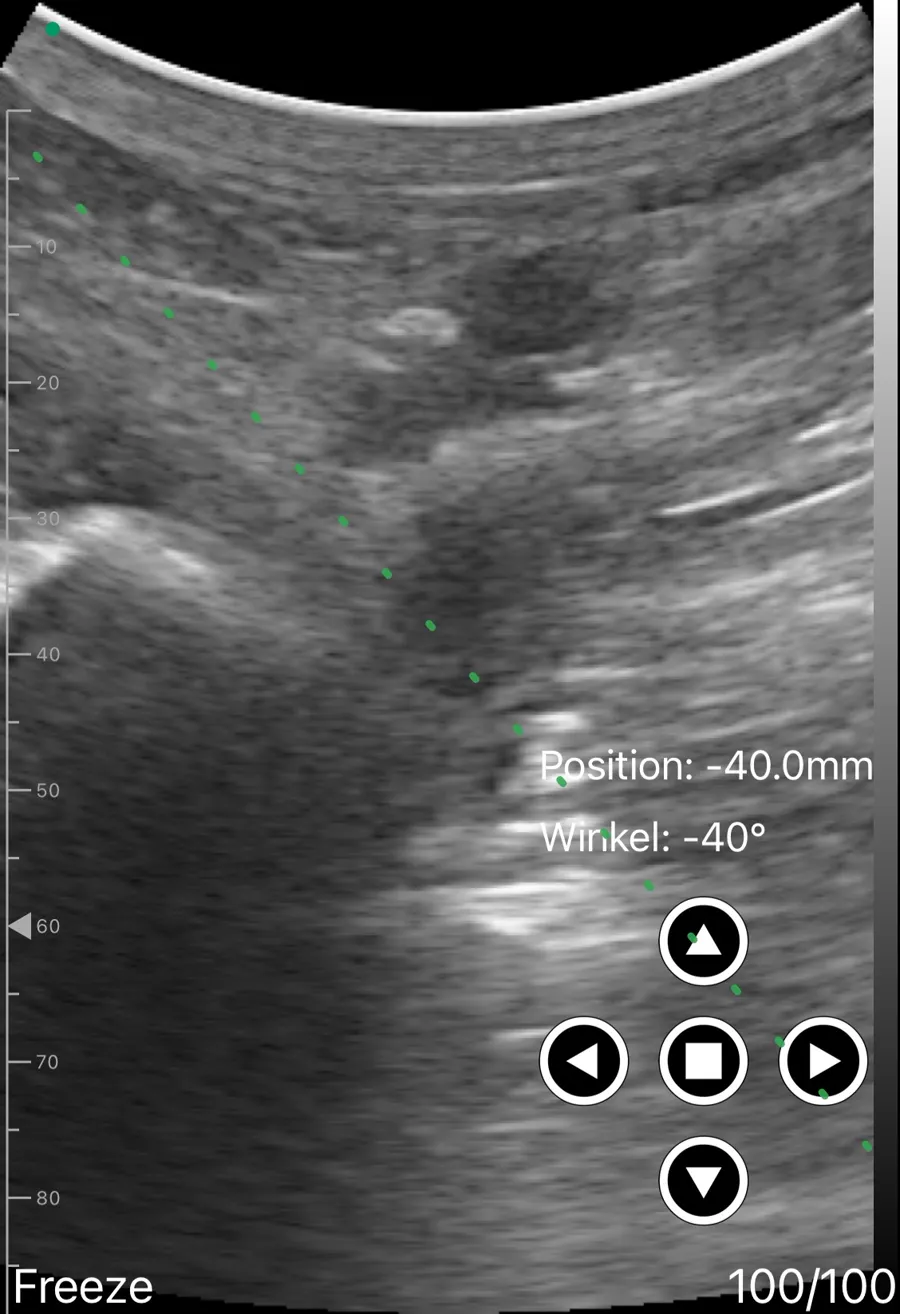
Bloqueo ciático proximal (anterior)
La ventana anterior profunda para visualizar el nervio ciático proximal. La ventana más profunda de esta página, a 6–10 cm, corresponde al campo de trabajo del cabezal convexo.
Rodilla & pierna4 bloqueos
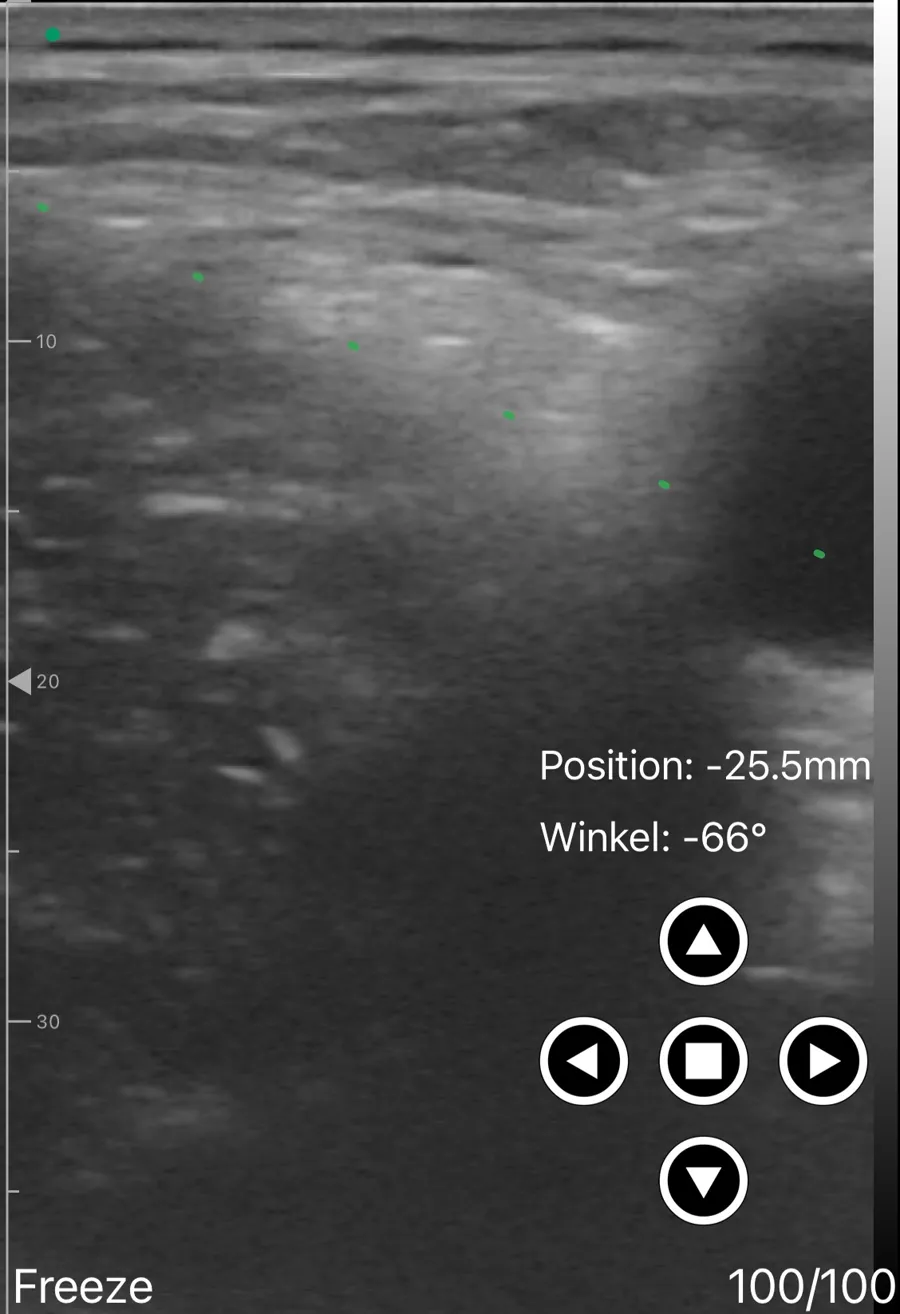
Bloqueo del nervio femoral
Cirugía de rodilla y muslo; el nervio se sitúa lateral a la arteria femoral, justo por debajo del ligamento inguinal. Superficial, visualizado con el cabezal lineal.
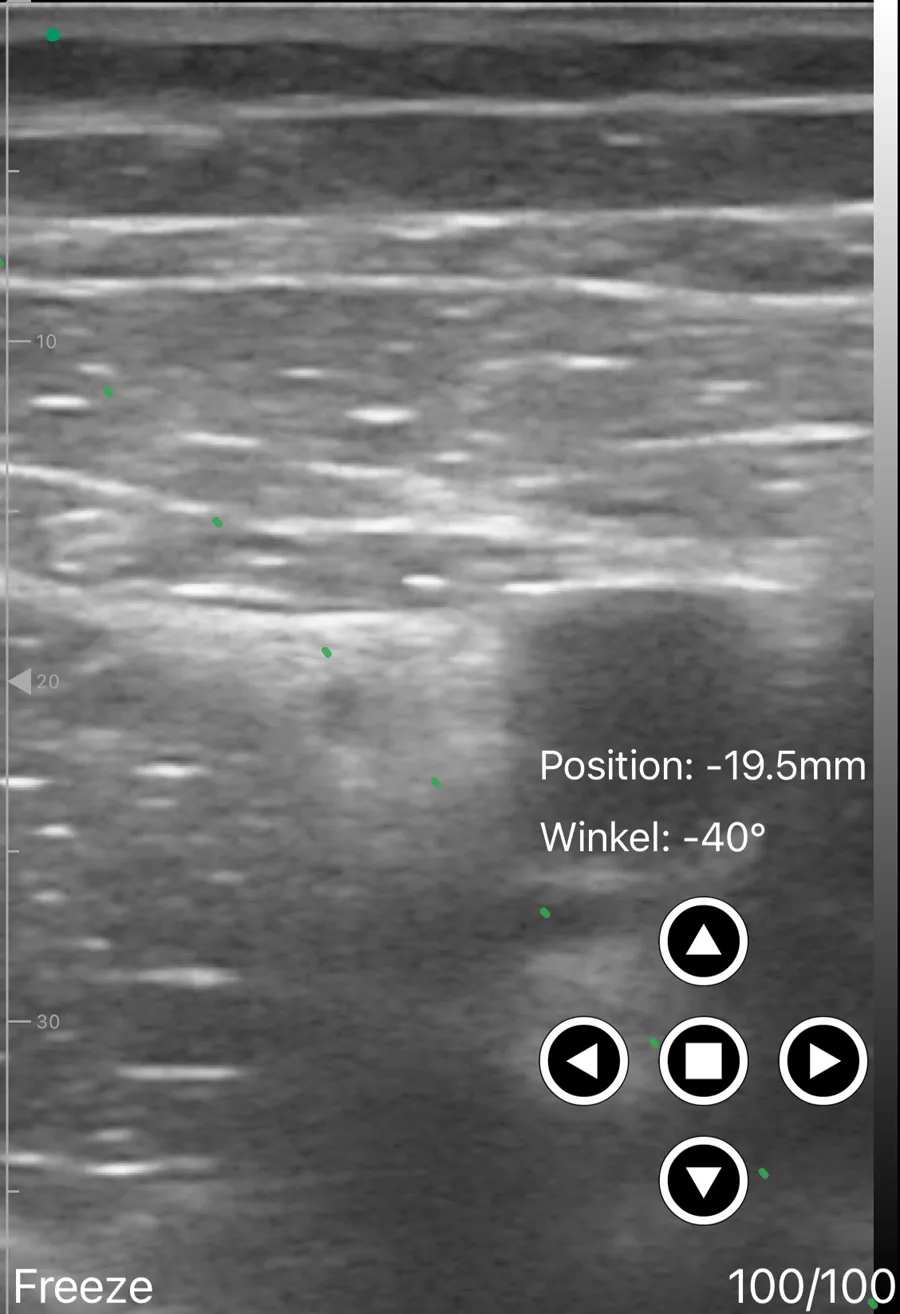
Bloqueo del canal aductor / del nervio safeno
El nervio safeno en el canal de los aductores: analgesia que preserva la función motora para cirugía de rodilla. En la zona media del muslo, bajo el sartorio y junto a los vasos femorales, visualizado con el cabezal lineal.
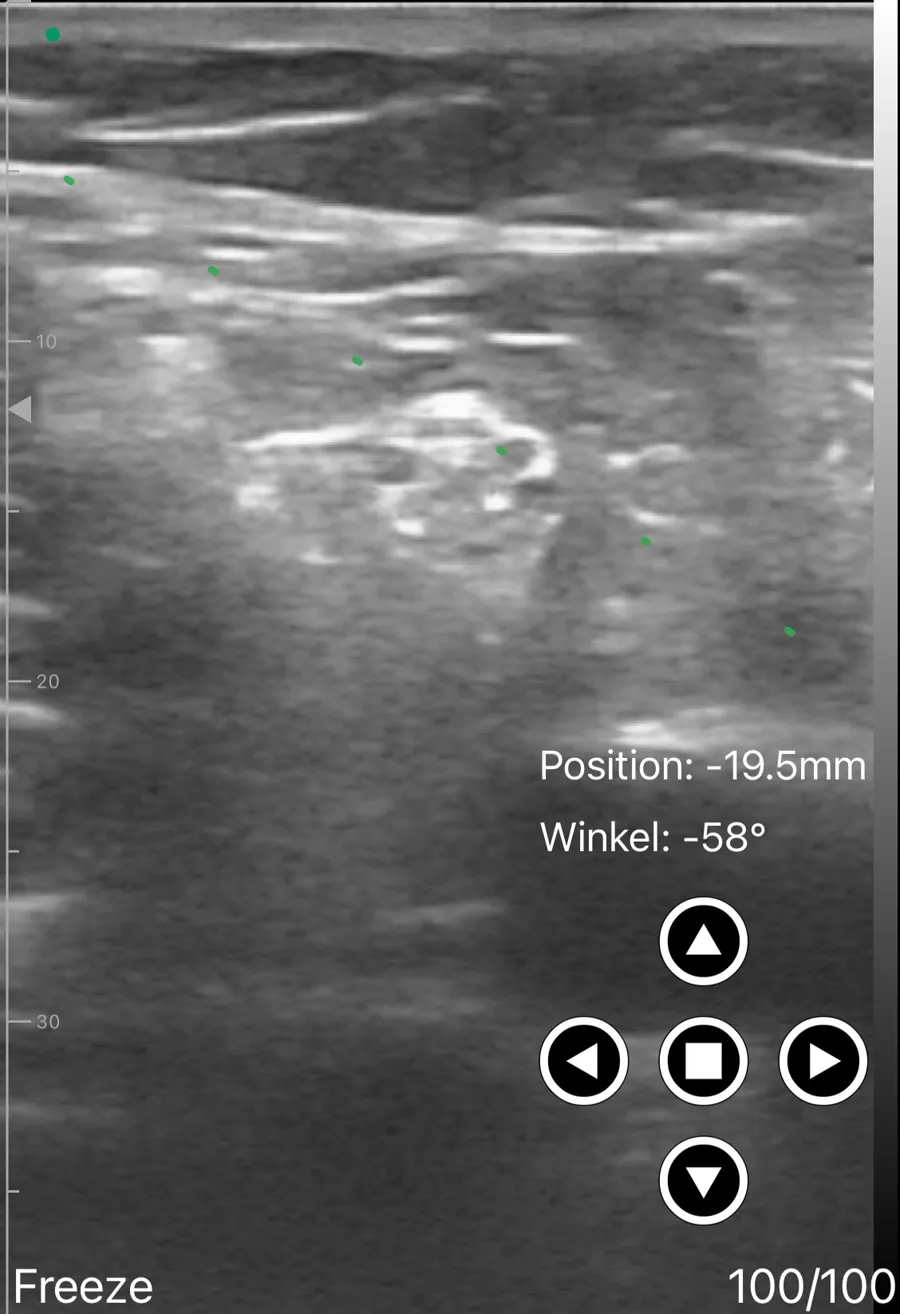
Bloqueo ciático distal
El nervio ciático justo antes de dividirse en tibial y peroneo común, por encima del pliegue poplíteo. Cabezal lineal a profundidad moderada.
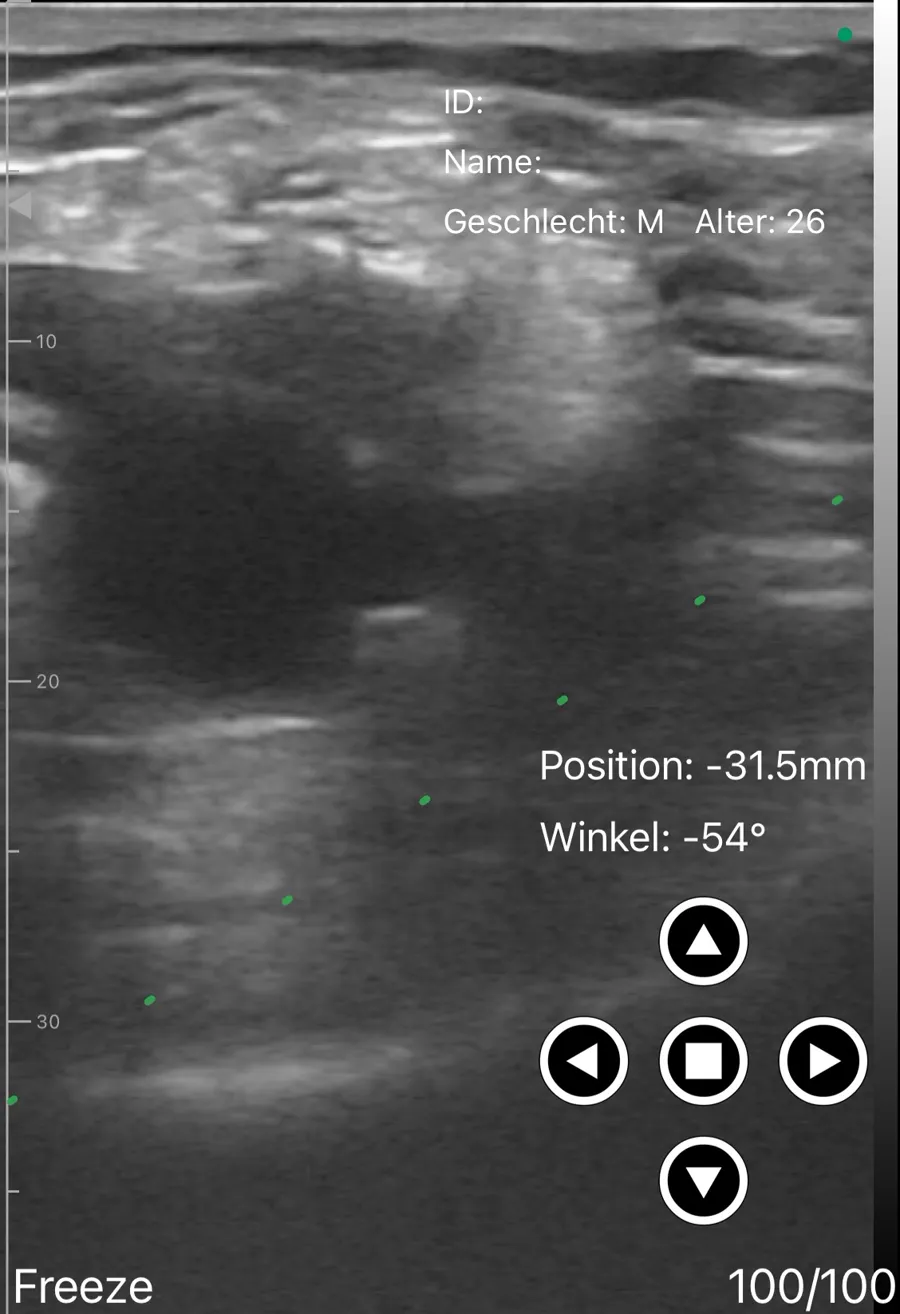
Bloqueo IPACK
Analgesia de la región posterior de la rodilla tras una artroplastia de rodilla. El anestésico local se deposita entre la arteria poplítea y la cápsula posterior, a la altura de los cóndilos femorales.
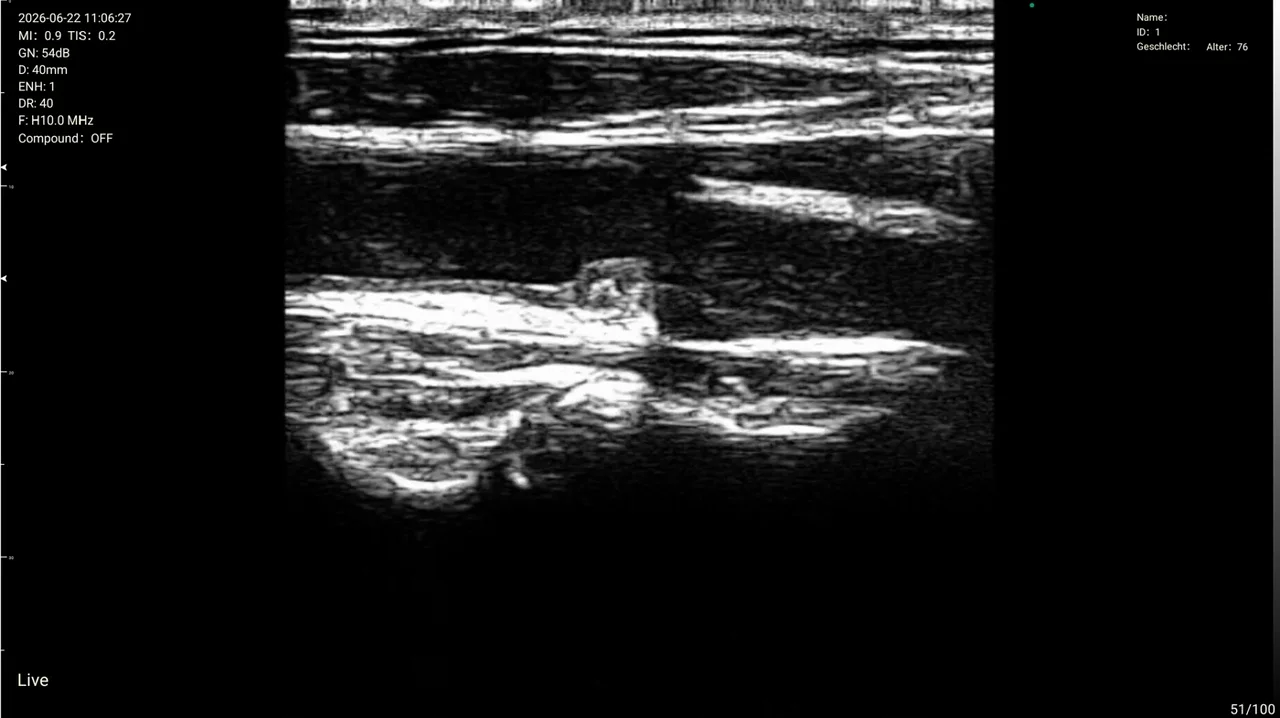
Seleccione una tarjeta para cambiar de captura
Grabaciones clínicas reales: imágenes de plexos y pases de la aguja de una jornada completa de anestesia regional.
Fundamentos de la técnica
Cómo se realizan los bloqueos nerviosos ecoguiados con un ecógrafo de mano
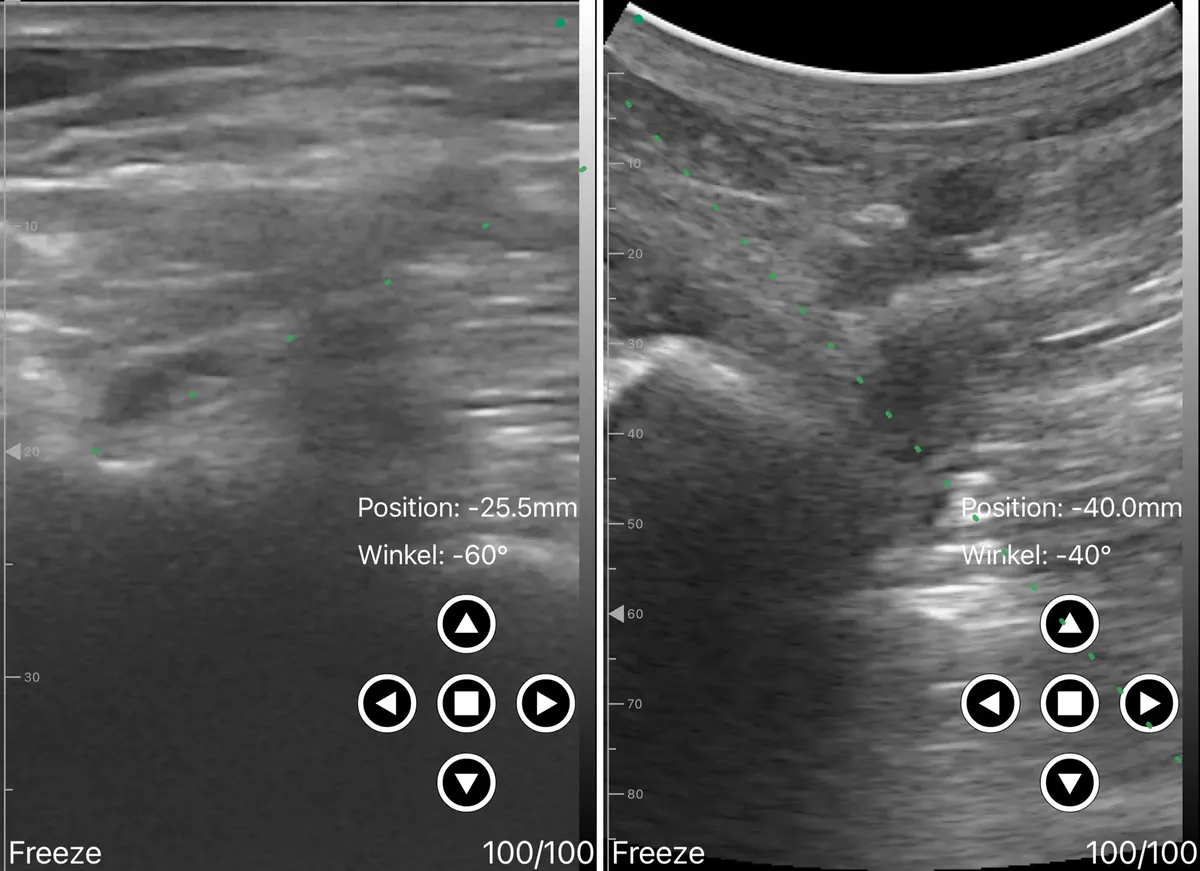 Elija el cabezal según la profundidad.
El cabezal lineal cubre los bloqueos de plexos superficiales; el convexo, las ventanas profundas del ciático.
Lineal y convexo en un solo D3Ultra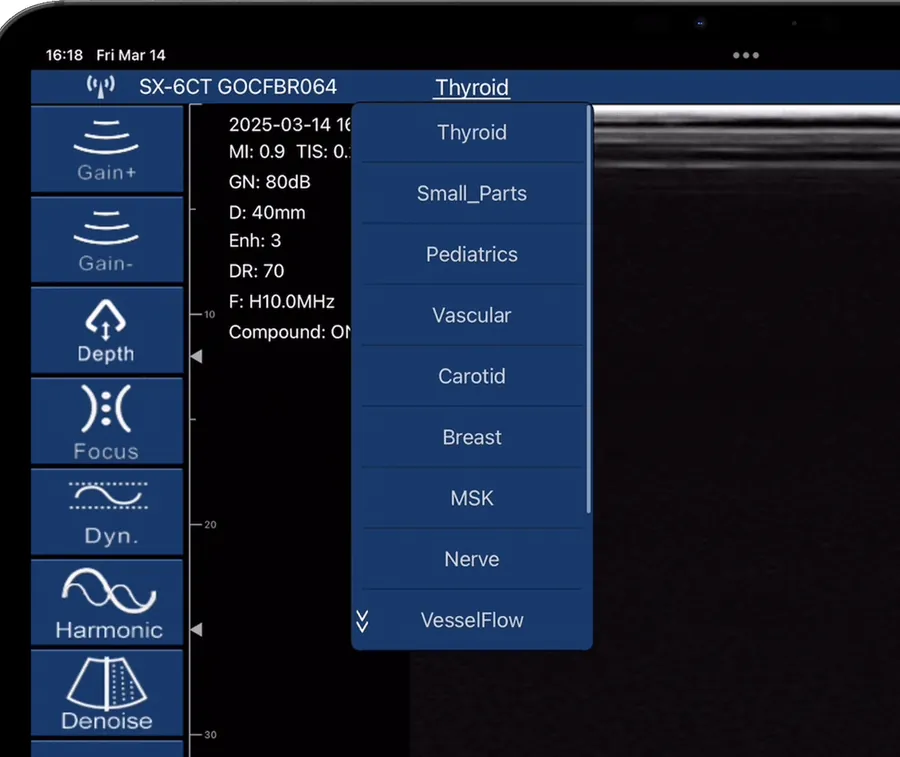 Configure primero la profundidad y el preajuste.
Seleccione el preajuste de nervios y ajuste la profundidad justo más allá del plano objetivo antes de introducir la aguja.
Lista de preajustes en la aplicación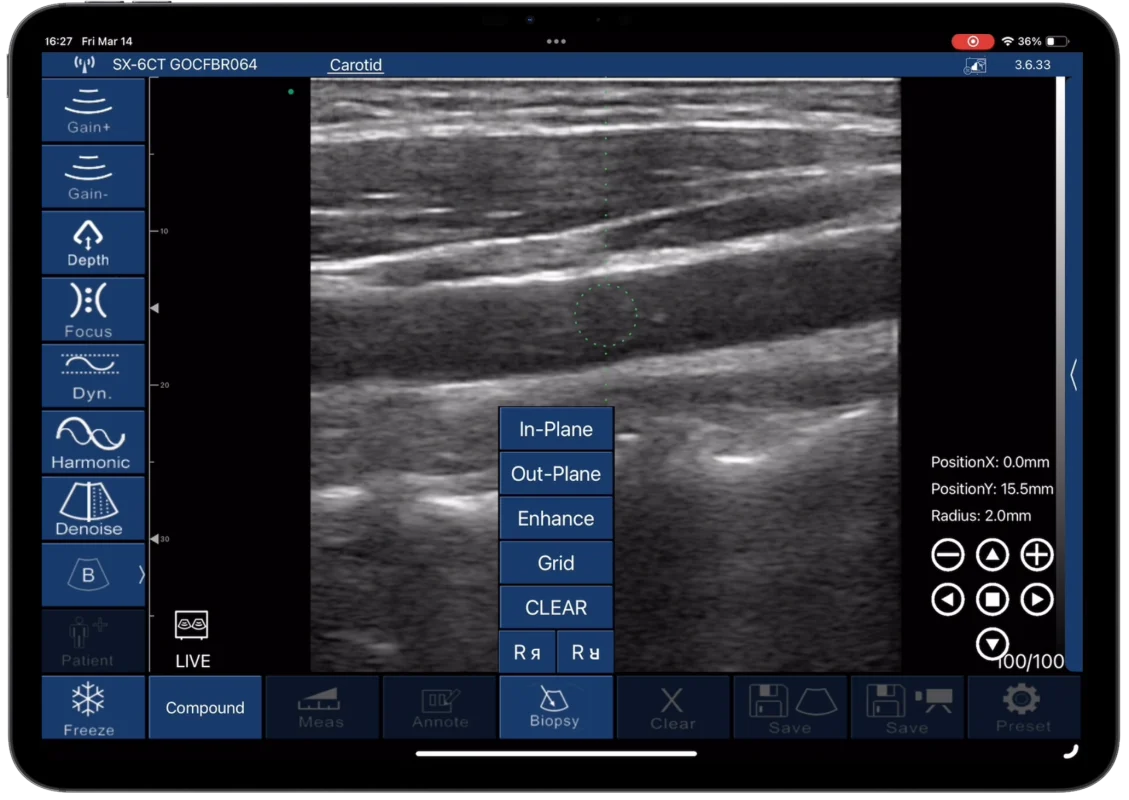 Mantenga la aguja en plano.
Avance a lo largo del eje longitudinal de la sonda, manteniendo la punta a la vista; la guía en pantalla y el indicador de ángulo muestran la trayectoria prevista.
Valores de la guía de aguja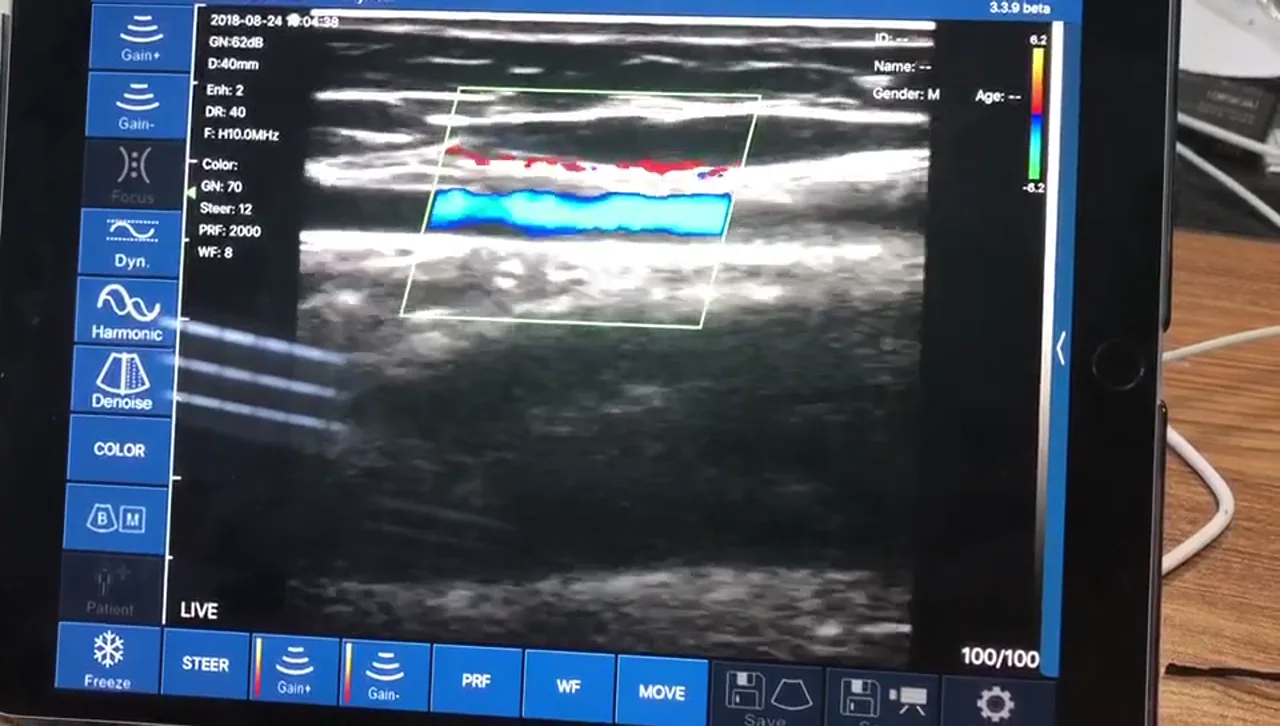 Confirme la distribución.
El Doppler color antes de la punción muestra los vasos que se encuentran en la trayectoria de la aguja; debe observarse la distribución del anestésico local alrededor del nervio.
Flujo en color, biblioteca de referencia de Suresult
Qué dicen los estudios
La evidencia para bloqueos nerviosos ecoguiados
- Mayor éxito, inicio más rápido.
Un metaanálisis de 2009 publicado en British Journal of Anaesthesia encontró que la guía ecográfica reducía el fracaso del bloqueo en más de la mitad frente a la neuroestimulación (riesgo relativo de 0,41). El inicio del efecto fue un 29% más rápido y los bloqueos duraron un 25% más.
Abrahams et al., Br J Anaesth 2009 - Menos punciones vasculares.
Una revisión Cochrane de 2015 sobre bloqueos de las extremidades encontró menos punciones vasculares accidentales y menos parestesias con la guía ecográfica.
Lewis et al., Cochrane 2015 - Menor riesgo de toxicidad.
Un estudio de registro de 2013 sobre 25.336 bloqueos nerviosos en Australia y Nueva Zelanda asoció la guía ecográfica con una menor tasa de toxicidad sistémica por anestésicos locales (LAST).
Barrington & Kluger, RAPM 2013
Elija su modelo
El mejor ecógrafo para anestesiólogos depende de los bloqueos que realiza con más frecuencia
El más elegidoLa anestesia regional es su día a díaD3Ultra
La anestesia regional es su día a díaD3UltraEl equipo para los doce bloqueos mostrado arriba: la combinación de cabezal lineal y convexo cubre las doce regiones del atlas, desde el bloqueo interescalénico hasta el ciático profundo.
$2,976 D3Ultra · cabezal dualComprar ahoraVer D3Ultra →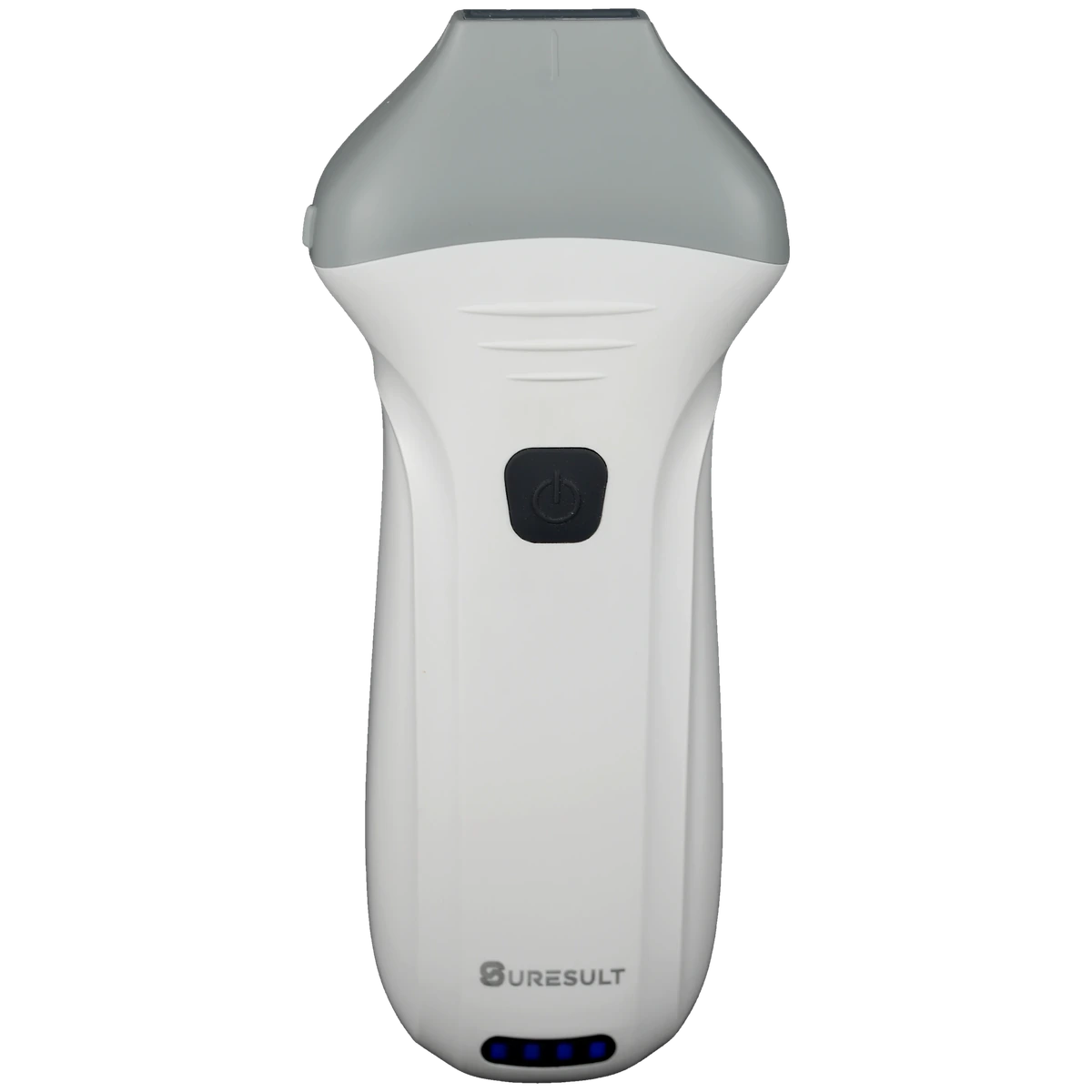 Bloqueos superficiales & pediátricosL20Pro
16/20 MHz permite distinguir nervios superficiales finos y pequeñas estructuras anatómicas donde el detalle es decisivo para el bloqueo.
$3,720 L20Pro · 256 elementosComprar ahoraVer L20Pro →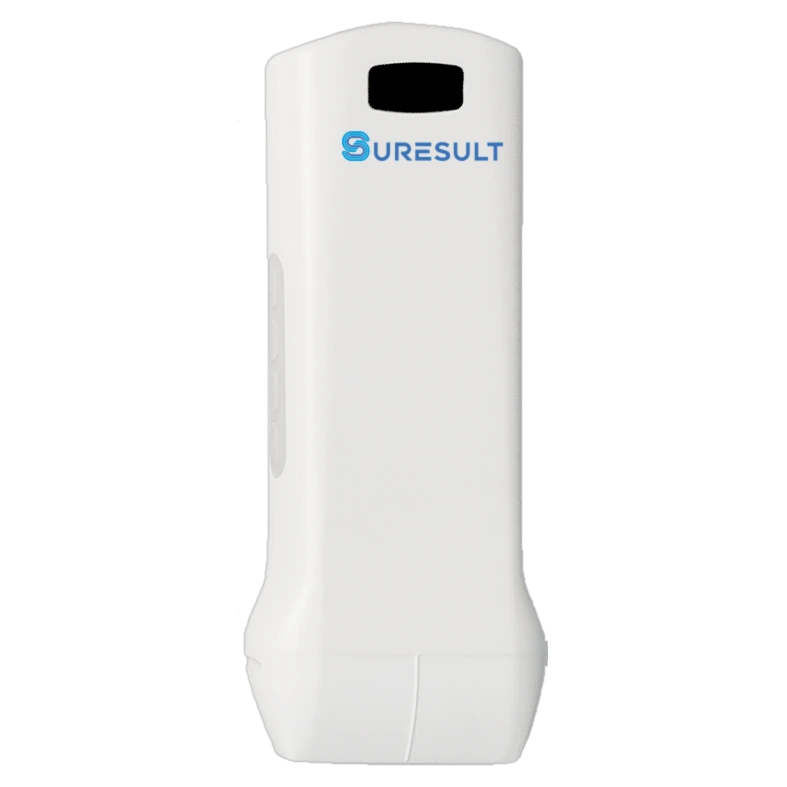 Para empezar, con el presupuesto como prioridadL10H
El modelo lineal de 7.5/10 MHz cubre la mayoría de los bloqueos de plexos y planos fasciales a un precio de gama de entrada.
$2,325 L10H · lineal de gama de entradaComprar ahoraVer L10H →Comparativa de ecógrafos
Seis equipos Suresult para bloqueos nerviosos ecografía cardíaca portátil, comparados
Deslice para ver todas las columnas →
| Modelo | Precio | Frecuencia | Profundidad | Ideal para |
|---|---|---|---|---|
 D3Ultra D3Ultra | $2,976 | 7.5/10 + 3.2/5 MHz | 20–100 mm, lineal | El equipo para los doce bloqueos del atlas: desde los superficiales hasta el ciático profundo |
 D3Pro D3Pro | $2,697 | 7.5/10 + 3.2/5 MHz | 20–80 mm, lineal | Tres formatos con batería de 3 horas para largas jornadas de bloqueos |
 L20Pro L20Pro | $3,720 | 16/20 MHz | 10/20/30/40 mm | El máximo detalle en bloqueos superficiales y pediátricos |
 L14Pro L14Pro | $3,441 | 10/14 MHz | 20/40/60/80 mm | Bloqueos y exploraciones musculoesqueléticas y vasculares con una sola sonda |
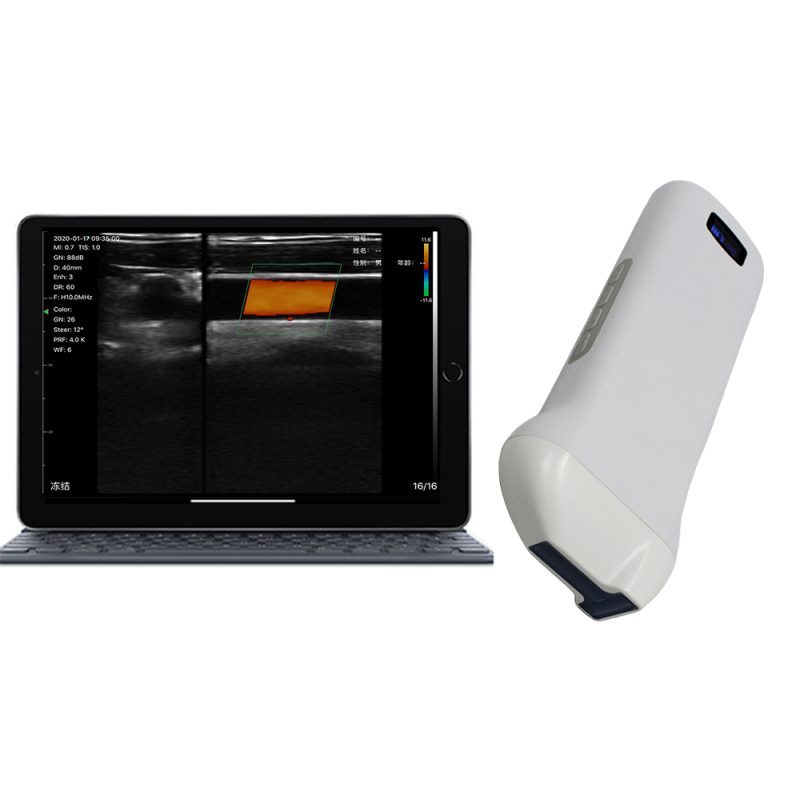 L10T L10T | $2,418 | 7.5/10 MHz | 20/40/60/100 mm | Vista biplanar: aguja y objetivo en una misma pantalla |
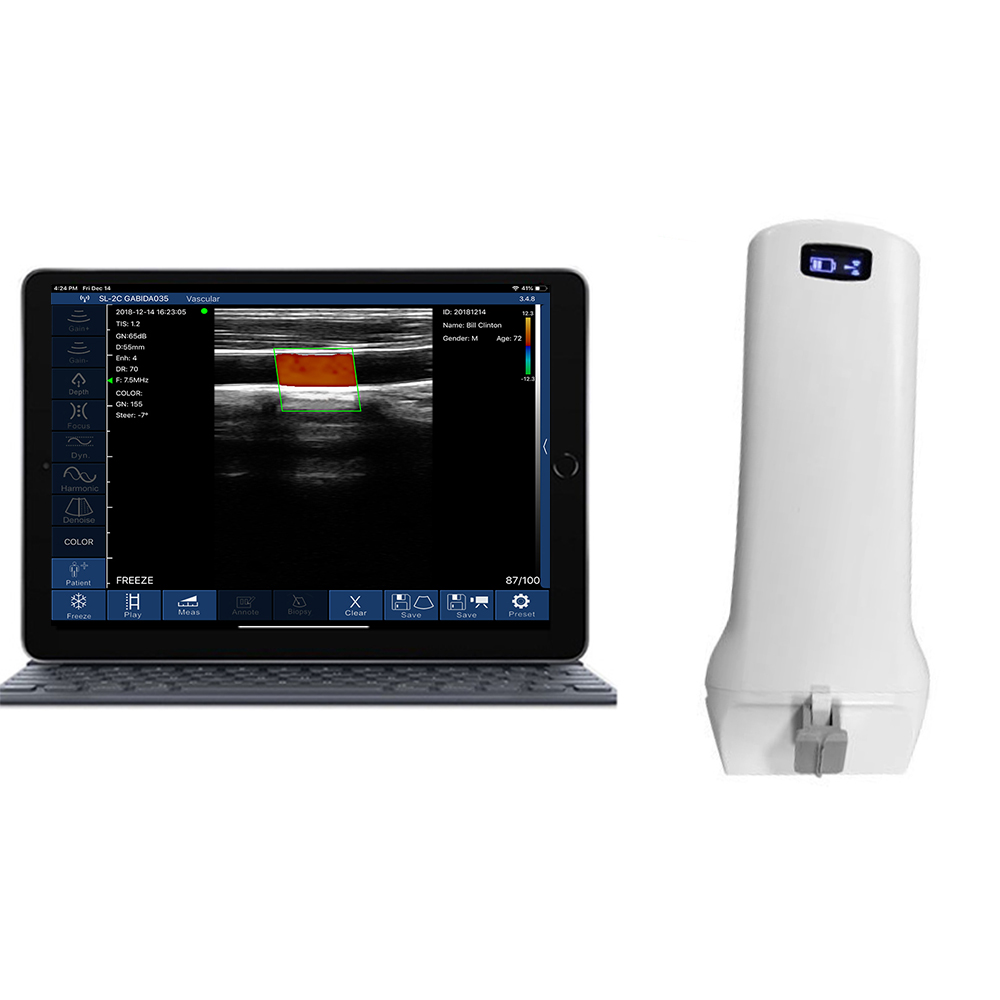 L10H L10H | $2,325 | 7.5/10 MHz | 20/40/60/100 mm | Sonda lineal a precio de gama de entrada para plexos y planos fasciales |
Frente a las marcas conocidas
Suresult frente a Clarius, Butterfly y GE Vscan para bloqueos nerviosos
Deslice para ver todas las columnas →
 Suresult Suresult | 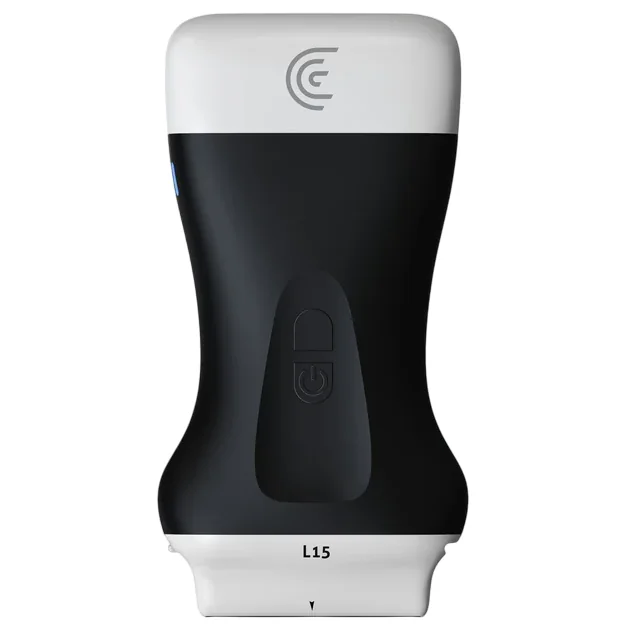 Clarius L15 HD3 Clarius L15 HD3 | 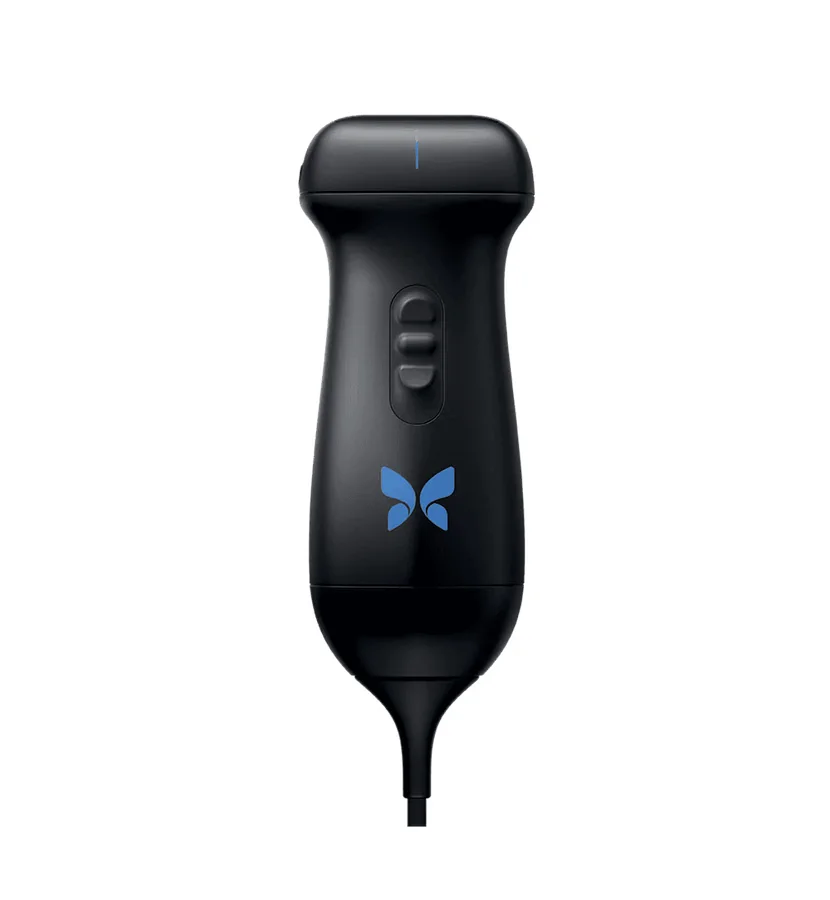 Butterfly iQ3 Butterfly iQ3 | 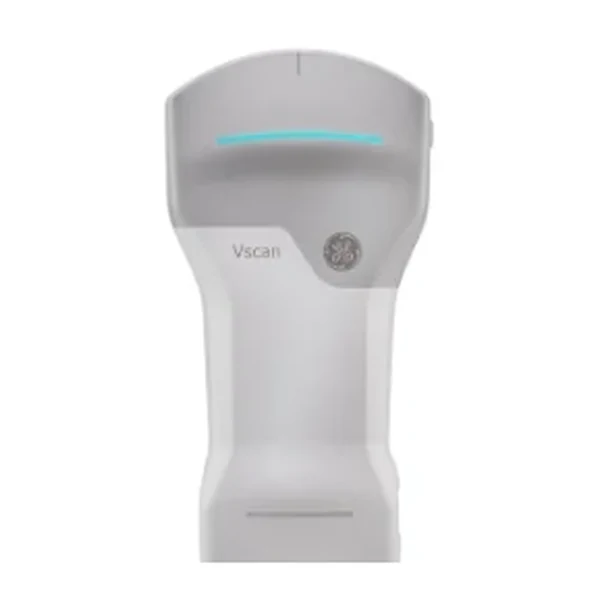 GE Vscan Air CL GE Vscan Air CL | |
|---|---|---|---|---|
| Imagen ecográfica para bloqueos | Doble cabezal: lineal + convexo en el D3Ultra | 5–15 MHz, lineal | Chip único de 1–12 MHz | 3–12 MHz, cabezal lineal |
| Precio del dispositivo | $2,325–$3,720, precio publicado | Precio publicado: $3,795 | Precio publicado: $3,899 | Precio publicado: $4,999 |
| Suscripción | Ninguna: software incluido | Suscripción de $695/año, $1,785 por tres años o un pago único de $2,500 | Requerido: $299–$420/año | Las funciones de Digital Tools requieren una suscripción |
| Coste total en destino | Aranceles + envío incluidos, 1–7 días | Precio de catálogo en EE. UU.; aranceles y envío adicionales fuera de EE. UU. | Precio de catálogo en EE. UU.; aranceles y envío adicionales fuera de EE. UU. | Precio de catálogo en EE. UU.; aranceles y envío adicionales fuera de EE. UU. |
| Registros regulatorios | FDA 510(k) · ISO 13485 · EU MDR (CE) · TGA · ANVISA · Health Canada | FDA 510(k) | FDA 510(k) | FDA 510(k) |
En qué destaca Suresult
- Doce bloqueos documentados.Cada captura del atlas anterior es una ecografía sin editar realizada por un comprador, agrupada por región corporal y con los valores de la guía de aguja en pantalla.
- Sin suscripción ni cuotas de software.Todos los ecógrafos incluyen Doppler color, guías de aguja, mediciones y exportación DICOM.
- El precio al finalizar la compra es el precio final puesto en destino.Aranceles y envío incluidos, entrega en 1–7 días.
- Registrado donde usted ejerce.FDA 510(k) · ISO 13485 · EU MDR (CE) · TGA · ANVISA · Health Canada.
Las cuentas a cinco años
La suscripción de Clarius de $695/año suma $3,475 al quinto año, antes de añadir el coste del propio ecógrafo. El plan obligatorio de Butterfly añade $1,495–$2,100.
D3Ultra, pago únicoClarius L15 HD3: ecógrafo + suscripción= $3,475 solo en cuotas al quinto año
Tres modelos, una decisión
Tiene dudas sobre qué modelo se adapta a sus casos?
Una conversación basta para obtener una recomendación directa: la sonda Suresult adecuada o un claro “ninguna de las dos.”

D3Ultra
Ecógrafo de mano multifunción D3Ultra: convexo, lineal y de matriz en fase
Frecuencia: Sonda convexa / de matriz en fase 3.2/5.0MHz Sonda lineal 7.5/10MHz
Profundidad de exploración: Lineal: 20-100 mm, convexa y sectorial: 90-300 mm
Anestesiología
buy scanner

L14Pro
Transductor lineal inalámbrico Suresult L14Pro para ecografía musculoesquelética – 10/14 MHz, 256 elementos
Frecuencia: 10/14 MHz
Profundidad de exploración: 20/40/60/80 mm
Anestesiología
buy scanner

D3Pro
Ecógrafo portátil inalámbrico Suresult D3Pro – 3 en 1: convexo, lineal y sectorial, 192 elementos
Frecuencia: Sonda convexa / sectorial 3.2/5.0MHz, sonda lineal 7.5/10MHz
Profundidad de exploración: Sonda convexa / sectorial: 90-305 mm, sonda lineal: 20-80 mm
Anestesiología
buy scanner




Asesoramiento experto
Hable con un especialista en ecógrafos
Cuente a Suresult cómo trabaja a diario y reciba una recomendación personalizada de ecógrafo con un presupuesto todo incluido.
- Asesoramiento gratuito para elegir su ecógrafo — sondas, frecuencia y profundidad adaptadas a sus procedimientos
- Presupuesto todo incluido — envío, despacho de aduanas e impuestos aplicables incluidos
- Entrega rápida — envío en un plazo de 24 horas, entrega a domicilio en 1–7 días
- No se requiere ninguna suscripción de software — aplicaciones para iOS, Android y Windows incluidas
- Devoluciones en 30 días y asistencia 24/7
El chat en directo se abre aquí mismo — acceso directo y atención inmediata.
