

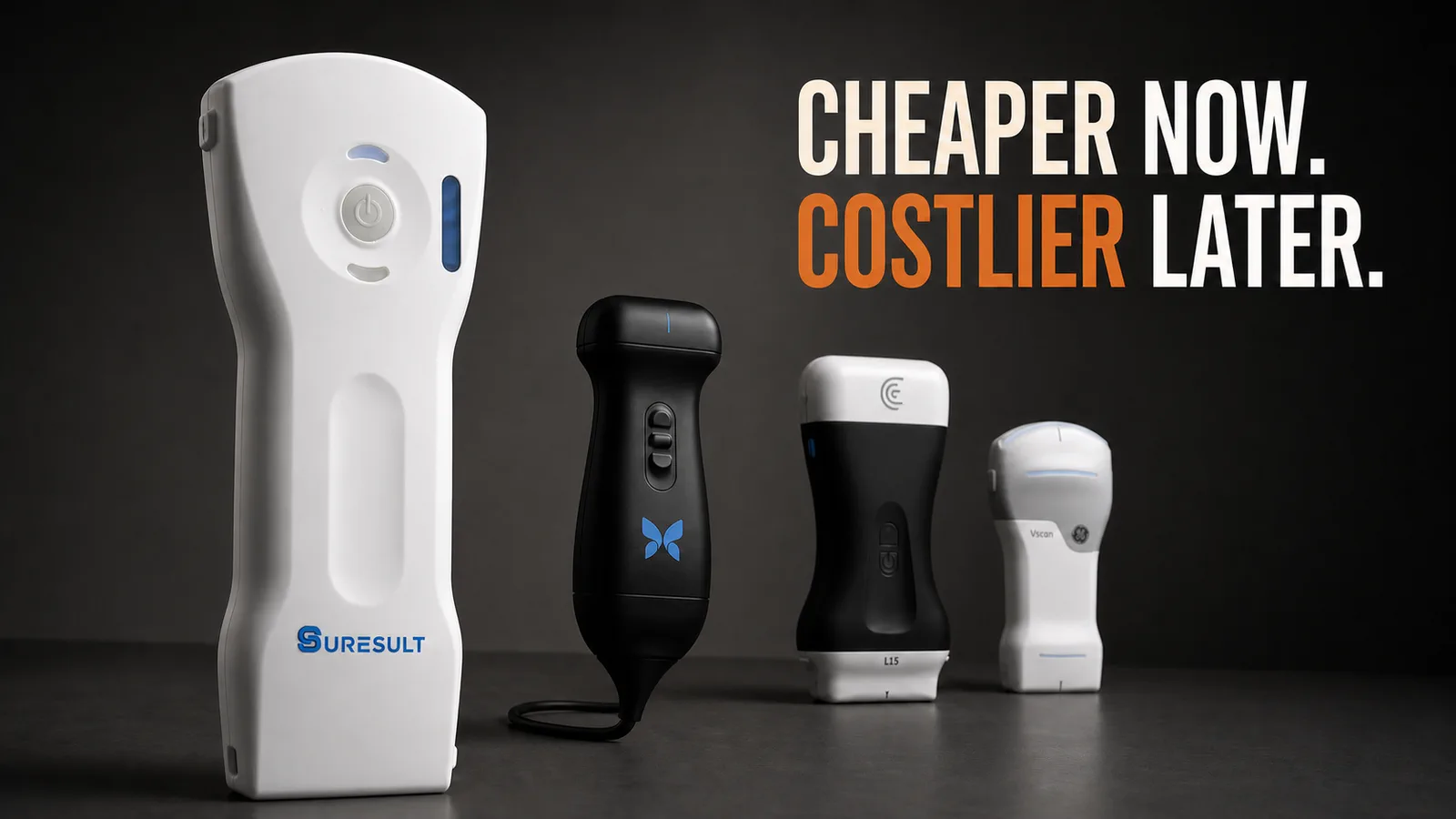
Sticker price hides the real number. Over five years, the subscription you don’t see on day one quietly becomes the biggest line on the invoice.
 フェルナンド・マリズ医師 · Gynecology, pelvic surgery, sonography
 ジェイリン・アビラ医師 · Emergency medicine, POCUS education
Verified authors
Updated July 10, 2026
Pricing figures are drawn from official manufacturer pages and public distributor listings, captured on the dates shown in Sources.
クイックアンサー
Over five years, a subscription handheld ultrasound can cost $2,000–$3,000 more than a no-subscription device of similar price — sometimes more than the hardware itself. As of July 2026, a flat no-subscription scanner such as the Suresult D3Ultra (about $3,200, software included) stays near its purchase price for five years, while a Butterfly iQ3 ($3,899 plus a required membership) reaches roughly $5,400–$6,000 once five years of subscription are added. The break-even — where the subscription device overtakes a slightly pricier no-subscription one — usually lands in year two or three.
This guide models 総所有コスト, not sticker price. Figures are U.S. list pricing before tax, for an individual or small-clinic buyer, and should be confirmed against current manufacturer pages before you commit.
The quick list: what the five-year math shows
Flat devices win over timeNo-subscription scanners (Suresult D3Ultra, Clarius without membership, Mindray e5M, GE Vscan Air) finish five years at roughly $3,200–$5,000 and stop there.
Subscriptions overtake fastButterfly iQ3, fully-featured Clarius, and GE with Innovations reach roughly $5,400–$7,300 by year five, and keep climbing every year after.
Break-even is earlyA cheaper subscription device is usually only cheaper for about the first year; the annual fee overtakes the price gap by year two or three.
Team size multiplies itPer-user memberships multiply across seats — a $420/year plan across three clinicians is $6,300 over five years on top of hardware.
The five-year meter · U.S. list, individual tier
What each scanner actually costs by year five
Teal is hardware you buy once. Amber is subscription that keeps running. Watch where the amber takes over.
Hardware (paid once)
Subscription over 5 years
Subscription over 5 years

スールスルト D3Ultra3-in-1 · no subscription
$3,200
クラリアスHD3no membership
$3,595
ミンドレーTEエアe5Mno subscription
$4,499

GE Vscan Air CLno subscription needed
$4,999

バタフライiQ3membership required
$5,700+ sub
クラリアスHD3with membership
$6,570+ sub
GE Vscan Air CLwith Innovations AI
$7,298+ sub
$0$2,000$4,000$6,000$8,000
Butterfly membership shown at an individual-tier midpoint (~$360/yr) of the $299–$420 range; clinic and enterprise tiers run higher. GE’s Innovations row keeps the optional AI package active all five years (3-year bundle plus two annual renewals). Philips Lumify sits off this scale — no subscription, but a single transducer lists near $12,000 at distributors, a different cost class entirely. Figures are U.S. list, July 2026; the full ledger below shows the exact ranges.
The full ledger
Handheld ultrasound 5-year cost compared (2026)
Forget the price on the box. The number that matters is what you will have paid by the end of year five. This table adds five years of software or membership cost to the upfront price — U.S. list, July 2026, single-user tier, before tax, shipping, and accessories.
| デバイス | Upfront | Software / year | 5-yr software | ≈ 5-year total | Subscription required? |
|---|---|---|---|---|---|
| スールスルト D3Ultra3-in-1 probe | $3,200 | $0 | $0 | ≈ $3,200 | No — software included |
| クラリアスHD3no membership | $3,595 | $0 | $0 | ≈ $3,595 | No — advanced features gated |
| ミンドレーTEエアe5Msingle probe | $4,499 | $0 | $0 | ≈ $4,499 | いいえ |
| GE Vscan Air CLdual-head probe | $4,999 | $0 | $0 | ≈ $4,999 | No — AI tools gated |
| バタフライiQ3individual tier | $3,899 | ≈ $299–$420 | ≈ $1,495–$2,100 | ≈ $5,400–$6,000 | Yes at purchase — lapse = live-view only |
| クラリアスHD3with membership | $3,595 | $595 | $2,975 | ≈ $6,570 | Optional — cloud, DICOM, advanced |
| GE Vscan Air CLwith Innovations | $4,999 | $500 (or $1,299/3 yr) | ≈ $2,299 | ≈ $7,298 | Optional — Caption AI, AutoEF |
| フィリップス ルミファイper transducer | ≈ $12,000+* | $0 | $0 | ≈ $12,000+ | No — own outright |
*Philips does not publish a fixed U.S. Lumify price; the figure is a public distributor list price for a single transducer (Penn Care, July 2026). Lumify carries no software subscription but sits in a higher upfront class. Butterfly individual tiers are Core ($299/yr) and Advanced ($420/yr), confirmed July 10, 2026; a $1,500 one-time Advanced option (1 user, 1 probe, 5-year software access) caps the five-year total at ≈ $5,399. Organization plans (Starter, Professional, Enterprise) are quote-based. GE figures are GE HealthCare’s official U.S. web-store list (CL and SL both $4,999, July 2026); the “with Innovations” row keeps the optional AI package active all five years via the 3-year bundle plus two annual renewals. Confirm all current pricing on the manufacturer pages in Sources.
The pattern holds all the way down the table: the flat scanners finish five years at roughly $3,200–$5,000 — and stop. The subscription-loaded devices finish at roughly $5,400–$7,300 — and don’t.
How the numbers were built
How we modeled the five-year cost
No estimates, no “starting at” marketing prices. Four rules govern every number on this page:
- Official sources only. Every figure traces to a manufacturer’s own store or pricing page, or a named public distributor listing, captured on the dates shown in Sources.
- One consistent tier. U.S. list pricing, single-user or individual tier, before tax, shipping, and accessories. Fleet and enterprise pricing is negotiated, so we model the price a solo buyer or small clinic actually sees.
- Ranges stay ranges. Where a vendor does not publish one exact figure (Butterfly’s membership tiers), we show the verified range instead of inventing precision; charts use a labeled midpoint.
- Five years, because that is how long you keep it. Handhelds typically serve four to six years before replacement, so a five-year window captures the full subscription burden without exaggerating it.
Why the math splits
Why subscriptions change the math
Handheld ultrasound pricing splits three ways, and the split is the entire story of total cost of ownership.
Subscription required
A new iQ3 must be purchased with a membership (Core $299/yr or Advanced $420/yr), and a membership login activates the device. Stop renewing and the probe drops to live-view only — B-mode and color Doppler, no saving new studies, no advanced modes, no AI — so for documented clinical use the fee is effectively permanent. A $1,500 one-time Advanced option (1 user, 1 probe, 5 years of software access) is the exception worth asking about. バタフライiQ3
Optional, but feature-gating
The scanner works without a membership, but cloud storage, DICOM export, pulsed-wave Doppler, and advanced imaging sit behind the paid Membership. Run it flat, or pay $595/year (or $2,500 once) for the full toolset. GE’s Vscan Air works the same way: core imaging is free and complete, while Caption AI guidance, AutoEF, and HD-SRI sit behind a $500/year Innovations plan. Clarius HD3 · GE Vscan Air
定期購読はありません
Software is included with purchase and updates are free. Five-year cost is essentially the purchase price plus accessories — no recurring software fee at all. Suresult D3Ultra · Mindray TE Air · Philips Lumify
Note: some third-party guides describe Clarius as a mandatory $1,200/year subscription. Clarius’s own membership page, checked in July 2026, lists it as an optional add-on at $595/year — we use the official figure.
The simplest way to hold the difference in your head: a subscription scanner is a phone sold with a mandatory plan; a no-subscription scanner is the unlocked phone. The plan phone looks cheaper in the store. The unlocked phone is cheaper every month after that — and it still works if you stop paying anyone.
None of these models is automatically “better.” A mandatory subscription funds continuous AI updates and a large education ecosystem that some buyers genuinely use. But for cost planning, the distinction is decisive: a subscription is a cost you pay again every year, while a no-subscription device is a cost you pay once. One more question worth asking that few buyers think of: what happens at resale? A flat device can be sold or handed to another clinician and simply works. A subscription-locked device is only worth what a buyer who is also willing to take on the annual plan will pay — ask the vendor directly whether the device functions for a second owner without a new membership.
The crossover
Break-even: when a subscription device costs more
The cheaper sticker should win. Over a realistic ownership period, it usually doesn’t. Put a $4,499 flat device (Mindray e5M) against a $3,899-plus-$420-a-year subscription device (Butterfly iQ3, individual tier):
| End of year | No-subscription ($4,499 flat) | Subscription ($3,899 + $420/yr) | Cheaper option |
|---|---|---|---|
| Year 1 | $4,499 | $4,319 | サブスクリプション |
| Year 2 | $4,499 | $4,739 | No-subscription |
| Year 3 | $4,499 | $5,159 | No-subscription |
| Year 5 | $4,499 | $5,999 | No-subscription |
The subscription device wins the first year. Then the fee eats the price gap, passes it, and keeps going — about $1,500 ahead by year five, wider every year after. The rule: if you’ll keep the device more than two years — and almost everyone does — model the total, not the sticker.
The same math, three real buyers
Three buyers, three five-year bills
Charts are easy to nod along to and hard to feel. Here is the same decision through three buyers we talk to every week — using only the verified list prices above.
The solo family physician adding POCUS
One user, one device, general scanning — abdomen, lung, quick cardiac looks. She is comparing the Butterfly iQ3 at $3,899 against a D3Ultra at $3,200.
iQ3: $3,899 + 5 × ~$360 membership ≈ $5,700 vs D3Ultra: ≈ $3,200 → difference ≈ $2,500
That $2,500 is not an abstraction — it is a used exam table, two years of gel and supplies, or most of a second probe. Unless she specifically wants Butterfly’s education library and AI tools, the subscription is rent on rooms she’ll never enter.
The three-provider urgent care
Three clinicians share scanning duties. Now licensing structure matters more than sticker price: if the vendor charges membership per user rather than per device, every fee multiplies by three. Three individual-tier plans at ~$420/year is $6,300 over five years before any hardware — on top of the $3,899 device. A flat device shared across the team has no multiplier at all.
Per-user subscription risk: 3 users × $420 × 5 yr = $6,300 in software alone vs shared flat device: $0
The single most valuable question this clinic can ask a vendor: “is the plan per user or per device, in writing?”
The residency program buying a small fleet
Teaching programs are the one buyer for whom subscriptions most often earn their cost: fleet management, exam review, and a structured education library are curriculum tools, not extras. But this is also where five-year totals quietly reach five figures — enterprise tiers are quoted, not listed, so the table above is a floor, not your price. Model per-seat pricing across the full residency class before signing anything.
Before you compare
Total cost of ownership: the six components buyers forget
Sticker price is one of six lines in a handheld ultrasound’s real cost. Before you compare devices, price all six:
- The device or transducer. The upfront hardware. On multi-probe systems, note whether you are buying one transducer or a package.
- Software or membership. Zero on no-subscription devices; the largest hidden cost on subscription devices. Model five years, not one.
- Warranty and extended coverage. Standard warranties range from one to three years. The Suresult D3Ultra ships with a one-year standard warranty and a paid extension; Clarius, Mindray, and GE Vscan Air include three years.
- Additional probes. If your practice needs both a linear and a convex/phased view, a single-probe scanner may need a second purchase. A 3-in-1 probe can remove that line entirely.
- DICOM, cloud, and integration. Free on some devices, membership-gated on others. If you need PACS/EMR integration, confirm whether it is included or billed.
- Batteries, cases, and replacement. Consumables and the eventual battery or unit replacement. Ask the vendor about battery service and replacement policy before you buy.
For per-brand purchase prices that feed line 1, see the ハンドヘルド超音波価格ガイド, and the brand-specific クラリアス, フィリップス ルミファイそして ミンドレー cost guides.
5-year total cost of ownership = device price + (annual software × 5 × users) + extra probes + warranty extension + accessories
Run every scanner you are considering through this one line before you request quotes. If a vendor cannot give you a number for each term in writing, that term is where your surprise cost lives. One more line for U.S. clinics: equipment like this is often deductible in the purchase year under Section 179 — ask your accountant, not us.
The ownership timeline
What ownership actually feels like, year by year
Costs do not arrive evenly. Here is the typical rhythm of owning a handheld scanner, and where each pricing model bites:
| Year | What typically happens | Flat device | Subscription device |
|---|---|---|---|
| Year 1 | Honeymoon. Everything under warranty, software fresh, heavy use. | Paid in full. Done. | First renewal notice arrives at month 12. |
| Year 2 | First accessories wear out: cables, cases, gel warmers. Short warranties expire. | D3Ultra-class 1-yr warranty ends — extension or self-insure. | Second renewal. Break-even point passes quietly. |
| Year 3 | Battery capacity noticeably down on heavily-used units. New models launch and tempt you. | Battery service is your main cost question. | You have now paid ~3 years of fees on 3-year-old hardware. |
| Year 5 | Replace-or-keep decision. Resale value matters for the first time. | Sell it, hand it down, or keep scanning — it works either way. | Total is $1,500–$3,000 above sticker; resale depends on the next owner accepting the plan. |
Timeline reflects typical ownership patterns, not guarantees; battery life and accessory wear vary with usage intensity. Warranty terms per the manufacturer pages in Sources.
When the fee earns its keep
When paying for a subscription is the right call
Cheapest is not the same as right. A subscription earns its fee when:
- you rely on continuously updated AI guidance and want new models pushed to your device automatically;
- you want cloud storage, exam management, and DICOM/EMR integration run by the vendor — not configured by you;
- your training program is built on the manufacturer’s education library and certification;
- a single-vendor support relationship is worth more to your practice than the lowest number.
If none of that describes how you actually scan, the subscription is a fee without a feature.
Copy, paste, send
Nine questions to send every vendor before you buy
Copy these into your quote request exactly as written. The answers — and especially the questions a vendor dodges — will tell you more than any brochure:
- Is the software included in the purchase price, or is there any recurring fee? If recurring: what exactly stops working when I stop paying?
- Is licensing per device or per user? If per user, what does adding a second and third clinician cost per year?
- What is the standard warranty term, and does it cover the battery? What does the extension cost, in writing?
- Is DICOM / PACS export included, or behind a paid tier?
- Which AI features are included forever, and which are subscription-gated?
- If I sell or transfer the device, does it work for the next owner without a new plan?
- What is the battery replacement path and price after year two?
- Which probes/presets do I need for my use case — and is that one purchase or two?
- Is this quote valid for 30 days, all-in, before tax? Ask for the total as one number.
A vendor with a clean cost structure answers all nine in one reply. Vagueness on questions 1, 2, or 6 is where five-year surprises are born.
The flat-cost example
The no-subscription option
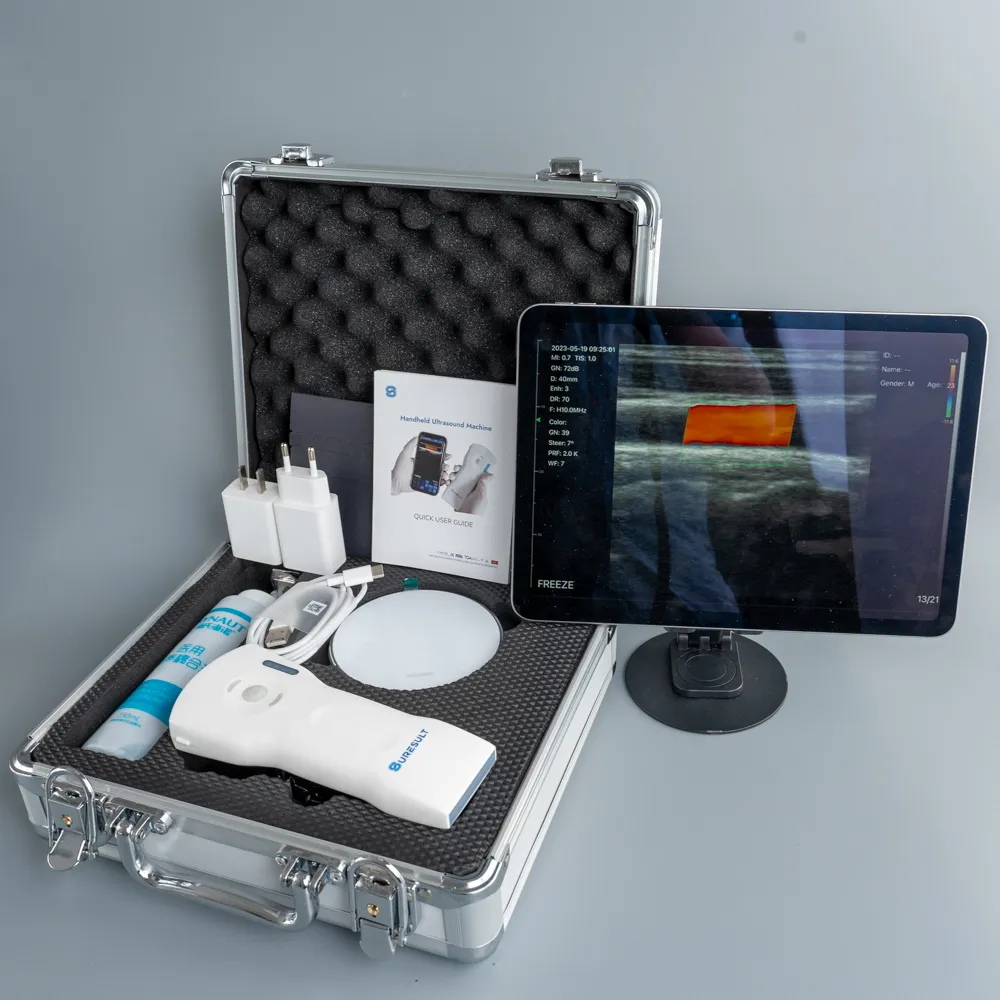
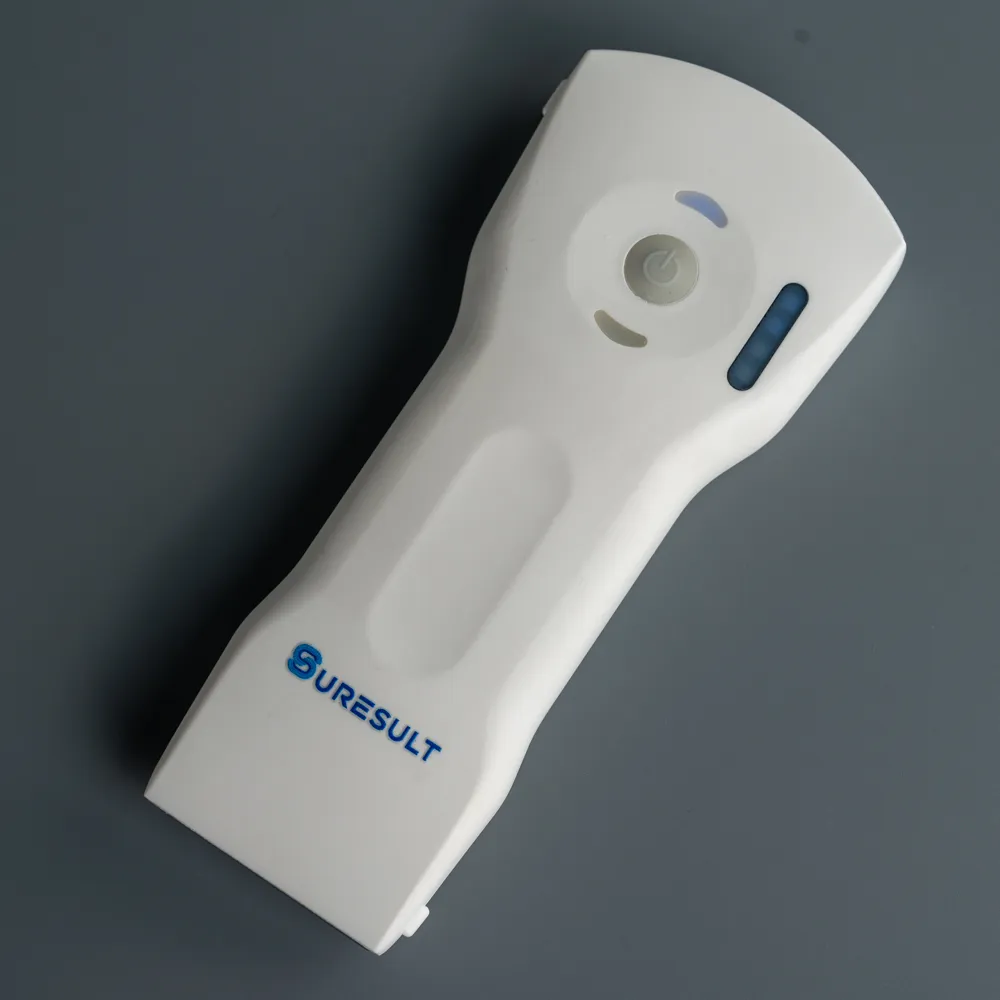
The D3Ultra lists at about $3,200 with free software across platforms, which puts its modeled five-year cost near $3,200 — the lowest in the table. The honest tradeoffs: its standard warranty is one year (extendable for a fee) versus three years on Clarius and Mindray, and as a challenger brand it does not carry the large education ecosystem that a Butterfly membership funds. It wins the cost column. Whether it wins your decision depends on the features and support your practice needs. See the no-subscription handheld ultrasound comparison for the full field.
The honest caveat
Who should not use this guide as the final word
Five-year cost is a decision tool, not the whole decision. Here is who should not buy on price alone:
Image quality is the deciding factorA cardiology or vascular buyer should validate Doppler and penetration on the actual device first — a peer-reviewed comparison of six handhelds by 35 POCUS experts is a good starting point. Cost is the wrong primary filter when the exam is demanding.
You need a specific integrationIf your hospital mandates a particular DICOM/PACS setup or vendor certification, that requirement outranks the cost table.
Your pricing is enterprise or quotedFleet, teaching, and hospital pricing is negotiated; the individual-tier figures here are a starting point, not your quote.
The figures have agedManufacturers change subscription tiers and prices. Re-check the Sources links before you commit — this guide is dated July 2026 for that reason.
Questions buyers ask
Frequently asked questions
Does the Butterfly iQ3 require a subscription?
Yes at purchase — a new iQ3 must be bought with a membership (Core $299/yr or Advanced $420/yr) and a membership login activates the device. If you stop renewing, the probe keeps scanning in live-view mode (B-mode and color Doppler) but loses saving new studies, advanced modes, and AI tools — so for documented clinical use the fee is effectively ongoing. Over five years that adds roughly $1,495–$2,100 to the $3,899 device; a $1,500 one-time Advanced option (1 user, 1 probe, 5-year software access) caps the total at about $5,399.
Is Clarius membership mandatory?
No. Per Clarius’s own membership page (July 2026), HD3 scanners operate without an active membership; the $595/year Membership is an optional add-on that unlocks cloud, DICOM, pulsed-wave Doppler, and advanced imaging.
What is the cheapest handheld ultrasound over five years?
Among the devices modeled here, the flat no-subscription scanners are lowest over five years: the Suresult D3Ultra at about $3,200, Clarius without membership at about $3,595, and the Mindray TE Air e5M at about $4,499. Because they carry no recurring software fee, their cost stays near the purchase price.
Does a no-subscription device mean lower quality?
Not inherently. No-subscription simply means the software is included rather than billed annually. The tradeoffs to check are standard warranty length, breadth of AI features, and the size of the vendor’s support and education ecosystem — not image quality by itself.
How much does a handheld ultrasound really cost per year?
For a no-subscription device, effectively the purchase price divided by the years you keep it (plus accessories) — often under $700/year over five years. For a subscription device, add the annual membership on top of that amortized hardware cost every year you own it.
How much does an AI-powered ultrasound machine cost?
The AI features usually cost more than the hardware suggests. Devices with heavy AI tooling (auto-labeling, guidance, ejection fraction) typically deliver those features through the subscription tier — so an “AI ultrasound” at $3,899 upfront is realistically $5,400–$6,000 over five years. Devices with built-in, non-subscription AI presets keep the cost at the purchase price. GE’s Vscan Air prices its AI the same way: Caption guidance and AutoEF come via a $500/year Innovations plan on top of a $4,999 device.
How much does a portable ultrasound machine cost for a clinic?
Handhelds run roughly $2,000–$9,000 upfront depending on brand and probe, laptop-style portables more, and the five-year total depends mostly on software licensing: flat devices stay near their purchase price, subscription devices add $1,500–$3,000 per user over five years. Multi-provider clinics should confirm per-user vs per-device licensing first.
Do handheld ultrasounds hold resale value?
Flat, no-subscription devices resell like any medical instrument — the next owner just uses them. Subscription-locked devices are harder to resell because the buyer inherits the membership requirement for full functionality; ask the vendor in writing what a second owner keeps without a new plan before you count on resale value.
How much does point-of-care ultrasound (POCUS) cost?
For a handheld POCUS device, the verified figures in this guide run roughly $3,200–$4,500 over five years for no-subscription scanners and $5,400–$6,600 for subscription devices; the broader handheld market spans about $2,000–$9,000 upfront depending on brand and probe. Cart-based POCUS systems are a different cost class entirely — this guide models handhelds.
情報源
- Clarius scanner prices, membership, and warranty — Clarius official store and Membership information pages, accessed July 7, 2026.
- Philips Lumify no-subscription wording and warranty — Philips USA official Lumify pages; transducer price signal — Penn Care public distributor listing, accessed July 8, 2026.
- Mindray TE Air e5M / i3P prices and warranty — Mindray North America official online store and product pages, accessed July 8, 2026.
- Butterfly iQ3 device price and membership requirement — Butterfly Network official pricing and support pages; individual tiers (Core $299/yr, Advanced $420/yr, one-time Advanced $1,500) confirmed July 10, 2026.
- GE Vscan Air CL/SL prices, Innovations and Digital Tools subscriptions, and warranty — GE HealthCare official U.S. online store and product pages, accessed July 10, 2026.
- Suresult D3Ultra price, included software, and warranty — Suresult product page, accessed July 7, 2026.
- Independent image-quality evidence — “Comparison of 6 handheld ultrasound devices by point-of-care ultrasound experts: a cross-sectional study,” PMC / POCUS Journal (peer-reviewed), linked in the guardrail section.
All prices are U.S. list, before tax, as of the dates above, and are subject to change by the manufacturers.
Run your five-year number with a specialist
Tell us how you scan and who’s on the team — we’ll work out your real number with you, brand by brand.

